ChatGPT crossed 800 million weekly active users in early 2026, with OpenAI’s annualized revenue past $10 billion — by every measurable metric the largest AI search engine on the planet, and by a wide margin (OpenAI, 2026). For most brands, “AI visibility” effectively means “ChatGPT visibility” first and everything else second.
Ranking in ChatGPT works nothing like Google. ChatGPT runs on at least three different infrastructures depending on the request — a baseline GPT model answering from training data, ChatGPT Search firing live queries against a Bing-backed web index, and Browse mode fetching specific URLs on demand. Measuring ChatGPT visibility means measuring appearance — citations, brand mentions, prompt-level share of voice — across all three paths. The nine tools below cover that job at different price points and depths. A no-commitment starting point: the free ChatGPT rank tracker — no credit card, no time limit.
TL;DR — best ChatGPT rank trackers by use case
- Geoptie — best for marketing teams that want multi-engine ChatGPT tracking on a flat entry tier
- Profound — best for enterprise teams running compliance-grade citation analytics across many engines
- AIclicks - best for teams tracking ChatGPT across the widest engine set, with ChatGPT ads data alongside organic
Those three cover most buyers. The full comparison, the four-question framework, and the budget options are below.
Quick comparison table
| Tool | Best for | AI engines covered | Pricing model | Starting price |
|---|---|---|---|---|
| Geoptie | Marketing teams that want multi-engine ChatGPT tracking on a flat entry tier | ChatGPT, Claude, Perplexity, Gemini, AI Overviews, AI Mode, Copilot (any 4 per brand) | Flat per-plan | $49/mo |
| Profound | Enterprise teams running compliance-grade citation analytics across many engines | Up to 9 engines incl. ChatGPT and Claude (Enterprise); free trial is ChatGPT only | Enterprise custom; free trial | Custom (Enterprise) |
| AIclicks | Teams tracking ChatGPT across the widest engine set, with ads data included | 10+ engines incl. ChatGPT, AI Overviews, AI Mode, Gemini, Perplexity, Claude, Copilot, Grok; 3 on Starter, 6 on Business | Flat per-plan | $59/mo Starter |
| Peec AI | Brand teams focused on how ChatGPT describes them, not just whether ChatGPT links them | ChatGPT, AI Mode, AI Overviews, Copilot, Perplexity, Gemini, Grok — choose 3 of 7 on self-serve; Claude Enterprise-only | Flat per-plan + engine add-ons | $95/mo Starter |
| Scrunch | SEO and content teams that also need to monitor how AI crawlers access their site | ChatGPT, Perplexity, Google AIO, Copilot (Core); Claude, Gemini, Meta AI, AI Mode, Grok (Enterprise) | Flat per-plan | $300/mo Core |
| Otterly AI | Solo SEOs testing ChatGPT visibility at the cheapest paid entry tier | ChatGPT, Google AI Overviews, Perplexity, Microsoft Copilot (4 included); AI Mode and Gemini as paid add-ons | Flat per-plan | $29/mo Lite |
| SE Ranking | SEO teams that already use SE Ranking and want ChatGPT visibility bolted on | ChatGPT, AI Overviews, AI Mode, Perplexity (AI Search add-on) | Flat plan + add-on | $218/mo combined |
| Semrush AI Toolkit | Semrush users adding ChatGPT visibility to existing keyword and content data | ChatGPT, Google AI, Gemini, Perplexity (Claude Enterprise-only) | Per-domain add-on, multiplied per seat | $99/mo per domain per user |
| Nightwatch | Agencies that track ChatGPT alongside traditional Google rankings with unlimited team seats | ChatGPT, Claude, Gemini, Perplexity on every tier | Flat per-plan, unlimited seats | €79/mo (~$85/mo) Starter |
All pricing is monthly-billed. Multi-engine coverage often depends on the tier: Profound now sells only custom Enterprise plans, Peec’s self-serve tiers cap engine selection at 3 of 7, and Semrush’s $99 is per domain per user.
What “tracking ChatGPT” actually means — four questions, one budget
Two ChatGPT trackers can report completely different numbers for the same brand, and both can be correct. They are answering different questions. The four-question framework clarifies which type of tool fits which buyer.
| Question | Tracker type | Why it matters for ChatGPT |
|---|---|---|
| Does ChatGPT cite my page as a source? | Citation / source tracking | ChatGPT Search and Browse surface URLs as visible footnotes more often than any other engine — citation tracking is the highest-leverage dimension for ChatGPT |
| Does ChatGPT name my brand in its answer? | Brand-mention tracking | Baseline GPT answers (no web search) include brand names without linking them; mention tracking covers the path where the web tool never fires |
| Where does my brand rank across the prompts that matter? | Prompt-level tracking | The closest analog to traditional SEO — share of voice across a defined query set |
| Can ChatGPT actually find my content? | Crawler / indexability tracking | Three distinct crawlers (GPTBot for training, OAI-SearchBot for the search index, ChatGPT-User for live retrieval) and a Bing index ChatGPT Search reads from |
Four implications follow from this:
Citation matters more for ChatGPT than for any other engine. ChatGPT Search shows visible footnote-style citations, and the web tool fires on a much larger share of queries than Claude’s does. If only one tracker type is in budget, citation tracking gets most of the way there for ChatGPT — the opposite of the rule for Claude.
ChatGPT has three crawlers, not two. GPTBot handles training, OAI-SearchBot indexes content for ChatGPT Search, ChatGPT-User fetches URLs in real time. Block one and the others may still work — but the standard “block AI bots” toggle most CMSs offer only addresses GPTBot, which is the wrong target if the goal is staying visible in ChatGPT Search.
Bing indexing is foundational and routinely overlooked. Strong Google rankings do not automatically translate to Bing coverage, and ChatGPT Search reads from Bing. Most trackers do not test this layer at all.
ChatGPT mode matters more than any other engine’s mode. Tools differ in whether they test the base GPT model (training data only), ChatGPT Search (live web via Bing), or Browse (live URL fetches). Tools that only test one mode miss the other paths, and many do not tell you which mode they tested. Two tools can report wildly different ChatGPT numbers for the same brand purely because they queried different paths.
The strongest setups combine at least two of the four question types — most commonly citation tracking plus brand-mention tracking, since citation alone misses brand context and mention alone misses click intent.
1. Geoptie
Best for marketing teams that want multi-engine ChatGPT tracking on a flat entry tier.
Tracking types: citation, brand mention, prompt-level, sentiment.
Geoptie tracks how a brand appears across seven engines (ChatGPT, Claude, Perplexity, Gemini, Google AI Overviews, Google AI Mode, and Microsoft Copilot), with any four selectable per brand on every paid tier starting at $49/mo. Claude is selectable on the entry plan, where Peec and Semrush keep it on Enterprise and Otterly does not support it. Every tracked prompt also feeds prioritized recommendations, with content generation and optimization on every plan. The free ChatGPT rank tracker covers citation, brand-mention, and prompt-level tracking with no credit card and no time limit.
Key features
- Seven engines, any four per brand, on every paid tier
- Citation tracking with source position, top cited pages, and top cited domains
- Brand-mention detection and sentiment on every tracked answer, not just URL citations
- Prioritized recommendations plus content generation and optimization on every plan
- Multi-brand workspaces (10 on Professional, unlimited on Enterprise), white-label reports from Professional
- CSV and PDF exports and unlimited seats on every plan
- Free standalone trackers for ChatGPT, Claude, and Perplexity
Pricing
- Starter — $49/mo ($41/mo billed annually). 15 prompts, 2 brands.
- Professional — $99/mo ($83/mo annually). 100 prompts, 10 brands.
- Enterprise — $399/mo ($333/mo annually). 400 prompts, unlimited brands.
Pros
- Four engines of seven on the $49 entry plan, Claude included
- Strong multi-brand support — 10 brand workspaces at $99
- Free single-engine rank trackers genuinely free, no time limit
Cons
- Tracks four engines at a time per brand, not all seven at once
- No GPTBot or OAI-SearchBot crawler-log analysis — Scrunch covers this dimension better
- Citation analytics are less granular than Profound’s Enterprise-tier breakdowns
2. Profound
Best for enterprise teams running compliance-grade citation analytics across many engines.
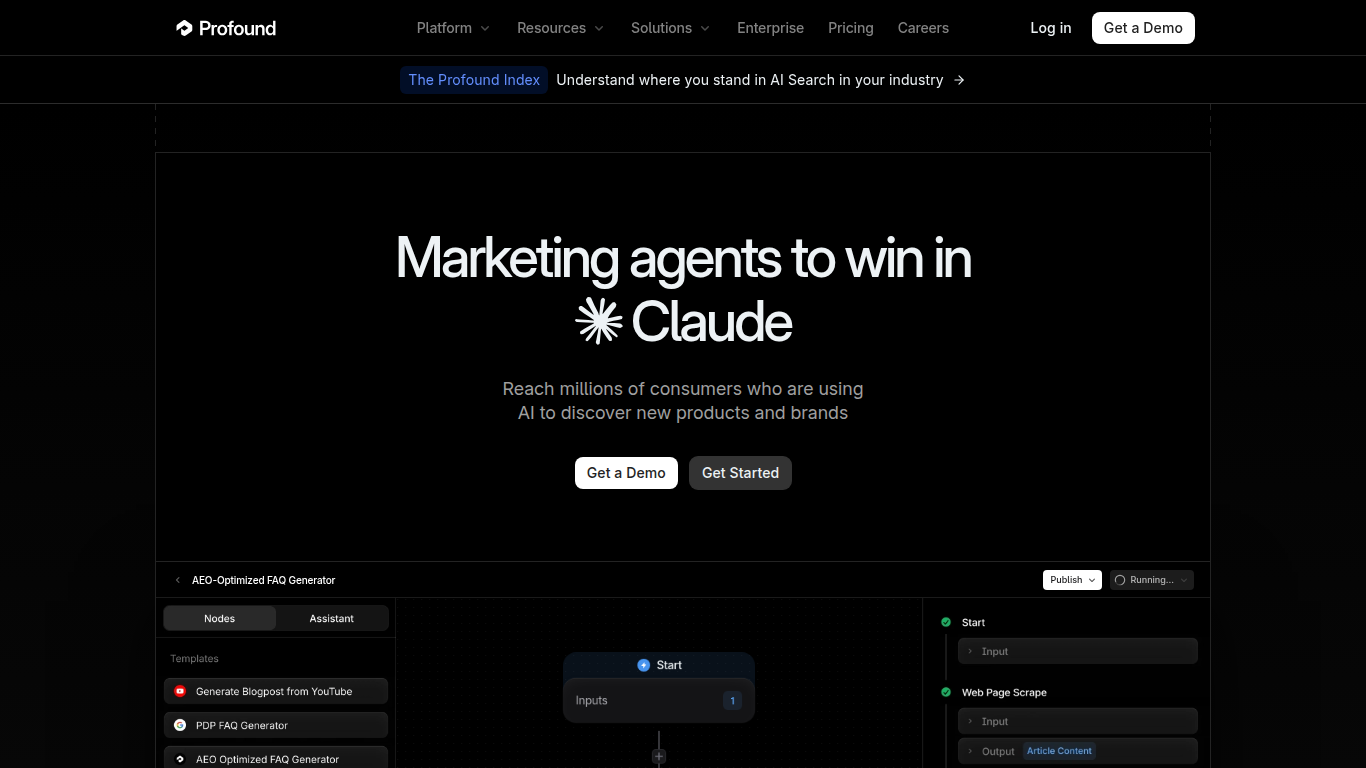
Tracking types: citation (deepest in category), prompt-level, brand mention, AI agent analytics.
Profound is enterprise-positioned and, since September 2026, sold only as a custom Enterprise contract tracking up to nine engines, Claude included. The former $99 Starter (ChatGPT only) and $399 Growth tiers are gone. The only way in without a sales call is a free trial that runs 10 prompts once on ChatGPT, with no history or exports. For a ChatGPT-focused buyer that means the deepest citation analytics in the category, bought through procurement rather than a credit card. See the Profound alternatives comparison for the wider context.
Key features
- Deepest ChatGPT citation analytics in this category (source URLs, citation frequency, competitor share)
- Up to 9 engines on Enterprise, including Claude
- Conversation and prompt analytics with competitor benchmarking
- Agent Analytics — full AI-crawler visibility (Anthropic, OpenAI, Perplexity bots)
- SOC 2 compliance and SSO/SAML on Enterprise
Pricing
- Trial — free. 10 prompts run once, ChatGPT only, no history or exports.
- Enterprise — custom. Up to 9 engines including Claude, daily tracking, SOC 2, SSO/SAML, unlimited seats.
Pros
- Deepest ChatGPT citation analytics in the category
- Up to nine engines on a single contract
- Strongest compliance posture for regulated industries
Cons
- No self-serve paid plan: buying starts with a sales call
- The free trial runs 10 ChatGPT prompts once, with no history
- No public pricing
3. AIclicks
Best for teams tracking ChatGPT alongside the widest set of other AI engines.
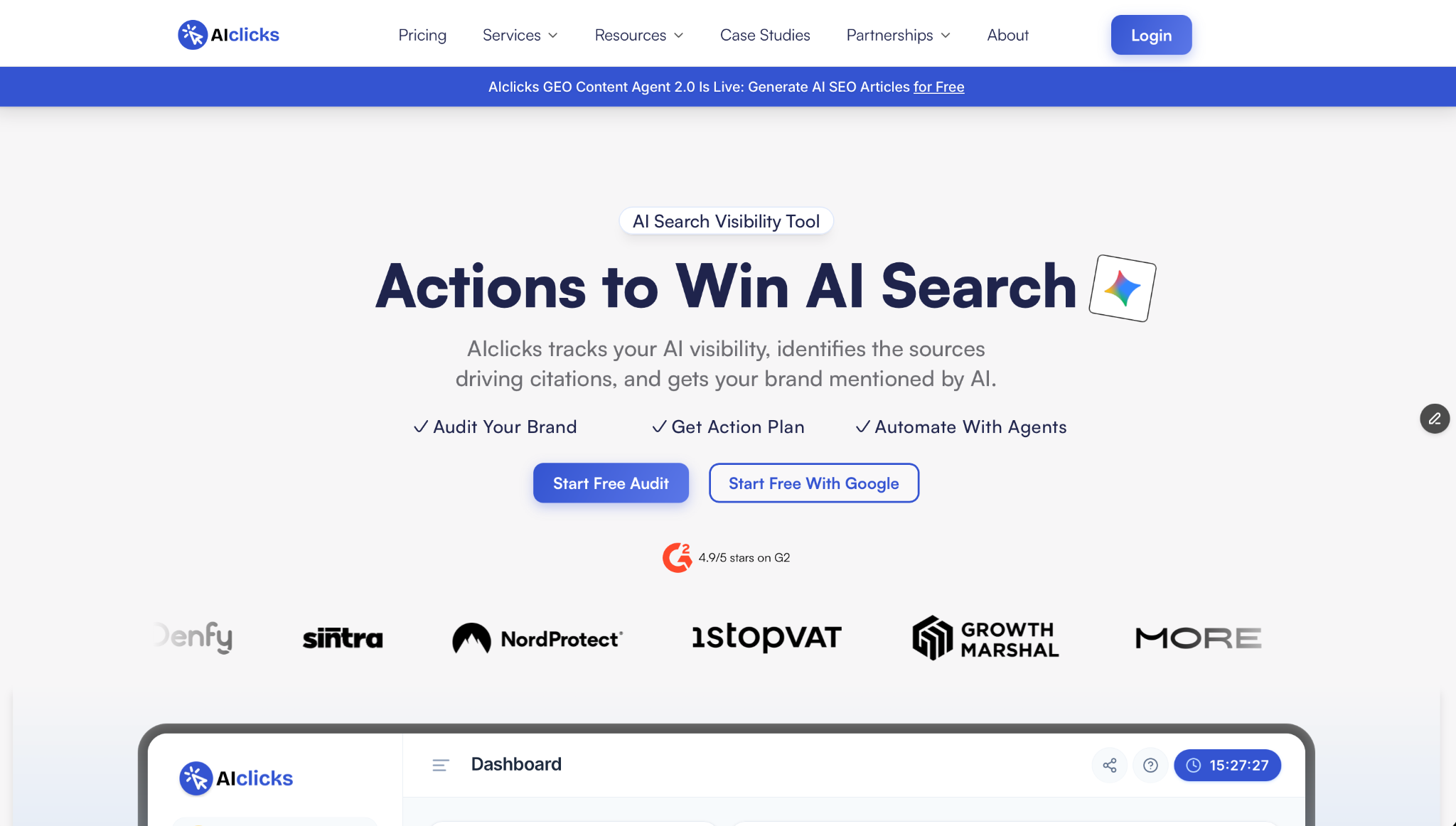
Tracking types: citation, brand mention, prompt-level, sentiment.
AIclicks covers 10+ engines; ChatGPT, Google AI Overviews, AI Mode, Gemini, Perplexity, Claude, Copilot, Grok, Meta AI, and DeepSeek, the broadest set in this list, with 3 selectable on the $59 Starter tier and 6 on Business.
Every tracked prompt runs daily on every enabled engine at all tiers, so refresh frequency is not something that unlocks higher up.
For ChatGPT specifically, AIclicks is the only tool here that also tracks ChatGPT ads: which advertisers are bidding against your tracked prompts, their creatives, and how that activity shifts over time, alongside the organic citation and mention data.
Key features
- 10+ engines available, 3 on Starter and 6 on Business
- Daily prompt runs on every tier, including the $59 entry plan
- ChatGPT ads intelligence: advertiser leaderboard, ad creatives, and timeline for your tracked prompts
- Citation tracking with cited URLs classified into 14 page types
- Fan-out query analysis, the sub-queries models run while composing an answer
- Content generation with publishing to WordPress, Webflow, Shopify, and Framer
- Read-only API and hosted MCP server from Pro, listed in Claude’s connector directory
Pricing
- Starter - $59/mo. 30 prompts, 3 engines, 1 website.
- Pro - $189/mo. 150 prompts, 4 engines, unlimited websites, API and MCP access.
- Business - $499/mo. 300 prompts, 6 engines.
- Up to 29% off annual billing. 3-day free trial, no credit card.
Pros
- Broadest engine roster in this list, with Claude included at self-serve tiers
- Daily refresh at every price point, including the $59 plan
- Only tool here tracking paid ChatGPT activity alongside organic citations
Cons
- 3-day trial is the shortest in this list
4. Peec AI
Best for brand teams focused on how ChatGPT describes them, not just whether ChatGPT links them.
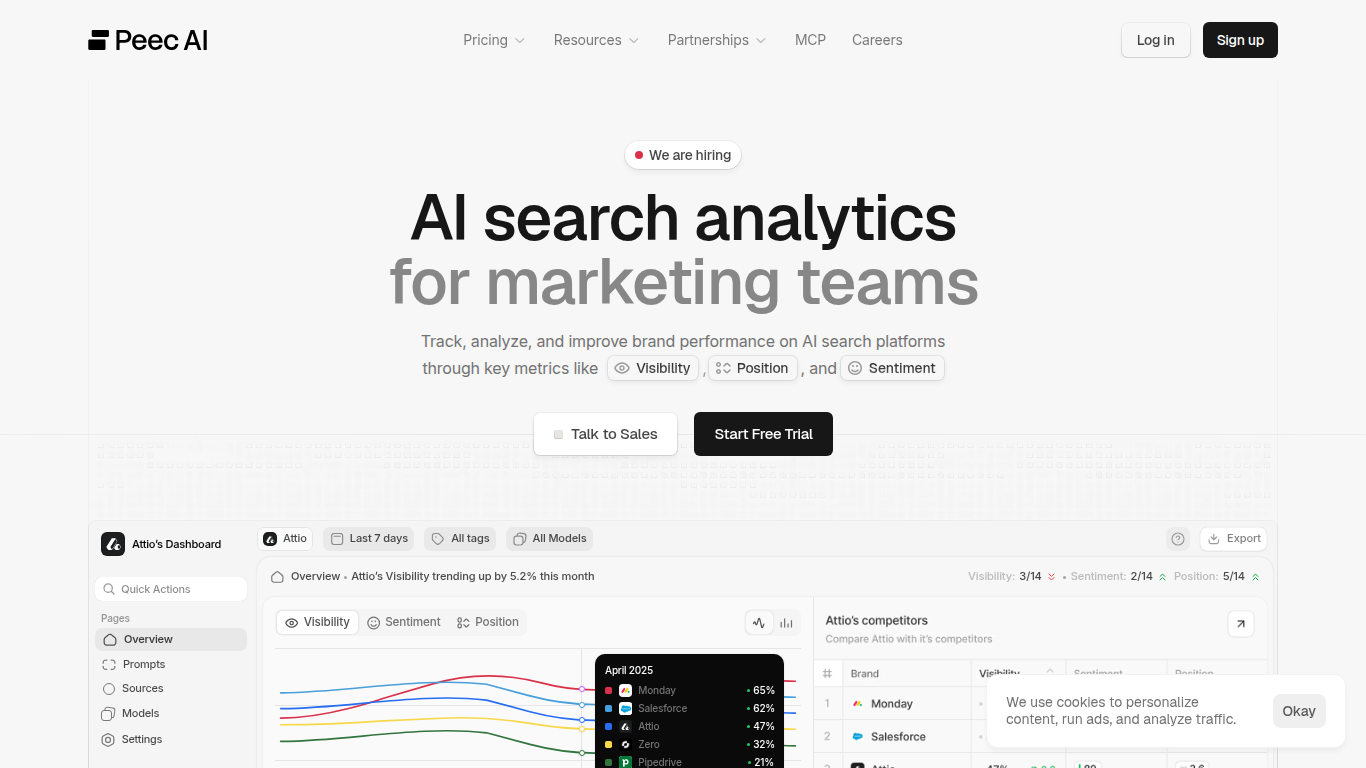
Tracking types: brand mention (strongest in category), citation, prompt-level, sentiment.
Peec’s NLP-based sentiment scoring is the strongest in this category — it tracks how an AI describes a brand (industry leader, budget alternative, cheap knockoff) rather than just whether it names you. Self-serve tiers cap engine selection at 3 of 7 (ChatGPT, AI Mode, AI Overviews, Copilot, Perplexity, Gemini, Grok), so ChatGPT is one of three choices alongside two others per project. Claude Sonnet 4 and GPT-5 Search are Enterprise-only via API. See the Peec AI alternatives breakdown for the broader comparison.
Key features
- Best-in-class brand-mention sentiment scoring
- 7 self-serve engines, choose 3 per project (ChatGPT is universally selectable)
- Daily prompt updates and competitor benchmarking
- Multi-language and country-level breakdown
- Looker Studio integration
- Unlimited user seats on every paid plan
Pricing
- Starter — $95/mo (€89/mo). 50 prompts, choose 3 of 7 engines.
- Pro — $245/mo. 150 prompts.
- Advanced — ~$495/mo. 350 prompts.
- Enterprise — custom. Claude Sonnet 4 and GPT-5 Search via API.
- 15% discount on annual billing.
Pros
- Best-in-class sentiment depth — answers “how does ChatGPT frame us?”
- Unlimited seats on every tier — agency-friendly
- Strong multilingual analytics
Cons
- 3-of-7 engine cap means engine selection trade-offs even at higher tiers
- Claude requires Enterprise — limits multi-engine value if Claude is also wanted
- Pricing tiers above Starter not always visible on the public page
5. Scrunch
Best for SEO and content teams that need ChatGPT visibility alongside crawler and indexability monitoring.
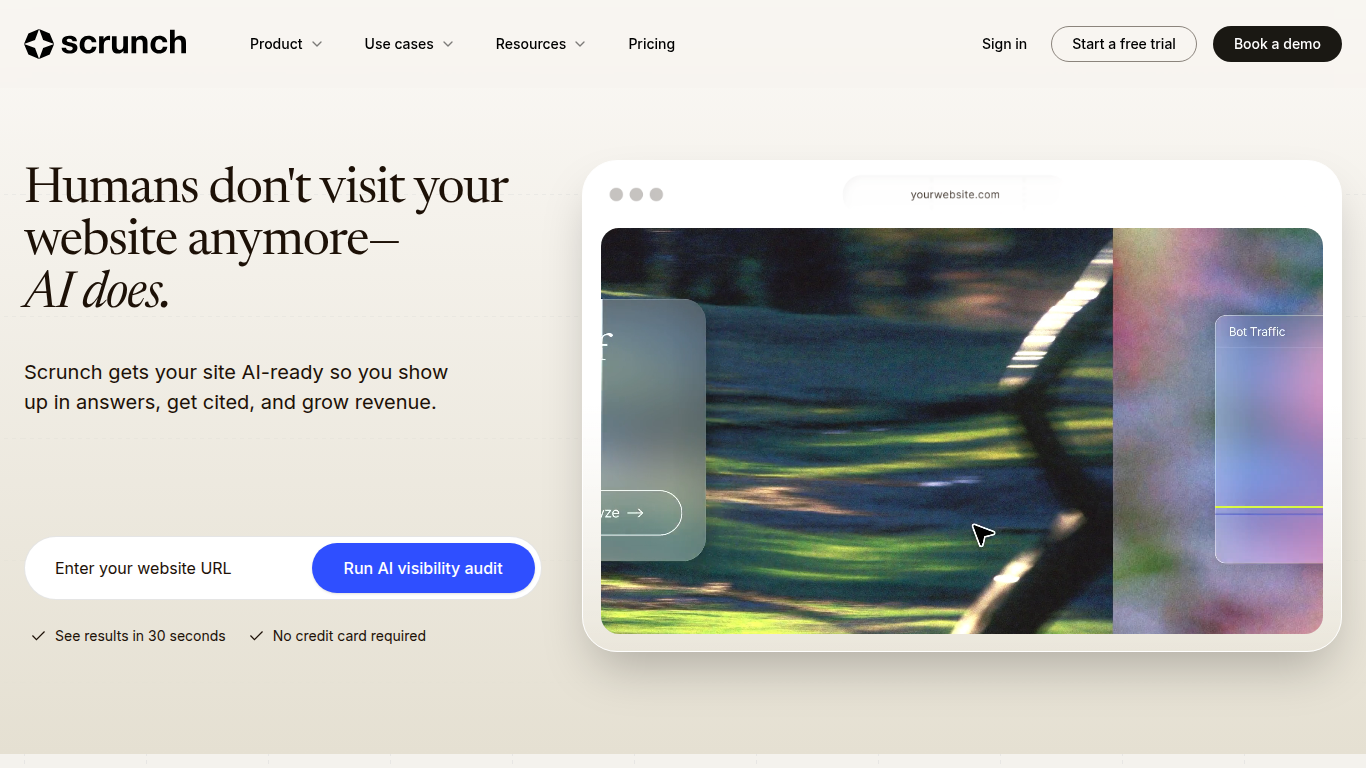
Tracking types: citation, prompt-level, AI-crawler analytics.
Scrunch (the domain redirected from scrunchai.com to scrunch.com in 2026) is this listicle’s strongest answer to the crawler-and-indexability question. It exposes named coverage of GPTBot, OAI-SearchBot, ChatGPT-User, ClaudeBot, and PerplexityBot alongside citation and mention tracking — letting teams correlate “blocked the wrong crawler” with “lost ChatGPT visibility.” The Core tier covers ChatGPT plus three other engines; Claude, Gemini, Meta AI, AI Mode, and Grok unlock on Enterprise. See the Scrunch AI alternatives comparison for the wider context.
Key features
- Named GPTBot, OAI-SearchBot, ChatGPT-User crawler analytics on Core
- 4 engines on Core: ChatGPT, Perplexity, Google AI Overviews, Microsoft Copilot
- Citation tracking with source-URL attribution
- Page-level audits and persona-based prompt sets
- Optimization recommendations tied to crawler-access gaps
Pricing
- Core — $300/mo ($250/mo billed annually). 4 engines, 350 custom prompts, 3 seats.
- Growth — $500/mo ($417/mo annually). 5 seats, 700 custom prompts.
- Enterprise — custom. Adds Claude, Gemini, Meta AI, AI Mode, Grok.
Pros
- Only tool in this list that ties named-crawler logs to ChatGPT citation data
- Strongest technical SEO orientation
- Clean published pricing on Core and Growth
Cons
- $300 entry is high if only ChatGPT visibility is needed
- 4-engine Core ceiling — Claude, Gemini, and AI Mode unlock only on Enterprise
- Crawler-log analysis is most useful for sites with a dedicated technical SEO function
6. Otterly AI
Best for solo SEOs and small teams testing ChatGPT visibility at the cheapest paid entry.
Tracking types: brand mention, citation, prompt-level.
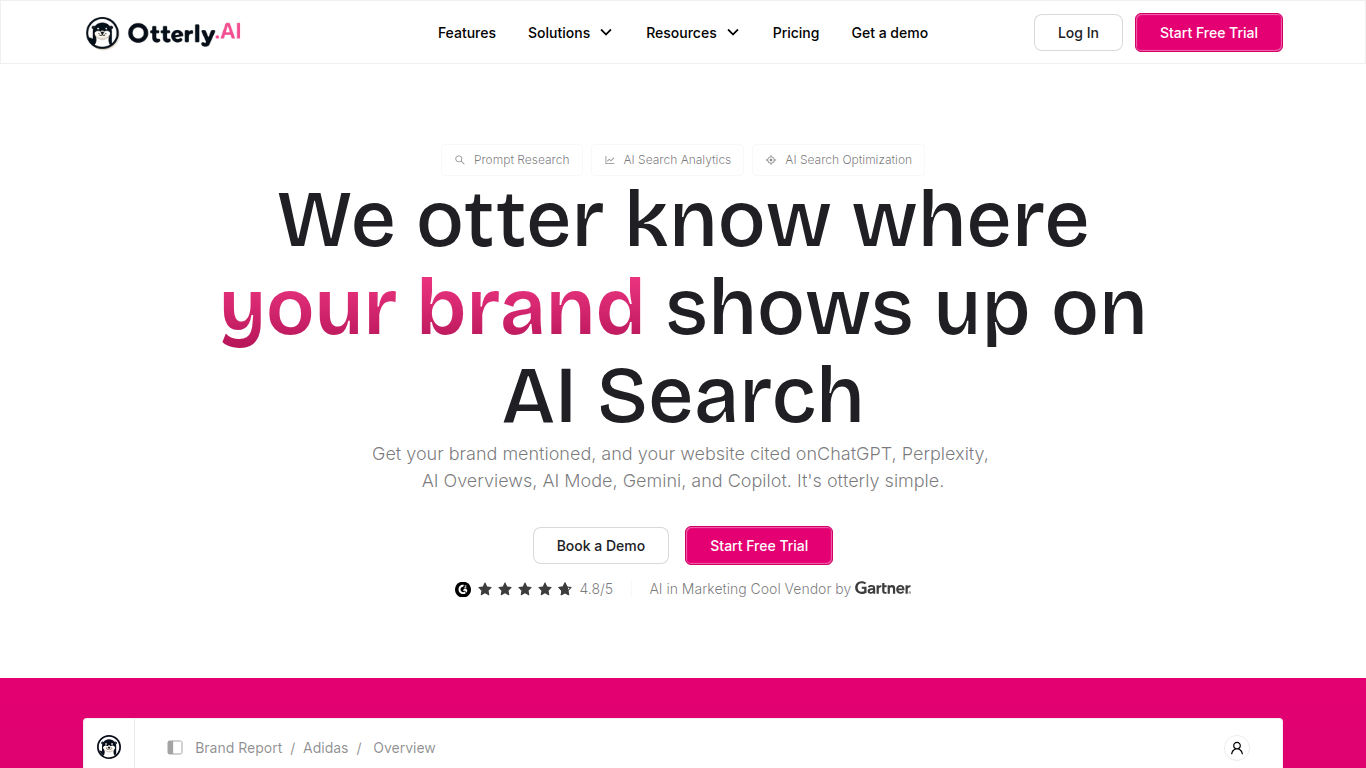
Otterly is the cheapest paid entry on this list — $29/mo Lite for 15 prompts across four engines (ChatGPT, Google AI Overviews, Perplexity, Microsoft Copilot). Solid fit for solo SEOs and freelancers running tight-budget ChatGPT-visibility experiments before justifying a bigger spend. Gartner Cool Vendor 2025 in AI Marketing. See the Otterly alternatives breakdown.
Key features
- $29 entry tier with daily tracking across 4 engines
- 1,000 GEO URL audits per month included on Lite
- Public API on Standard and Premium
- Google Looker Studio connector on Standard and Premium
- Real-time visibility alerts and sentiment analysis
Pricing
- Lite — $29/mo ($25/mo billed annually). 15 prompts.
- Standard — $189/mo ($160/mo annually). 100 prompts, public API.
- Premium — $489/mo ($422/mo annually). 400 prompts.
- AI Mode and Gemini available as paid add-ons ($9–$149/mo).
Pros
- Cheapest paid ChatGPT tracker with multi-engine coverage
- Gartner Cool Vendor 2025 credibility for SMBs
- Strong real-time alerting
Cons
- Claude is not supported on any tier — competitor listicles routinely misreport this
- Gemini and AI Mode are paid add-ons, not included
- 15 prompts on Lite is enough for a single-brand audit, not a full team rollout
7. SE Ranking
Best for SEO teams that already use SE Ranking and want ChatGPT visibility bolted onto existing keyword workflows.
Tracking types: citation, prompt-level, brand mention.
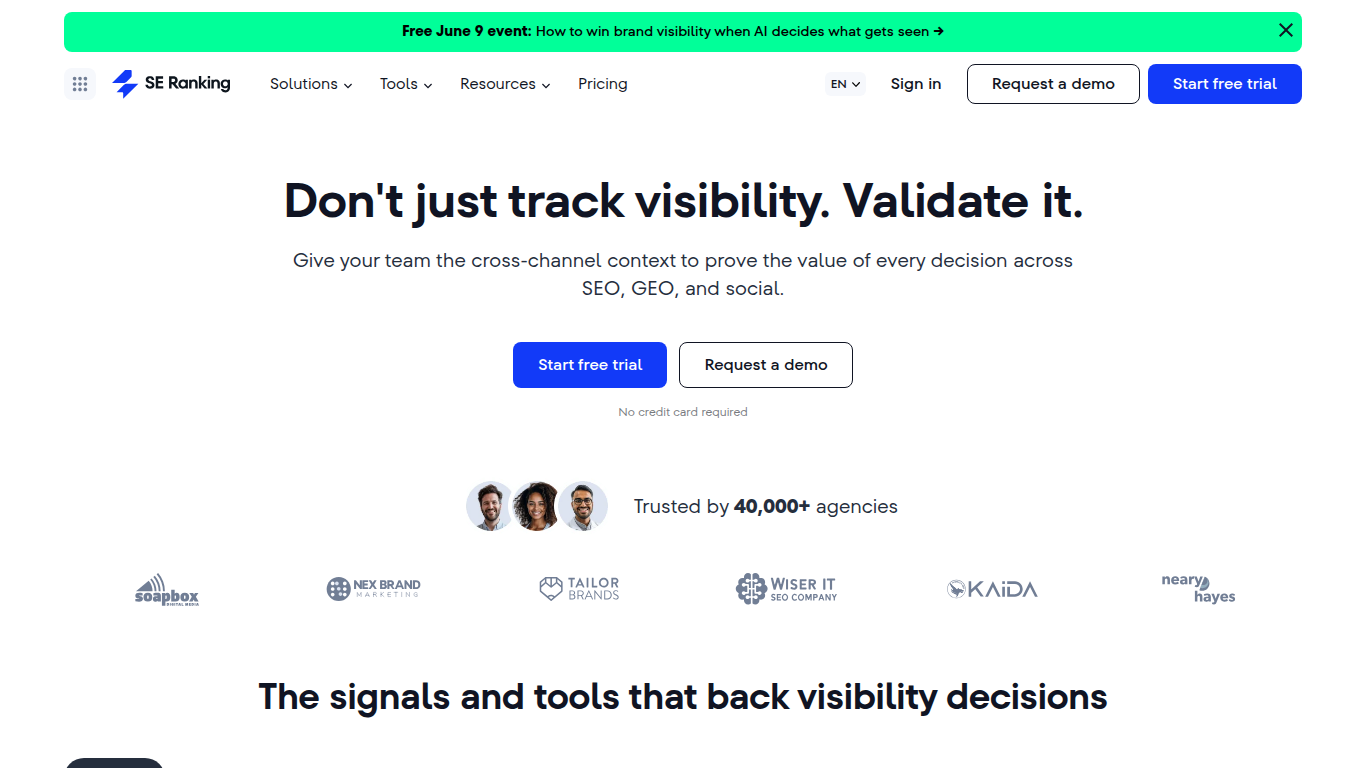
SE Ranking is a traditional SEO suite with an AI Search add-on layered on top. The differentiator is consolidation — ChatGPT visibility lives in the same dashboard as Google rank tracking and keyword research. The combined entry is $218/mo (Core $129 + AI Search $89), and the AI Search add-on covers ChatGPT, AI Overviews, AI Mode, and Perplexity. The combined Core+AI Search bundle is the realistic floor, not the $89 add-on price alone.
Key features
- AI Search add-on covers 4 engines (ChatGPT, AI Overviews, AI Mode, Perplexity)
- Unified dashboard with Google rank tracking, keyword research, and AI visibility
- SE Visible — separate strategic dashboard for brand mentions, citations, sentiment trends
- 14-day free trial on Core, no credit card
- Daily refresh on AI Search data
Pricing
- Core (SEO) — $129/mo ($103.20/mo annually).
- AI Search add-on — $89/mo ($71.20/mo annually). 200 prompts.
- Combined entry — $218/mo ($174.40/mo annually).
- Growth (SEO) — $279/mo ($223.20/mo annually).
- Agency Pack — +$69/mo annually with white-label reporting.
Pros
- Strongest integration of ChatGPT visibility with traditional Google rank tracking
- Unified billing for teams already using SE Ranking
- 14-day free trial — more generous than most dedicated AEO tools
Cons
- True entry is $218/mo combined — Core alone does not include AI Search
- Four-engine ceiling — no Claude, Copilot, Grok, or Gemini
- Standalone AI Search add-on doesn’t replace the Core plan — it layers on top
8. Semrush AI Toolkit
Best for Semrush users adding ChatGPT visibility to existing keyword and content data.
Tracking types: prompt-level, citation, competitor analytics.
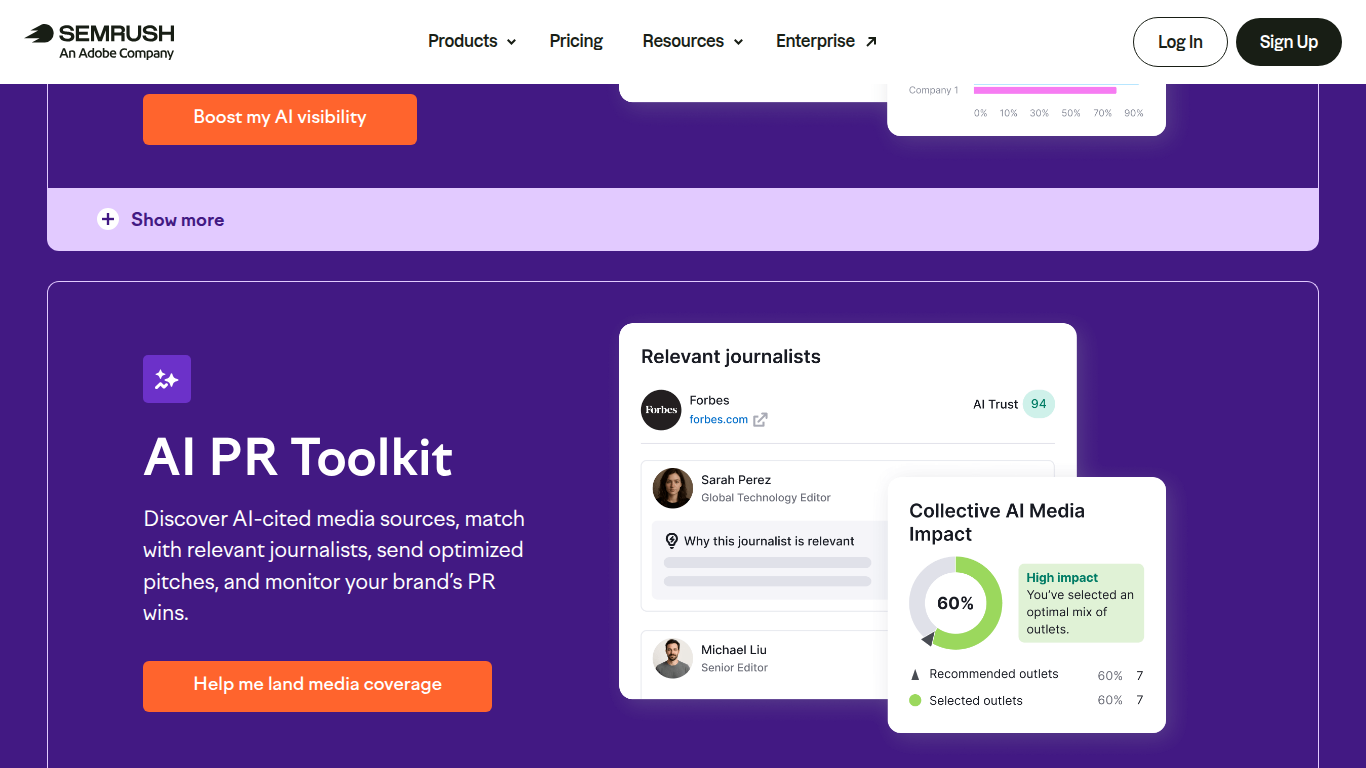
The Semrush AI Toolkit is a $99/mo add-on layered onto a Semrush plan (Semrush One bundles start at $199/mo). It tracks ChatGPT, Google AI, Gemini, and Perplexity; Claude is Enterprise-only with no public pricing. The strongest feature is the prompt-research database, which leans on Semrush’s existing keyword-and-competitor data to surface high-value prompts to track. The catch worth flagging: the $99 add-on is per domain per user. Three teammates needing access on one domain runs $297/mo just for the add-on, before the base Semrush plan.
Key features
- 4 AI engines tracked (ChatGPT, Google AI, Gemini, Perplexity)
- Brand mentions and competitive AI visibility benchmarking
- Largest prompt-research database in this listicle — leverages Semrush’s keyword data
- Integration with existing keyword, traffic, and SEO data
- AI competitor analysis and AI readiness site audit
Pricing
- AI Toolkit add-on — $99/mo per domain per user.
- Semrush One — Starter — $199/mo.
- Semrush One — Pro+ — $299/mo.
- Semrush One — Advanced — $549/mo.
- Claude — Enterprise-only, custom quote.
Pros
- Bolts onto a tool many SEO teams already pay for
- Strong prompt-research depth from the Semrush data layer
- Familiar interface for existing customers
Cons
- Per-seat multiplication makes team rollouts expensive fast
- Claude is Enterprise-only with no public pricing
- No free trial on the AI Toolkit
9. Nightwatch
Best for agencies that track ChatGPT alongside traditional Google rankings with unlimited team seats.
Tracking types: prompt-level, citation.
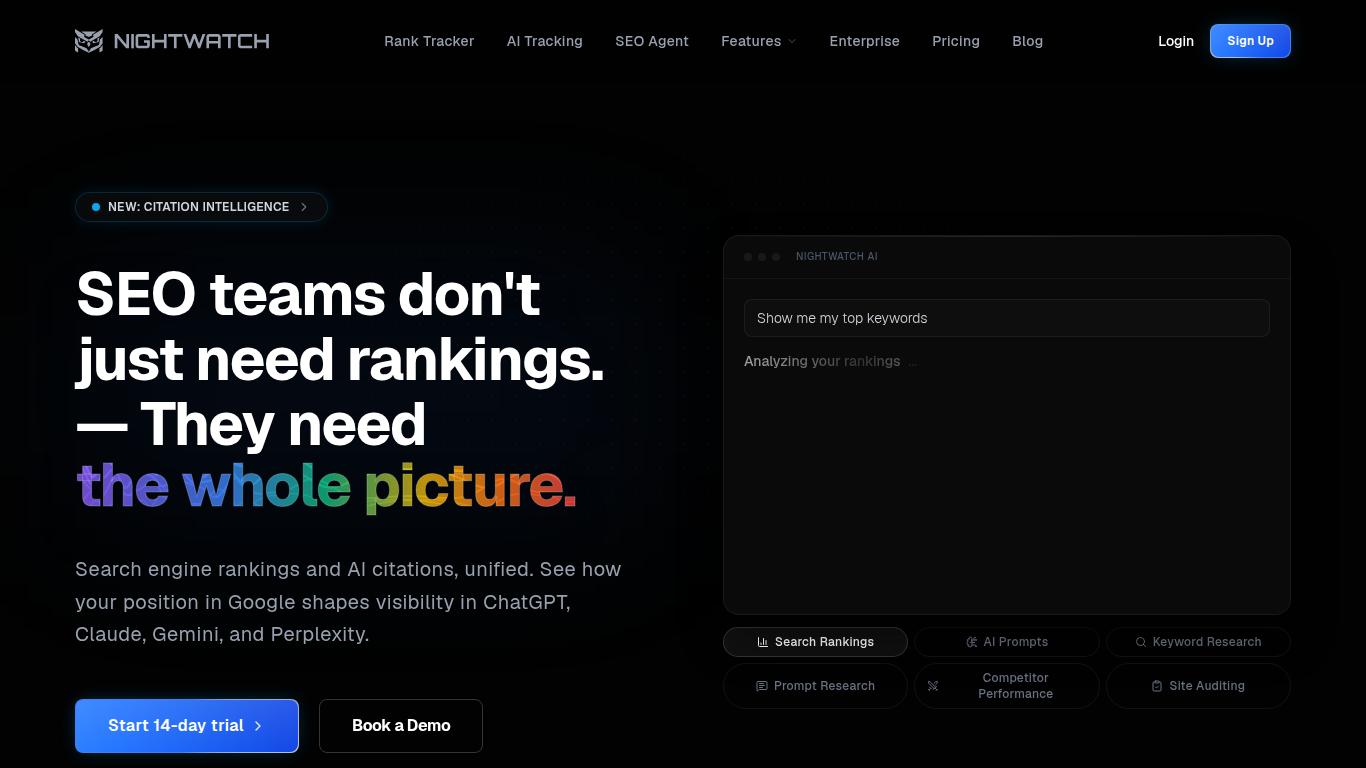
Nightwatch is a traditional SEO rank tracker that added AI Tracking across ChatGPT, Claude, Gemini, and Perplexity on every tier — including the entry plan. The standout structural feature is unlimited team seats on every plan, which is rare in this category (Semrush charges $45+/seat). Strong agency fit for tracking ChatGPT visibility alongside conventional Google rankings without paying per user.
Key features
- AI Tracking on ChatGPT, Claude, Gemini, Perplexity included on every tier
- AI Overview tracking across Google, YouTube, and Bing
- Unlimited team seats on every plan
- Traditional Google rank tracking in the same dashboard
- 3-year SERP history, SOC2-compliant
Pricing
- Starter — €79/mo (~$85/mo). Entry tier; AI Tracking included.
- Professional — €159/mo. White-label reporting, Looker Studio.
- Agency — €399/mo. Agency-oriented features.
- Enterprise — custom.
Pros
- All four major engines on the entry tier
- Unlimited team seats — agencies save real money vs. Semrush
- Strong integration with traditional Google rank tracking
Cons
- Less ChatGPT-specific depth than Profound or Scrunch — no granular citation source breakdowns
- AI Tracking is closer to “did you appear” than “why did you appear”
- Pricing in euros — USD buyers face FX noise
How to choose the right ChatGPT tracker
The right tool depends on which of the four question types matters most, the team’s existing stack, and budget.
- Four engines including Claude on a sub-$50 entry plan: Geoptie at $49/mo, any four of seven engines per brand.
- Cheapest paid ChatGPT tracking with multi-engine coverage: Otterly Lite at $29/mo.
- How ChatGPT describes a brand, not just whether it links it: Peec AI for sentiment depth.
- GPTBot, OAI-SearchBot, and ChatGPT-User crawler analytics: Scrunch on Core.
- Deepest ChatGPT citation analytics at enterprise scale: Profound Enterprise.
- ChatGPT ads activity alongside organic citations: AIclicks at $59/mo - 10+ engines available, 3 selectable on Starter.
- ChatGPT visibility folded into a full SEO suite: SE Ranking combined Core + AI Search.
- ChatGPT visibility inside an existing Semrush workflow: Semrush AI Toolkit (watch per-seat multiplication).
- Agencies tracking ChatGPT across many client brands with unlimited seats: Nightwatch Agency, or Geoptie Professional for 10 brand workspaces at $99/mo.
- Free ChatGPT citation and mention tracking: the ChatGPT rank tracker — no credit card, no time limit.
Frequently asked questions
How do I track my brand’s ranking in ChatGPT?
ChatGPT does not have a 1–10 ranking the way Google does. Tracking means measuring appearance — does ChatGPT cite a URL, does it mention a brand in the answer text, and how does share of voice compare to competitors across a defined prompt set. The four-question framework above breaks this down. The free ChatGPT rank tracker is the fastest way to see current state.
Is there a free ChatGPT rank tracker?
Yes — the ChatGPT rank tracker is free with no credit card and no time limit. It covers citation tracking, brand mentions, and prompt-level appearance for ChatGPT. The free GEO rank tracker covers ChatGPT alongside Claude, Perplexity, and Gemini in one report. Most paid tools above offer 14-day free trials.
What is the difference between citation and brand-mention tracking for ChatGPT?
Citation tracking counts how often ChatGPT links to a URL — typically when ChatGPT Search or Browse fires and pulls live web sources. Brand-mention tracking counts how often ChatGPT names a brand in the answer text, with or without a link. Both matter; for ChatGPT, citation tracking is the heavier signal because ChatGPT Search shows visible footnotes and the web tool fires more often than Claude’s.
What is the best ChatGPT rank tracking tool under $100 per month?
Otterly AI at $29/mo Lite is the cheapest paid entry but excludes Claude. Geoptie Starter at $49/mo tracks any four of seven engines, Claude included. Both are well under $100/mo with daily tracking. Peec AI Starter at $95/mo covers ChatGPT plus a choice of two other engines from a 7-engine self-serve set.
How does ChatGPT decide which sources to cite?
When ChatGPT Search fires, it pulls candidate URLs from its Bing-backed web index, scores them by relevance and authority, and the model decides which to cite based on answer quality. Three foundations help: clear, answer-first content; recency; and being indexed in Bing — since Bing is the underlying source for ChatGPT Search.
How do I get cited by ChatGPT?
Three layers. First, do not block GPTBot, OAI-SearchBot, or ChatGPT-User in robots.txt — each one serves a different purpose, and at least OAI-SearchBot and ChatGPT-User need to be unblocked to be eligible for ChatGPT Search citations. Second, write structured, scannable content that answers questions directly. Third, get indexed in Bing — strong Bing rankings correlate with ChatGPT Search citation eligibility.
Can I track ChatGPT rankings in Google Search Console?
No — Google Search Console only reports performance in Google Search and has no view into ChatGPT answers. To see whether a brand is cited or mentioned inside ChatGPT answers, one of the dedicated trackers above is required. The free ChatGPT rank tracker is the no-commitment starting point.
What is the difference between ChatGPT and ChatGPT Search?
ChatGPT is the overall product. ChatGPT Search is the specific live-web mode that fires when a query needs fresh information — it queries Bing under the hood and returns sources with visible citations. Browse mode lets ChatGPT fetch a specific URL on demand. All three paths can produce different brand-visibility outcomes, which is why tool selection matters.
What to do next
The fastest way to see current standing is a free check on the ChatGPT rank tracker — no credit card, no time limit. Track citations and mentions across the prompts that matter, and decide which of the nine paid tools above (if any) is worth the budget once a baseline exists.
For broader context, see AEO vs GEO vs SEO, how to rank on ChatGPT, and the sister listicles for best Claude rank tracking tools and best Perplexity rank tracker tools.