
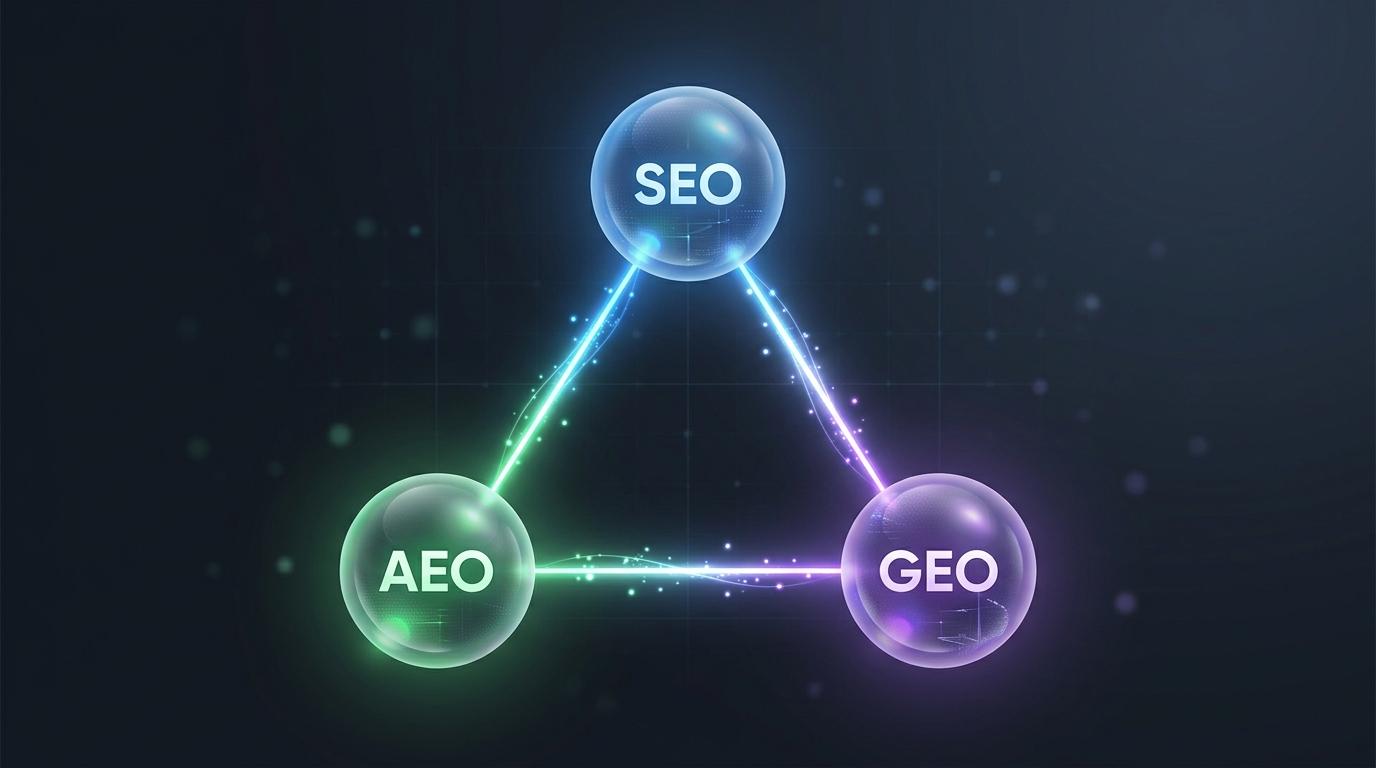
Answer Engine Optimization (AEO) is the practice of structuring content so that AI-powered platforms and search features can extract it as a direct answer to user queries. If you’ve seen the terms AEO, GEO, and SEO thrown around and wondered how they’re different — or whether they even are different — you’re not alone. The marketing world is drowning in acronyms right now, and the definitions keep shifting as AI search evolves.
Here’s the short version: SEO gets you ranked. AEO gets you quoted. GEO gets you recommended. They overlap significantly, but each optimizes for a different outcome. This guide breaks down what each one actually means, where they converge, where they diverge, and how to decide where your time and budget should go.
What Is AEO (Answer Engine Optimization)?
AEO stands for Answer Engine Optimization. It’s the practice of formatting and structuring content so that search engines and AI platforms can extract a clean, direct answer from your page and display it to users — often without requiring them to click through to your site.
The concept isn’t new. AEO traces back to around 2017-2018, when Google started aggressively expanding featured snippets, knowledge panels, and People Also Ask boxes. Voice assistants like Siri, Alexa, and Google Assistant accelerated the trend — when someone asks a voice assistant a question, it can only read one answer. AEO is how you become that answer.
What’s changed in 2026 is the scale. Google’s AI Overviews now appear in roughly 13-25% of all searches, depending on the query type. ChatGPT has over 800 million weekly active users. When these platforms answer a question, they need to pull that answer from somewhere. AEO ensures that somewhere is your content.
In practice, AEO comes down to a few core principles. Your content needs to directly answer specific questions — not dance around them with long introductions. The answer should appear within the first 40-60 words after the question heading, formatted in a way that’s easy for machines to extract. Schema markup (particularly FAQ and HowTo schema) helps search engines understand the structure of your answers. And the content backing up that answer needs to demonstrate genuine expertise and trustworthiness, because answer engines only quote sources they consider authoritative.
Here’s a concrete example. If someone searches “what is keyword cannibalization,” an AEO-optimized page would have an H2 that reads exactly that — “What Is Keyword Cannibalization?” — followed immediately by a clear, concise definition in one to two sentences. The rest of the section provides depth, examples, and context. But the extractable answer comes first.
AEO is about winning the answer box. But what happens when there is no answer box — when an AI generates a full conversational response that cites multiple sources and tells a story? That’s where GEO enters the picture.
What Is GEO (Generative Engine Optimization)?
GEO stands for Generative Engine Optimization. The term was formally introduced in a 2023 research paper by a team at Princeton, Georgia Tech, The Allen Institute, and IIT Delhi, and later presented at KDD 2024 — one of the most prestigious conferences in data science. GEO is specifically about getting your content cited, mentioned, and recommended inside AI-generated responses from platforms like ChatGPT, Perplexity, Claude, Google AI Overviews, and Gemini.
The difference from AEO is subtle but important. AEO aims to be the single extracted answer to a specific question. GEO aims to influence a narrative. When someone asks Perplexity “what are the best tools for AI search optimization,” the platform doesn’t return one answer — it generates a multi-paragraph response that synthesizes information from dozens of sources. GEO determines whether your brand appears in that response and how it’s described.
The Princeton research found that certain optimization strategies significantly improved visibility in generative search results. Adding statistics and data increased citation rates. Including source citations within content made AI engines more likely to trust and reference it. Including expert quotes improved content authority. Traditional SEO tactics like keyword stuffing, on the other hand, actually hurt performance in generative contexts — a finding that separates GEO from old-school optimization.
GEO also introduces a fundamentally different relationship with traffic. In traditional SEO, the goal is a click. In AEO, you might get a click or you might get a zero-click impression. In GEO, your brand might be mentioned in a ChatGPT response that the user never leaves — no click, no visit, but the user now knows your brand and trusts it because an AI recommended it. This means GEO success isn’t just about website traffic. It’s about brand visibility, share of voice in AI responses, and the quality of how AI describes your company.
Here’s a concrete example. Someone asks ChatGPT “what’s the best way to track my brand’s visibility in AI search?” If your brand is well-optimized for GEO, ChatGPT might respond with something like: “Several platforms offer AI rank tracking. [Your Brand] provides free tracking across ChatGPT, Perplexity, and Claude, while [Competitor] focuses on enterprise monitoring.” You’ve just been recommended to a potential customer in a context where they’re highly likely to act on the suggestion.
For a deeper dive into GEO strategies and tactics, read our complete guide to Generative Engine Optimization.
What Is SEO (Search Engine Optimization)?
SEO — Search Engine Optimization — is the foundation that both AEO and GEO are built on. It’s the practice of optimizing web pages to rank higher in traditional search engine results and earn organic traffic through clicks.
SEO has been around for over two decades and encompasses keyword research, on-page optimization (title tags, meta descriptions, content quality), technical optimization (site speed, mobile-friendliness, crawlability), and off-page signals (backlinks, domain authority, brand mentions). The fundamental unit of success is your position on a search engine results page and the click-through rate you earn from that position.
The reason SEO still matters deeply in 2026 — even with AI search growing rapidly — is that traditional organic rankings and AI visibility are closely correlated. Research shows that 99% of URLs cited in Google’s AI Overviews also appear in the top 20 organic search results. In other words, if you can’t rank in traditional search, you’re unlikely to get cited in AI responses either. SEO is the prerequisite, not the alternative.
AEO vs GEO vs SEO: How They Compare
Here’s where most articles on this topic fall short. They present AEO, GEO, and SEO as three separate strategies in neat boxes. The reality is messier and more useful — they overlap about 70-80% in practice, and the differences live in the remaining 20%.
| SEO | AEO | GEO | |
|---|---|---|---|
| Goal | Rank on search engine results pages | Be the direct extracted answer | Be cited and recommended in AI responses |
| Platforms | Google, Bing | Google featured snippets, voice assistants, AI Overviews | ChatGPT, Perplexity, Claude, Gemini, Google AI Overviews |
| Success metric | Rankings, clicks, organic traffic | Featured snippet ownership, zero-click visibility | Citation rate, brand mentions, share of voice in AI |
| Content style | Keyword-optimized, comprehensive pages | Q&A structured, concise direct answers | Authoritative, data-rich, entity-clear, multi-source validated |
| Technical focus | Core Web Vitals, crawlability, backlinks | FAQ/HowTo schema, direct answer formatting | Structured data, entity relationships, freshness signals |
| Off-site factor | Backlinks and domain authority | Authority signals from trusted domains | Multi-source consensus — mentions across review sites, Reddit, publications, YouTube |
| Time to results | 3-6 months | 1-3 months | 2-6 months |
| Measurement maturity | Mature (Search Console, Ahrefs, Semrush) | Moderate (snippet tracking, PAA monitoring) | Early (AI citation tracking, brand mention monitoring) |
The table gives you the quick comparison, but the real insight is in understanding the overlaps and divergences.
What they share: All three reward clear, authoritative, well-structured content. All three benefit from strong technical foundations — fast load times, proper indexing, schema markup. All three perform better when your brand has genuine expertise and third-party validation. If you write excellent content that answers real questions with real data, you’re serving all three goals simultaneously.
Where SEO diverges: SEO is unique in its emphasis on backlinks as a ranking signal and on click-through rate as a success metric. SEO also has the most mature measurement tools — Google Search Console, Ahrefs, Semrush — giving you precise data on rankings, traffic, and keyword performance. SEO is also the only one of the three where paid advertising (Google Ads) can supplement your organic efforts.
Where AEO diverges: AEO is laser-focused on single-question, single-answer precision. The content format matters more in AEO than in SEO or GEO — your answer needs to be in the right place on the page (directly under the H2), in the right length (40-60 words for featured snippets), and in the right format (paragraphs for definitions, ordered lists for how-tos, tables for comparisons). AEO also puts more weight on FAQ schema and HowTo schema than general SEO does.
Where GEO diverges: GEO introduces a dimension that SEO and AEO don’t — multi-source authority. AI engines don’t just look at your website when deciding whether to recommend you. They synthesize information from your site, third-party review platforms, Reddit discussions, YouTube videos, news articles, and industry publications. Your GEO strategy therefore extends beyond your own content into managing how your brand appears across the entire web. GEO also requires topical depth over breadth — AI engines prefer to cite sources that demonstrate comprehensive expertise on a subject rather than surface-level coverage of many subjects.
The overlap between AEO and GEO is significant and growing. Google’s AI Overviews, for instance, sit right at the intersection — they extract direct answers (AEO) but also synthesize information from multiple sources into a narrative (GEO). Optimizing for AI Overviews requires both approaches simultaneously. Similarly, when Perplexity answers a factual question, it may extract your answer directly (AEO) and cite you as a source within a longer response (GEO).
Which Should You Prioritize?
Rather than giving you an “it depends” non-answer, here’s a decision framework based on where your business actually is.
Prioritize SEO if your site is relatively new, your organic traffic is below 1,000 visits per month, or you have unresolved technical issues (slow load times, indexing problems, thin content). SEO is the foundation. Without it, neither AEO nor GEO efforts will gain traction because you won’t have the baseline authority that AI engines look for when selecting sources.
Prioritize AEO if your business serves an audience that searches with questions — how-tos, what-is queries, comparisons, troubleshooting. This is especially relevant for SaaS companies, educational content, healthcare information, financial services, and any space where users need specific answers. AEO wins you featured snippets, People Also Ask placements, and AI Overview citations for direct queries.
Prioritize GEO if you’re a brand that needs to be recommended rather than just found — SaaS products, professional services, B2B solutions, consumer brands. If your competitors are showing up when people ask ChatGPT or Perplexity for recommendations and you’re not, GEO is your gap. GEO is also the priority when you’re competing in “best of” and comparison contexts, where AI engines recommend a shortlist of options.
In practice, the smartest approach is to do all three simultaneously because the tactics overlap so heavily. Writing clear, authoritative, well-structured content with proper schema markup and strong third-party signals serves SEO, AEO, and GEO at the same time. The 20% of effort that’s unique to each discipline is what you adjust based on your priorities.
Not sure where you currently stand? Run a free GEO audit to see how AI search engines perceive your content today, or use our GEO readiness checklist to identify which areas need attention.
How to Optimize for All Three at Once
These six tactics serve SEO, AEO, and GEO simultaneously. Implement them and you’re building a foundation that works regardless of where search goes next.
Start every section with a direct answer. Use an H2 that mirrors a real question your audience asks, then answer it clearly in the first 40-60 words of that section. This wins AEO featured snippets, gives AI engines a clean chunk to extract for GEO, and improves your on-page relevance for SEO. The supporting detail, context, and nuance come after the answer — not before it.
Add FAQ schema to every key page. Identify five to eight real questions your audience asks about each topic and implement them as FAQ structured data. This makes your page eligible for People Also Ask placements (AEO), gives AI engines structured Q&A pairs to reference (GEO), and sends strong relevance signals to Google’s traditional ranking algorithm (SEO).
Include statistics, citations, and expert perspectives in your content. The Princeton GEO study identified these as the top-performing optimization signals in generative contexts. Adding data points and source citations makes your content more trustworthy for AEO answer extraction, more authoritative for GEO citation selection, and more aligned with Google’s E-E-A-T quality standards for SEO.
Build topic clusters, not isolated pages. Instead of writing standalone articles, create interconnected content hubs — a pillar page surrounded by supporting pages that cover subtopics in depth. This helps search engines understand your topical authority (SEO), gives AI engines multiple touchpoints to understand your expertise (GEO), and increases the surface area of questions your site can answer (AEO). For example, a pillar page on “AI search optimization” linked to pages covering specific platforms, tools, tactics, and case studies signals comprehensive authority across all three disciplines.
Get mentioned on third-party sites that AI engines trust. This is where SEO link building, AEO authority signals, and GEO citation optimization converge. AI engines heavily weight third-party mentions when deciding which brands to recommend. Industry publications, review platforms like G2 and Capterra, Reddit discussions, YouTube reviews, and expert roundups all serve as sources that AI models reference. Being mentioned across multiple trusted sources builds what GEO practitioners call “multi-source consensus” — the AI equivalent of social proof.
Audit your AI visibility regularly. Traditional SEO has mature tracking through tools like Google Search Console and Ahrefs. AEO can be tracked through snippet monitoring and People Also Ask tracking. GEO requires checking how ChatGPT, Perplexity, Claude, and Google AI Overviews actually describe your brand when users ask relevant questions. If you’re not tracking it, you can’t improve it.
Use a GEO rank tracker to monitor your position across AI platforms, or try our dedicated trackers for ChatGPT and Perplexity to see exactly where you stand.
How to Measure Success Across AEO, GEO, and SEO
Each discipline has its own metrics, but they increasingly feed into each other.
SEO metrics are the most established: organic traffic, keyword rankings, click-through rates, domain authority, and backlink growth. Google Search Console remains the primary source of truth, supplemented by tools like Ahrefs or Semrush for competitive analysis.
AEO metrics focus on visibility in search features: featured snippet ownership (how many snippets you hold and for which queries), People Also Ask appearances, and zero-click impression share. You can track these through rank tracking tools that specifically monitor SERP feature ownership.
GEO metrics are newer and require specialized tools: AI citation frequency (how often your brand is mentioned in AI-generated responses), share of voice across AI platforms (your mentions vs. competitors), sentiment analysis (how AI describes your brand — positively, neutrally, or negatively), and referral traffic from AI platforms (visits from chatgpt.com, perplexity.ai, and similar sources that show up in your analytics).
The emerging metric that matters most across all three is what some practitioners call “share of answer” — what percentage of AI-generated responses in your category include your brand. Unlike traditional search rankings where position 1-10 is well-defined, AI responses vary every time they’re generated. Monitoring your share of answer over time gives you the clearest picture of whether your combined SEO, AEO, and GEO efforts are working.
For a comprehensive overview of the tools available for tracking AI search performance, see our guide to the best GEO tools in 2026.
The Bottom Line
The brands winning in 2026 aren’t choosing between SEO, AEO, and GEO — they’re treating them as three layers of one strategy. SEO builds the foundation of authority and technical health. AEO ensures your content is the answer to specific questions. GEO ensures your brand is part of the conversation when AI engines recommend solutions.
The good news is that roughly 80% of the work is the same across all three: write genuinely useful content, structure it clearly, back it with data, build authority through third-party mentions, and keep it fresh. The remaining 20% — the schema markup focus of AEO, the multi-source brand building of GEO, the backlink strategy of SEO — is where you fine-tune based on your specific goals.
Start by understanding where you currently stand. Run a free GEO audit to see how AI search engines perceive your content, and use the GEO readiness checklist to identify which optimization layers need attention first.


![AI Search Optimization: How to Get Cited by ChatGPT, Perplexity & Google AI [2026]](/_next/image?url=%2Fblog%2Fai-search-optimization%2FWebpage_document_connecting_AI_i%E2%80%A6_202604291551.jpeg&w=3840&q=75)