AI search is changing how customers discover brands. Instead of clicking through Google results, users now ask ChatGPT, Perplexity, and Google AI for direct answers, and your brand is either getting cited or getting ignored.
We reviewed 20+ GEO tools to find which platforms actually help you show up in AI-generated responses. Here are the 11 that deliver real results.
What Are GEO Tools?
GEO tools help brands get discovered and cited by AI search engines like ChatGPT, Perplexity, Google AI Overviews, Claude, and Gemini. Unlike traditional SEO tools that focus on Google rankings, GEO tools optimize your content to appear in AI-generated answers.
This practice is called Generative Engine Optimization (GEO). As Gartner predicts traditional search volume will drop 25% by 2026 due to AI assistants, brands that ignore GEO risk becoming invisible in the new search landscape.
The best GEO tools combine two core functions: monitoring (tracking where and how your brand appears in AI answers) and optimization (improving your content to earn more citations).
One thing worth checking before you buy: engine coverage is usually tiered. Several platforms on this list advertise Claude, Grok, or Copilot at the platform level but unlock them only on custom-priced enterprise contracts. The sections below say which engines you actually get at the entry price.
Best GEO Tools 2026: Quick Comparison
| Rank | Tool | Best For | Starting Price | Free Trial |
|---|---|---|---|---|
| 1 | Geoptie | Teams wanting tracking and optimization in one place | $49/mo | No |
| 2 | Brandi AI | PR, content, and brand strategy teams | $349/mo | No |
| 3 | Profound | Enterprise brands with compliance requirements | $99/mo | Yes (Growth) |
| 4 | Rankshift | Teams wanting every model without tier gating | $92/mo | 30 days |
| 5 | Ahrefs Brand Radar | Researchers who want real search-derived prompts | $398/mo | No |
| 6 | Gauge | Teams buying high daily prompt volume | $599/mo | 7 days |
| 7 | Goodie AI | Retail and CPG brands tracking shopping assistants | $479/mo | 7 days |
| 8 | Peec AI | Multilingual and multi-country visibility analytics | $95/mo | 7 days |
| 9 | Rankscale | Teams wanting the widest engine list with flexible volume | $99/mo | Yes (Pro) |
| 10 | Otterly.AI | Lean teams wanting simple monitoring | $29/mo | 14 days |
| 11 | HubSpot AEO Grader | A free one-time diagnostic before buying | Free | N/A |
Top 11 GEO Tools Reviewed
1. Geoptie: Best All-in-One GEO Platform
Pricing:
- Starter: $49/mo ($41/mo billed annually) for 15 prompts, 2 brands
- Professional: $99/mo ($83/mo billed annually) for 100 prompts, 10 brands
- Enterprise: $399/mo ($333/mo billed annually) for 400 prompts, unlimited brands
- Unlimited audit reports and unlimited content generations on every tier
- Extra prompts: +100 for $99/mo on Enterprise
- Unlimited seats on every plan
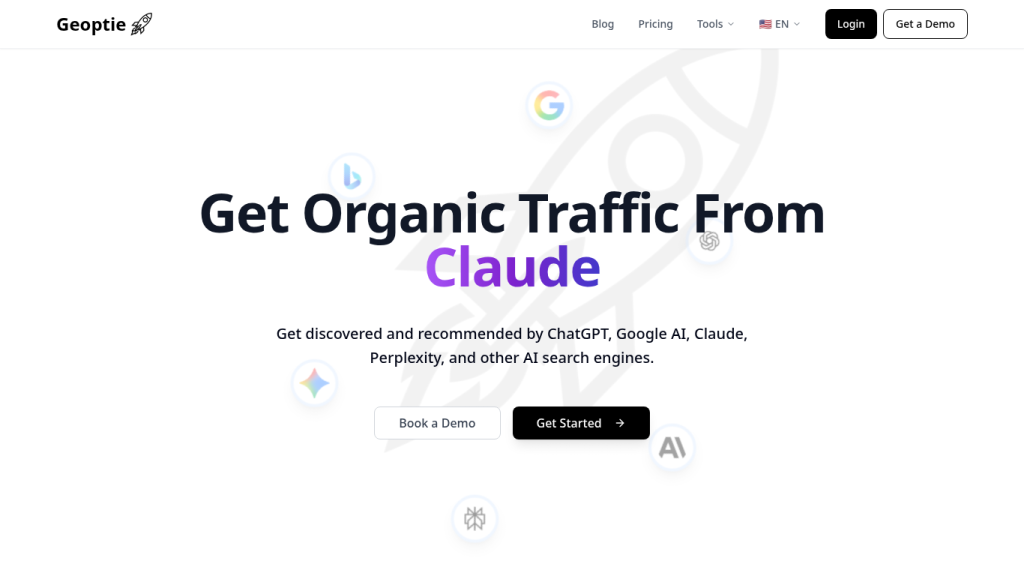
Geoptie is purpose-built for Generative Engine Optimization, combining AI visibility tracking with content optimization in a single platform. Most competitors at this price only monitor. Geoptie tracks and then gives you the work to do next.
The platform covers seven engines: ChatGPT, Claude, Perplexity, Gemini, Google AI Overviews, Google AI Mode, and Microsoft Copilot, with any four selectable per brand on every paid tier and no per-engine surcharge. Claude on the $49 plan is unusual in this category, where most platforms route it to an enterprise conversation or charge for it separately. Engine selection is per brand, so two clients on one account can track different mixes. On the monitoring side you get citation tracking alongside brand-mention tracking, competitor share of voice across the same prompt set, sentiment scoring on every tracked answer, and GEO audit reports. White-label report branding (your logo, name, and color) is available on Professional and Enterprise.
The optimization side is what earns the all-in-one label. Tracked visibility feeds a prioritized list of recommended actions, so the dashboard answers what to do next rather than just what happened. From there you can score an existing page against the prompts you are losing and see what to change, or generate new content aimed at the gaps. Both audits and content generation are unmetered on every plan, which is rare here: Profound sells its content engine as a monthly credit pool, Goodie caps optimization actions at 10 a month on its $479 entry tier, and Gauge includes 18 articles a month at $599.
Free Tools Available: GEO Audit, Content Checker, Keyword Finder, Rank Tracker (with dedicated trackers for ChatGPT, Perplexity, and Claude), GEO Checklist, Cannibalization Checker, and Backlink Finder, all available without a subscription.
Pros: Most affordable all-in-one option; Claude selectable on every tier including the $49 plan; unmetered audits, recommendations, and content generation; unlimited seats on every plan
Cons: Four engines per brand at a time out of the seven covered; no free trial; no scheduled report delivery
Bottom Line: Geoptie delivers the best value for teams that need both monitoring and optimization without enterprise pricing. Tracking Claude alone costs $439/mo as an add-on at comparable prompt volume elsewhere.
2. Brandi AI: Best for PR and Brand Strategy Teams
Pricing: Starting at $349/mo (contact for plan details)
Brandi AI approaches GEO from the brand and communications side rather than technical SEO. The platform combines four layers: GEO analytics and insights, market and competitive intelligence, content optimization guidance, and technical GEO checks. It tracks brand presence across ChatGPT, Gemini, Perplexity, Grok, and Claude.
What differentiates Brandi is the buyer context it surfaces alongside the visibility numbers, including the specific prompts and pain points shaping vendor shortlists, which maps to how PR and content teams plan narrative work. Brandi reports GEO share-of-voice gains within four to six weeks and won the 2025 Intellyx Digital Innovator Award.
Pros: Built around PR, content, and brand strategy workflows; five engines including Claude and Grok; pairs visibility data with prompt-level buyer insight
Cons: No published pricing beyond the starting price; sales-led onboarding; premium entry point for smaller teams
Bottom Line: Strong fit for enterprise and agency teams where PR or brand strategy owns the AI narrative. Teams that only need monitoring will find cheaper options further down this list.
3. Profound: Best for Enterprise Brands
Pricing:
- Starter: $99/mo for 50 prompts, ChatGPT only, 1 seat
- Growth: $399/mo for 100 prompts, 3 answer engines, 3 seats
- Enterprise: custom, up to 9 answer engines, multiple company workspaces
- Annual billing on Starter and Growth is two months free
Profound is the most established enterprise platform in AI visibility, backed by Sequoia. Its Enterprise tier tracks up to nine answer engines and is the only place Claude appears. The self-serve tiers are much narrower: Starter covers ChatGPT alone, and Growth covers three engines.
What sets Profound apart is depth of data rather than breadth of plan. You get AI crawler analytics through its Agent Analytics module with Cloudflare integration, a Conversation Explorer built on a large real-prompt dataset, and a credit-metered content and optimization engine (400 credits per month on Growth). SOC 2, SSO/SAML, multiple company workspaces, and a dedicated specialist with a 24-hour SLA all sit on Enterprise.
Prompt volume is where the price lands. Growth is $399 for 100 prompts across three engines, and there is no published step above that, so scaling volume means moving to a custom Enterprise contract. For comparison, $399 is Geoptie’s Enterprise price for 400 prompts across any four of seven engines. The gap buys you Profound’s crawler and conversation datasets, which nothing else on this list matches, so the question is whether you need that data or more prompts.
Pros: Deepest crawler and conversation data in the category; up to nine engines at Enterprise; strongest compliance posture; self-serve trial available on Growth
Cons: Claude and compliance features are Enterprise-only; the $99 Starter is single-engine; 100 prompts is the ceiling before custom pricing; users on G2 report a steep learning curve and occasional dashboard slowdowns
Bottom Line: The right choice for enterprises that need crawler-level data and have the budget for it. Teams optimizing for prompt volume or Claude coverage will pay considerably less elsewhere.
4. Rankshift AI: Best for Multi-Engine Tracking with Built-in Optimization
Pricing:
- Starter: $92/mo ($82/mo billed annually) for 150 prompts per day and 9,500 credits
- Professional: $210/mo ($189/mo billed annually) for 350 prompts per day and 22,000 credits, adding crawler analytics, the Looker Studio connector, and MCP and API access
- Business: $473/mo ($425/mo billed annually) for 850 prompts per day and 53,000 credits
- Enterprise: custom, adding custom prompt tracking, SSO, a dedicated account manager, and an SLA
- 30-day free trial, no credit card required
Rankshift is a Belgian platform built specifically for AI visibility and GEO rather than adapted from an SEO suite. It uses prompt-based tracking to analyze how brands surface inside AI answers, and it tracks every major model on every paid tier: ChatGPT, Gemini, Google AI Overviews, AI Mode, Copilot, Perplexity, Claude, Meta AI, and Mistral.
Every paid tier tracks all LLMs, so Claude is available at the $92 Starter price rather than reserved for enterprise, and the credit pool (9,500 on Starter, rising to 22,000 and 53,000 above it) governs how often you refresh across models.
Pros: Tracks every major LLM including Claude, Meta AI, and Mistral on every paid tier rather than gating models behind enterprise; unlimited projects and seats on all plans; combines monitoring with optimization through content briefs, an AI writer, and a prioritized Action Center
Cons: Credit-based pricing means model selection and prompt frequency need planning to control usage; crawler analytics, Looker Studio, and MCP/API access require the $210 Professional tier rather than Starter; purpose-built for AI visibility and GEO rather than a full traditional SEO suite; a newer entrant founded in 2025 with a shorter public track record than incumbents
Bottom Line: A strong pick for teams that want every major model, Claude included, tracked from the entry tier while keeping content optimization in the same platform. Budget around the credit model, and note that crawler data and integrations start one tier up at Professional.
5. Ahrefs Brand Radar: Best for Prompt Research
Pricing:
- Select platforms: $398/mo
- All platforms: $699/mo, including 2,500 custom-prompt checks per month
- Custom-prompt tracking is now bundled into every paid Ahrefs plan, from 150 checks per month on Lite at $129
- No free trial, though a single-lookup AI Visibility Checker is free
Brand Radar’s real differentiator is its dataset. Ahrefs tracks 470M+ monthly prompts derived from real search queries rather than synthetic prompt sets, the largest such index in this category and the only one built from actual search behavior. The $398 tier covers AI Overviews, AI Mode, ChatGPT, Perplexity, Copilot, and Gemini; the $699 tier adds Grok, plus YouTube, TikTok, and Reddit tracking while those remain in beta.
You get brand mentions, citations, share-of-voice benchmarking, sentiment across brand variations, and 90-day historical reporting, all sitting alongside Ahrefs’ keyword and backlink data. Claude is the notable gap: Brand Radar does not track it on any plan.
Pros: Largest search-derived prompt dataset; multi-channel tracking beyond AI answers; unlimited projects; strong for competitive research
Cons: No Claude coverage; $398 buys the prompt index rather than prompt tracking, which now comes with any paid Ahrefs plan; monitoring rather than optimization guidance
Bottom Line: Best for research-heavy teams already paying for Ahrefs. The prompt dataset justifies the price if competitive intelligence is the job, and it is expensive if you only need brand tracking.
6. Gauge: Best for High Prompt Volume
Pricing:
- Growth: $599/mo for 600 prompts run daily, 6 platforms, 18 articles per month, 10 seats
- Enterprise: custom, adds Claude and Grok, unlimited articles and seats, API and BI integration
- 1-week free trial on Growth
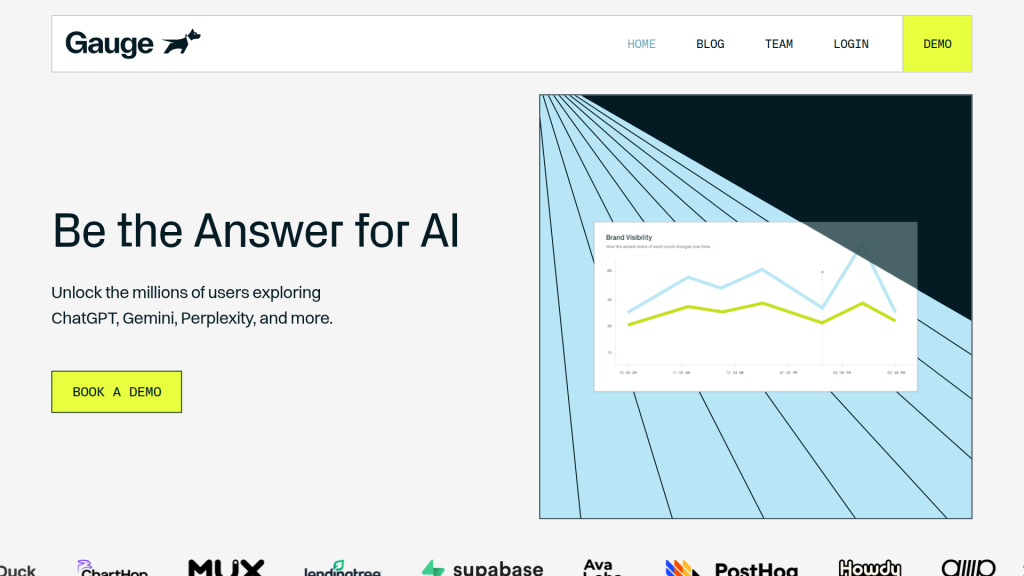
Gauge, a Y Combinator S24 company, sells on throughput. Growth runs 600 prompts every day across ChatGPT, Google AI Overviews, Google AI Mode, Gemini, Perplexity, and Copilot, which works out to roughly 108,000 tracked answers a month. Its own pricing argument is cost per answer rather than cost per prompt, which is how it justifies sitting above cheaper trackers.
The platform bundles a content engine that turns visibility gaps into publish-ready articles, plus GA4, Search Console, and DataForSEO integrations and an agent chat that queries across all of it. Claude and Grok require Enterprise, since both need API access rather than front-end scraping.
Pros: Highest daily prompt throughput at a published price; content engine and agent chat included rather than sold as add-ons; unlimited domains and competitors; genuine self-serve trial
Cons: $599 entry with no lower tier; Claude and Grok are Enterprise-only; single location on Growth
Bottom Line: Good economics for teams that genuinely need hundreds of prompts tracked daily. Overkill for a brand monitoring a few dozen.
7. Goodie AI: Best for Shopping Assistant Coverage
Pricing:
- Explorer: $479/mo for 100 prompts, 3 engines, 3,000 AI responses, 10 optimization actions, 3 seats
- Pro: demo-only, 250 prompts, 6 engines, 7,500 responses, 30 optimization actions, 5 seats
- Enterprise: demo-only, 500+ prompts, up to 11 engines, unlimited seats
- 20% annual discount; 7-day free trial on Explorer
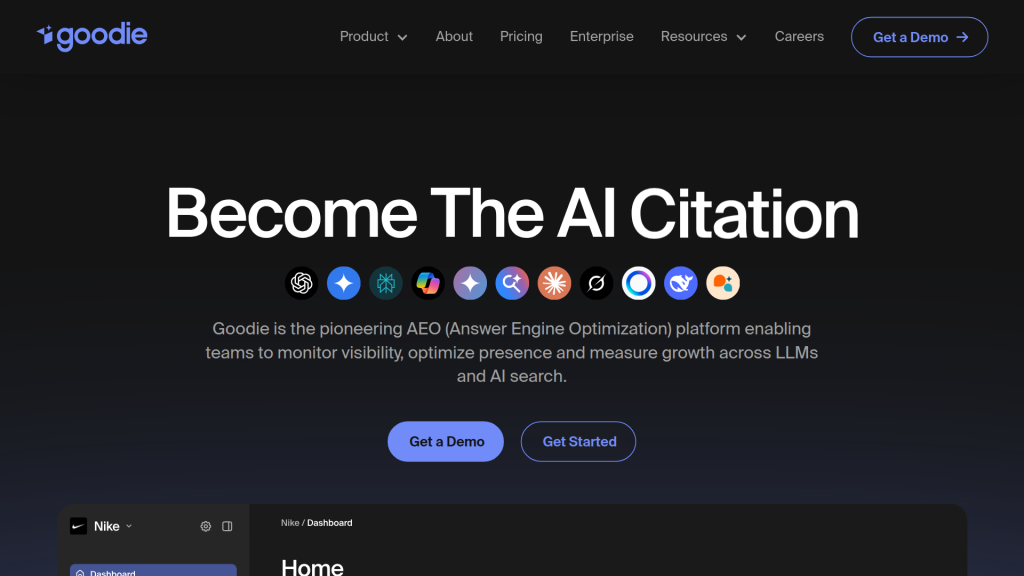
Goodie is an enterprise AEO and GEO platform built for AI search from the start rather than retrofitted from an SEO suite. Its genuine differentiator is Agentic Commerce coverage: it tracks Amazon Rufus and Walmart Sparky, which no other platform on this list does, making it the obvious candidate for retail and CPG brands whose buyers start inside a shopping assistant. Revenue attribution through Google Analytics and MCP server access come standard on every tier.
Engine coverage climbs steeply, and so does the price. The $479 Explorer plan buys three engines: ChatGPT, AI Overviews, and Perplexity. Pro adds Gemini, Copilot, and Amazon Rufus for six. The eleven-engine list advertised on the homepage is true only at Enterprise, which is where Claude, Meta AI, Grok, DeepSeek, and Google AI Mode unlock. Data retention also scales by tier, from three months to twelve.
Pros: Only platform here covering Amazon Rufus and Walmart Sparky; published entry price with a real trial; revenue attribution and MCP access on every tier
Cons: $479 for three engines is the steepest entry-to-coverage ratio on this list; Pro and Enterprise are still demo-only; Claude requires Enterprise; agentic commerce needs Pro
Bottom Line: The clear pick if you sell physical products and shopping-assistant visibility matters, since nothing else here tracks Rufus or Sparky. Just note that the feature you are buying it for sits on Pro, which has no published price.
8. Peec AI: Best for Multilingual Visibility Analytics
Pricing:
- Starter: $95/mo for 50 prompts, 1 project
- Pro: $245/mo for 150 prompts, 2 projects
- Advanced: $495/mo for 350 prompts, 5 projects
- Enterprise: custom, all models, unlimited projects
- Separate agency plans from $245/mo on a shared credit pool
- 15% annual discount; 7-day free trial, no credit card
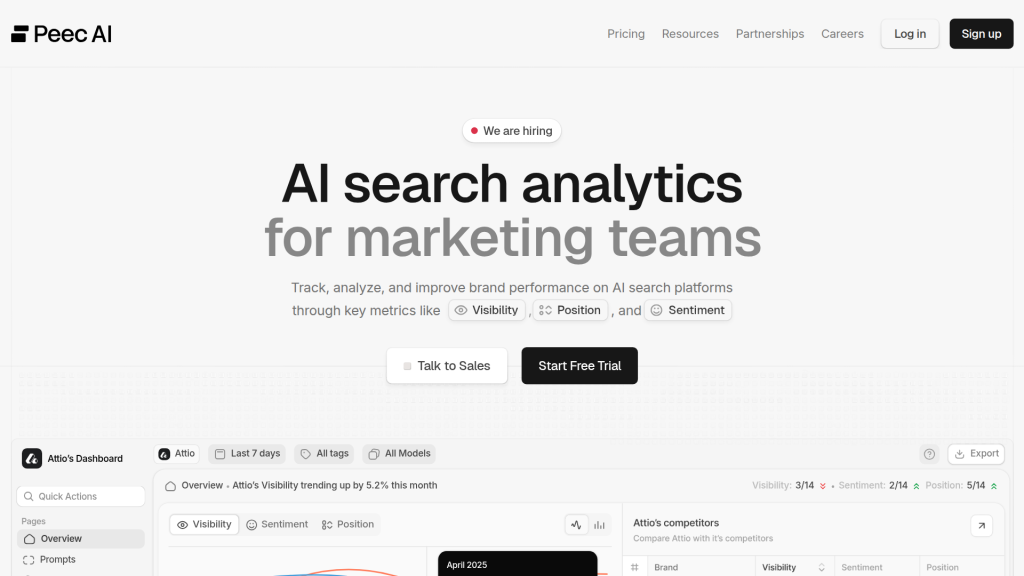
Peec is a Berlin-built platform with clean dashboards for brand visibility, position, and sentiment. Its sentiment scoring is frequently cited as the most granular in the category, and country-level citation share plus analytics across 14+ languages make it the strongest option here for brands operating outside a single English-speaking market.
The constraint is engine choice. Every self-serve tier lets you pick three models from a pool of seven (ChatGPT, AI Mode, AI Overviews, Copilot, Perplexity, Gemini, Grok), and tracking a fourth costs $35 to $165 per month depending on tier. Claude sits outside that pool entirely and requires Enterprise. Unlimited seats on every plan partly offsets this.
Pros: Best-in-class sentiment scoring; multilingual and multi-country analytics; unlimited seats; separate agency plans with white-label reporting
Cons: Only three of seven models per self-serve tier, with add-ons to widen it; Claude is Enterprise-only; low project counts on lower tiers
Bottom Line: Excellent for analytics and reporting, especially across languages. Teams that need broad engine coverage at a fixed price will hit the three-model cap quickly.
9. Rankscale: Best for Engine Breadth
Pricing:
- Pro: $99/mo for 1,200 credits, 10 brand dashboards, 50 page audits, up to 4,800 AI responses
- Growth: $385/mo for 5,500 credits, 50 dashboards, 22,000 responses
- Enterprise: $780/mo for 12,000 credits, 100 dashboards, 48,000 responses
- 15% annual discount; unused credits roll over; free trial on Pro
Rankscale covers more engines than anything else on this list, including ChatGPT, Perplexity, Google AI Mode, AI Overviews, Gemini, DeepSeek, Mistral, Claude, Grok, and Copilot. You get a Visibility Score dashboard, citation analysis showing which sites get cited instead of yours, page audits, scheduling from hourly to monthly, and unlimited seats on every tier. Growth adds white-label dashboard links, REST API access, and an agency program with a partner directory listing.
Credits are where the real cost lives, because engines do not bill equally. ChatGPT, Gemini, Perplexity, and Google AI Mode run 0.25 credits per check. DeepSeek and AI Overviews cost 1. Claude costs 2, eight times the base rate. On Pro’s 1,200 credits, 50 weekly prompts across the four cheap engines uses around 217 credits a month, and adding Claude at the same cadence roughly triples that.
Pros: Broadest engine list; credits roll over up to 2x on Pro and 3x above; unlimited seats on every tier; genuine agency program on Growth; frequently praised UX
Cons: Claude burns credits eight times faster than base engines, so the pool depletes quickly; forecasting a monthly bill takes credit math that flat plans do not; more technical than beginner-friendly
Bottom Line: The widest engine coverage available at $99, and the right pick if you want to track unusual engines like Mistral or DeepSeek. Run the credit calculator against your real prompt set first, because Claude changes the math substantially.
10. Otterly.AI: Best Budget Monitoring Tool
Pricing:
- Lite: $29/mo ($25/mo billed annually) for 15 prompts
- Standard: $189/mo ($160/mo annually) for 100 prompts
- Premium: $489/mo ($422/mo annually) for 400 prompts
- Enterprise: from $1,000/mo, adding SSO, custom prompt tracking, and a dedicated CSM
- Engine add-ons: Gemini and AI Mode from $9/mo, Claude from $29/mo on Lite up to $439/mo on Premium
- 14-day free trial on every tier; unlimited team members
Otterly is a Gartner Cool Vendor 2025 and the simplest tool here to get running. Four engines are included on every paid tier: ChatGPT, Google AI Overviews, Perplexity, and Copilot. Daily tracking, real-time alerts, sentiment analysis, GEO crawlability audits, and citation analysis come standard on every plan, along with unlimited team members, which is rare at this price. The Looker Studio connector, API and MCP access, AI crawler analytics, and multiple client workspaces start on the $189 Standard plan; Lite is a single workspace.
Three engines cost extra. Gemini, Google AI Mode, and Claude are all paid add-ons rather than base coverage, and the Claude add-on scales sharply with plan size, reaching $439/mo on the 400-prompt Premium tier. Otterly does not offer DeepSeek, Grok, or Meta AI at all.
Pros: Cheap entry at $29/mo; unlimited team members on every tier; 14-day trial; simple setup; Looker Studio connector
Cons: Gemini, AI Mode, and Claude are all paid add-ons; the $29 Lite plan is one workspace with no connector or API; costs scale steeply with volume; users on G2 note dashboard clutter at higher prompt counts
Bottom Line: A solid pick for lean teams that want monitoring and nothing more. Add up the engine add-ons before comparing the headline price against all-in-one platforms.
11. HubSpot AEO Grader: Best Free Option
Pricing: The AEO Grader is free. HubSpot AEO, the continuous version, is $50/mo with no HubSpot subscription required, and is bundled into Marketing Hub Pro and Enterprise.
HubSpot’s AEO Grader runs a free one-time check of how ChatGPT, Perplexity, and Gemini describe your brand from their training data, with no account required. It returns a score out of 100 across five weighted dimensions: sentiment (40 points), presence quality (20), brand recognition (20), share of voice (10), and market competition (10), plus a written interpretation of what the scores mean. It accepts any brand name, so it doubles as a quick competitor probe, and results come back in under two minutes.
For ongoing tracking, HubSpot AEO monitors the same three engines week over week with competitor comparison and prioritized recommendations at $50 a month. Three engines is the narrowest coverage on this list, and neither product tracks Claude, Copilot, Grok, or Google AI Mode.
Pros: Genuinely free with no account needed; fast; works on any brand including competitors; cheap upgrade path at $50/mo
Cons: Only three engines; the grader reads what models recall rather than what they cite live, so it will not show you citation wins; no Claude coverage on either product
Bottom Line: The best free starting point for measuring where you stand. Treat it as a diagnostic, then move to a real tracker once you know you have a gap.
Frequently Asked Questions
What is the difference between GEO and traditional SEO?
Traditional SEO focuses on ranking web pages in Google search results. GEO (Generative Engine Optimization) focuses on getting your brand cited and recommended in AI-generated answers from ChatGPT, Perplexity, and Google AI Overviews. Both matter: traditional SEO drives clicks, while GEO drives brand mentions in the growing AI search channel.
Which GEO tool is best for beginners?
Geoptie suits beginners best, with a $49/mo entry price and a set of free tools you can run before subscribing, no credit card required. HubSpot’s free AEO Grader is also a useful no-cost way to see where you currently stand.
How much do GEO tools cost?
GEO tools range from free to $700 or more per month. Otterly is the cheapest paid entry at $29/mo. All-in-one platforms run $49 to $99. Research-heavy and enterprise platforms sit between $349 and $699, and several vendors publish a price only on their entry tier or not at all.
Which GEO tools actually track Claude?
Fewer than the marketing suggests. Claude is selectable on every paid tier at Geoptie, included on every paid tier at Rankshift, and appears on Brandi’s engine list. Everywhere else it is gated: Profound, Peec, Goodie, and Gauge all reserve it for custom-priced enterprise plans, Otterly sells it as an add-on costing up to $439/mo, and Rankscale charges eight times its base credit rate for it. Ahrefs Brand Radar and HubSpot do not track it at all.
Do I need separate tools for monitoring and optimization?
Not necessarily. Geoptie, Rankshift, Brandi, Goodie, and Gauge combine monitoring with content optimization. Others (Peec, Otterly, Ahrefs Brand Radar) focus on monitoring, so you would pair them with a separate content workflow.
Can GEO tools guarantee I’ll appear in ChatGPT responses?
No tool can guarantee AI citations. Answers are non-deterministic and vary with the phrasing of the prompt, the context, and whatever the engine retrieves at that moment. GEO tools show you which sources are being cited for the prompts you care about, so you can work on becoming one of them.
How long does it take to see results from GEO?
Faster than SEO timelines would suggest, because most brand answers are assembled from live web results rather than recalled from training data. Once a page is crawled and starts getting picked up as a citation, the answers it feeds can shift within days. What moves slowly is the other layer: how a model describes your brand from memory with no search involved, which only changes when that model is retrained. So expect quick movement where citations are the lever, and a much longer horizon for correcting an entrenched description that lives in training data.
Is GEO replacing SEO?
No. GEO complements traditional SEO. Strong SEO fundamentals improve GEO performance, because AI models often cite high-ranking, authoritative sources. The most effective strategy runs both.
Conclusion
The AI search landscape is moving quickly, and brands investing in GEO now will hold an advantage as AI-generated answers become the default discovery layer.
Our top recommendations:
For most teams: Geoptie offers the best combination of coverage and value, with seven engines, any four per brand, and optimization tooling from $49/mo.
For PR and brand teams: Brandi AI focuses on the narrative and communications side of GEO, starting at $349/mo.
For enterprises: Profound provides the deepest crawler and conversation data with the strongest compliance posture, at Enterprise pricing.
For every model on the entry plan: Rankshift tracks nine models including Claude on its $92 tier, with a 30-day trial.
For existing tool users: Ahrefs Brand Radar integrates with the suite you already pay for.
For budget-conscious teams: Otterly at $29/mo is the cheapest paid entry, and HubSpot’s AEO Grader is free.
For high prompt volume: Gauge tracks 600 prompts daily across six platforms, the best cost per answer at that scale.
The most important step is starting. Run a free diagnostic to establish your baseline, then pick the platform that matches your budget, your engines, and the number of brands you need to track.