Anthropic crossed a $30 billion revenue run-rate in early 2026, with roughly 30 million monthly active users on Claude (Anthropic and Spotlight, 2026). Inside enterprise buying teams and developer workflows, Claude has quietly become the AI assistant of choice for a high-value audience — which makes how Claude talks about your brand a question worth answering.
The catch: ranking in Claude works nothing like Google, and nothing like Perplexity either. Claude’s baseline answers come from training data; its web tool fires only when the model decides it needs fresh information, and pulls from Brave Search rather than Google. Measuring Claude visibility means measuring appearance — citations, brand mentions, prompt-level share of voice. The eight tools below cover that job at different price points and depths. If a starting point with no commitment helps, the free Claude rank tracker covers citations and mentions across a set of prompts with no credit card and no time limit.
TL;DR — best Claude rank trackers by use case
- Geoptie — best for marketing teams that want multi-engine Claude tracking on a flat-priced entry tier
- LLMrefs — best value: 11 engines including Claude on a single €79 tier with a keyword-led methodology
- Mangools AI Search Watcher — best for SEOs who want Claude tracking bundled with a traditional SEO suite under $40
Those three cover most buyers. The full comparison and the four-question framework are below.
Quick comparison table
| Tool | Best for | AI engines covered | Where Claude lives | Starting price |
|---|---|---|---|---|
| Geoptie | Marketing teams that want multi-engine Claude tracking on a flat entry tier | Claude, ChatGPT, Perplexity, Gemini | Every paid tier from Starter | $49/mo |
| LLMrefs | SEO teams that want to track AI visibility by keyword rather than by prompt | 11 engines on a single tier (ChatGPT, Claude, Gemini, AI Overviews, AI Mode, Perplexity, Grok, Copilot, Meta AI, DeepSeek, ChatGPT Search) | Single tier — Claude included | €79/mo |
| Promptwatch | Teams that want daily Claude refresh with MCP access at the $99 mark | 9 models available; paid plans choose 4 at a time | Essential and above (one of four chosen models) | $99/mo |
| Mangools AI Search Watcher | Solo SEOs who want Claude tracking bundled with a traditional SEO suite | Claude, ChatGPT, Perplexity, Gemini, AI Overviews | Every paid bundle from Basic | $30.50/mo |
| Rankscale | Founders running their own generative-search optimisation at the lowest paid floor | 17+ engines (Claude costs 8× base rate per query) | Essentials and above | $20/mo |
| AthenaHQ | Brands wanting Claude on a credit-pool model with the broadest self-serve engine list (8 LLMs) | Up to 8 major LLMs including Claude on Self-Serve | Self-Serve and above | $295/mo Self-Serve |
| Scrunch | SEO and content teams that also need to monitor how AI crawlers access their site | ChatGPT, Perplexity, AIO, Copilot (Core); Claude, Gemini, Meta AI, AI Mode, Grok (Enterprise) | Enterprise only | $300/mo Core |
| Peec AI | Brand teams focused on how Claude describes them, not just whether Claude links them | Choose 3 of 7 on self-serve tiers; Claude on Enterprise via API | Enterprise only | $95/mo Starter |
All pricing is monthly-billed. Two of the eight tools below — Scrunch and Peec — gate Claude behind an Enterprise tier with custom pricing. The other six include Claude on a self-serve, published-price tier.
What “tracking Claude” actually means — four questions, one budget
Two Claude trackers can report completely different numbers for the same brand, and both can be correct. They are answering different questions. The four-question framework below clarifies which type of tool fits which buyer.
| Question | Tracker type | Why it matters for Claude |
|---|---|---|
| Does Claude name my brand in its answer? | Brand-mention tracking | Claude writes long, prose-heavy answers and names brands without linking them. This is the dimension that matters most. |
| Does Claude cite my page as a source? | Citation / source tracking | Web-tool citations are higher-intent but rarer than mentions; citation-only tools systematically undercount Claude visibility. |
| Where does my brand rank across the prompts that matter? | Prompt-level tracking | The closest analog to traditional SEO — share of voice across a defined query set. |
| Can Claude actually find my content? | Crawler / indexability tracking | Two crawlers (ClaudeBot for training, anthropic-ai for retrieval) and a separate Brave Search index Claude reads from when its web tool fires. |
Three implications follow from this:
Citation and mention are different metrics, and the gap is wider for Claude than for any other engine. Claude prefers prose to bullet-with-source lists, so it often names a brand without dropping a link. If one tool reports 40% Claude visibility and another reports 8%, the first is counting mentions in the answer text and the second is counting URL citations. Both can be right.
Brave indexing is foundational and routinely overlooked. Strong Google rankings do not automatically translate to Brave coverage, and Claude’s web tool reads from Brave. Most trackers do not test this layer at all.
The strongest setups combine at least two of the four question types. The tool list below flags which questions each one actually answers.
1. Geoptie
Best for marketing teams that want multi-engine Claude tracking on a flat entry tier.
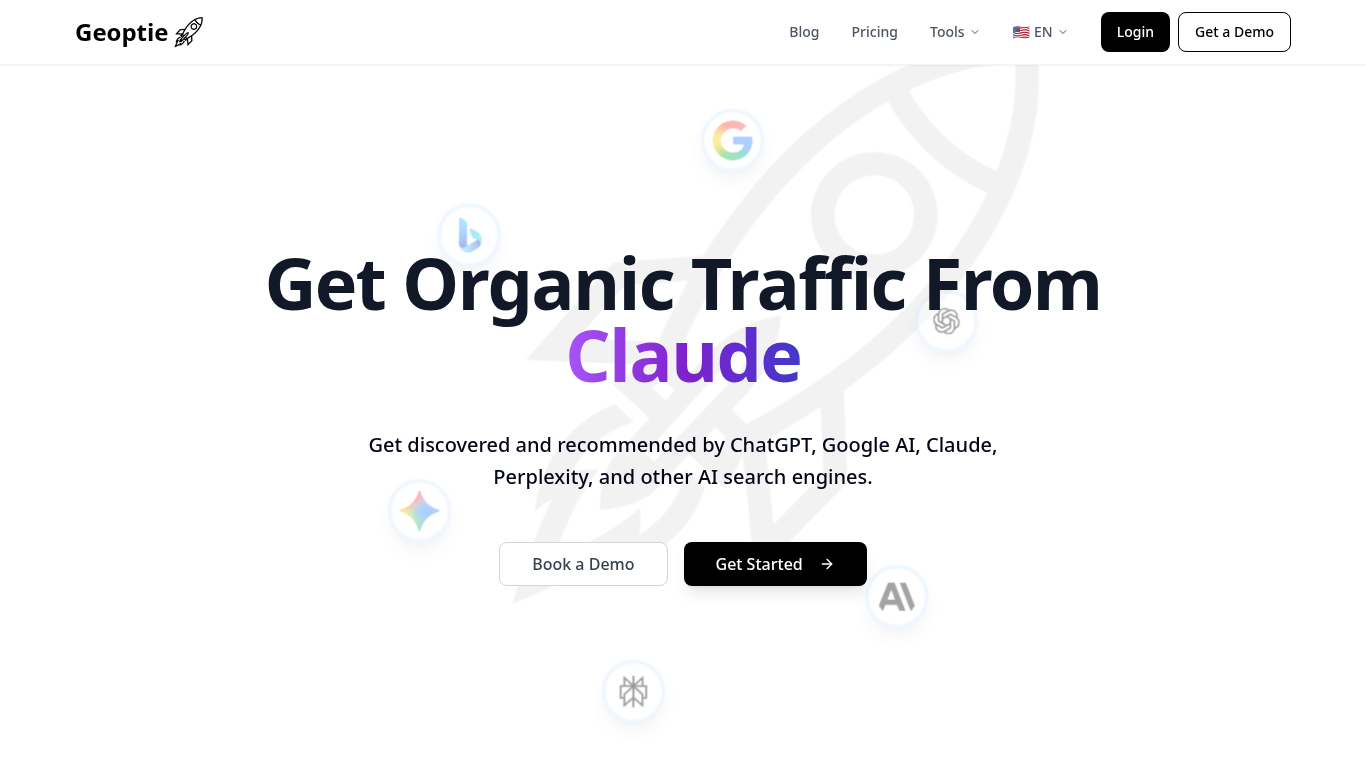
Tracking types: citation, brand mention, prompt-level.
Geoptie tracks how a brand appears across Claude, ChatGPT, Perplexity, and Gemini — all four engines included on every paid plan, starting at $49/mo. Most multi-engine competitors gate Claude behind enterprise pricing or skip it entirely, so an entry tier that covers Claude alongside the other three is unusual. The platform combines per-prompt citation and mention tracking, competitor benchmarking, and sentiment scoring in one workspace, plus a set of free diagnostic tools.
Key features
- Claude, ChatGPT, Perplexity, and Gemini on every paid tier
- Per-prompt Claude citation and mention tracking with daily refresh
- Competitor share-of-voice benchmarking
- Sentiment scoring on every tracked Claude response
- Multi-brand workspaces (10 on Professional, unlimited on Enterprise)
- CSV and PDF exports
- Free standalone trackers for Claude, ChatGPT, and Perplexity plus a free GEO audit
Pricing
- Starter — $49/mo ($41/mo billed annually). 15 prompts, 2 brands.
- Professional — $99/mo ($83/mo annually). 100 prompts, 10 brands.
- Enterprise — $199/mo ($166/mo annually). 400 prompts, unlimited brands.
Pros
- Full Claude coverage on the $49 entry plan alongside three other engines
- Affordable scaling — Professional gives ~7× the prompts for ~2× the price
- Agency-friendly: 10 brand workspaces on the $99 tier
Cons
- Four engines, not the 8+ that AthenaHQ covers at the higher self-serve tier
- No dedicated ClaudeBot crawler-log tracking — only Scrunch does this well
- Brand-mention sentiment scoring is less granular than Peec’s, which specialises in this dimension
2. LLMrefs
Best value: 11 engines including Claude on a single tier with a keyword-led methodology.
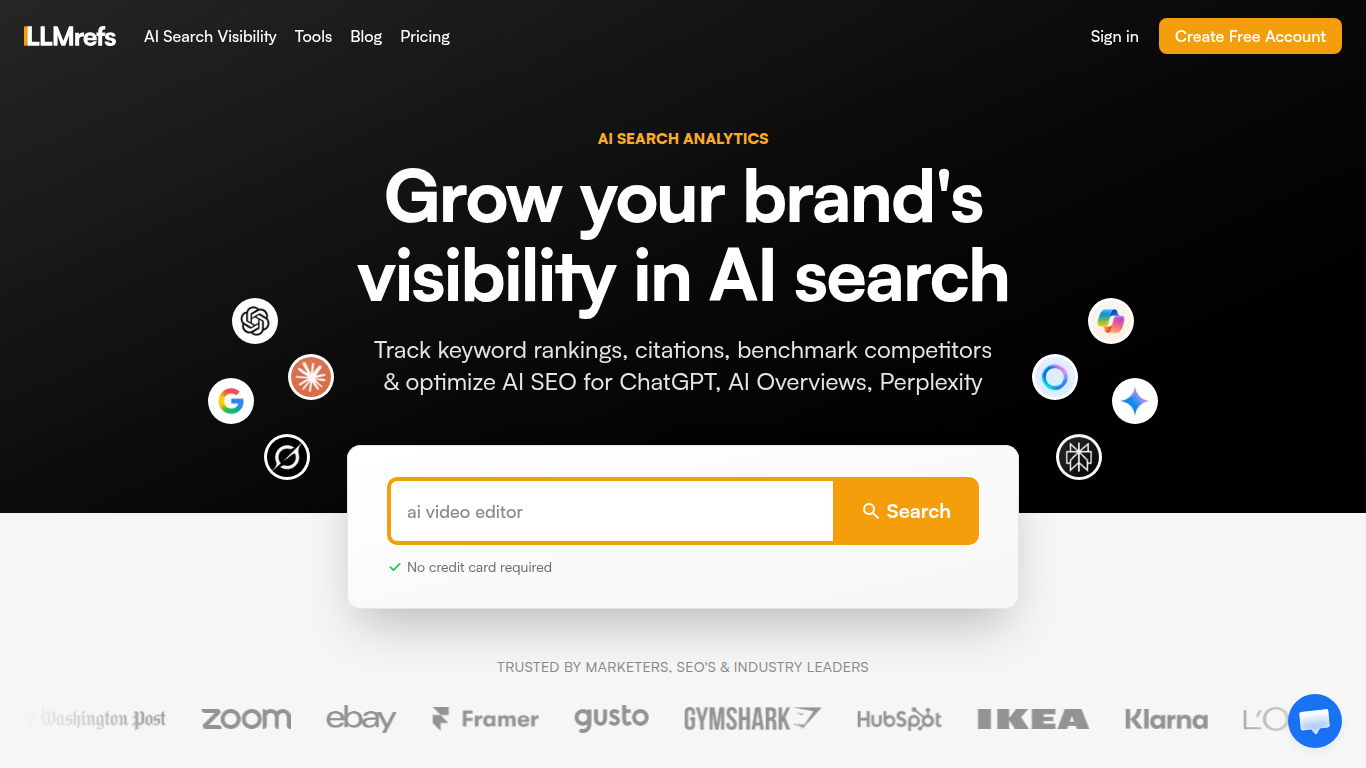
Tracking types: citation, brand mention, keyword-led prompt-level.
LLMrefs takes a keyword-first approach to AI visibility. Instead of asking users to write prompts manually, it imports SEO keyword lists and auto-generates fan-out prompts that reflect how real users talk to chatbots. Brand rankings, share-of-voice, and citation sources are aggregated and weighted across those prompts for statistical significance — one keyword maps to a confident visibility score rather than a noisy per-prompt readout. Customers include eBay, IKEA, NVIDIA, Shopify, HubSpot, Klarna, Twilio, Washington Post, and Zoom.
Key features
- 11 AI engines on a single tier with no per-engine gating, Claude included
- Keyword-led methodology — imports SEO keywords, generates prompts automatically
- Aggregated share-of-voice and position metrics across prompts
- Full citation source list per keyword
- Geo-targeting across 50+ countries and 20+ languages
- Unlimited projects and unlimited team seats
- CSV export and API access
Pricing
- All in One — €79/mo. 500 prompts, all 11 engines, 7-day free trial, cancel anytime.
There is no Pro or Enterprise upsell — LLMrefs runs on the single tier.
Pros
- Cheapest tool on this list that ships Claude without engine gating
- Strongest enterprise customer base on this list at the sub-€100 price point
- Keyword-led methodology removes prompt-writing overhead
Cons
- Single-tier pricing hits a 500-prompt ceiling sooner than multi-tier platforms
- Aggregated scoring is less granular than the per-prompt drill-downs in Peec or Promptwatch
- EUR pricing — USD-only teams will see a small FX premium
3. Promptwatch
Best for teams that want daily Claude refresh with MCP access at the $99 mark.
Tracking types: citation, brand mention, prompt-level, AEO content generation.
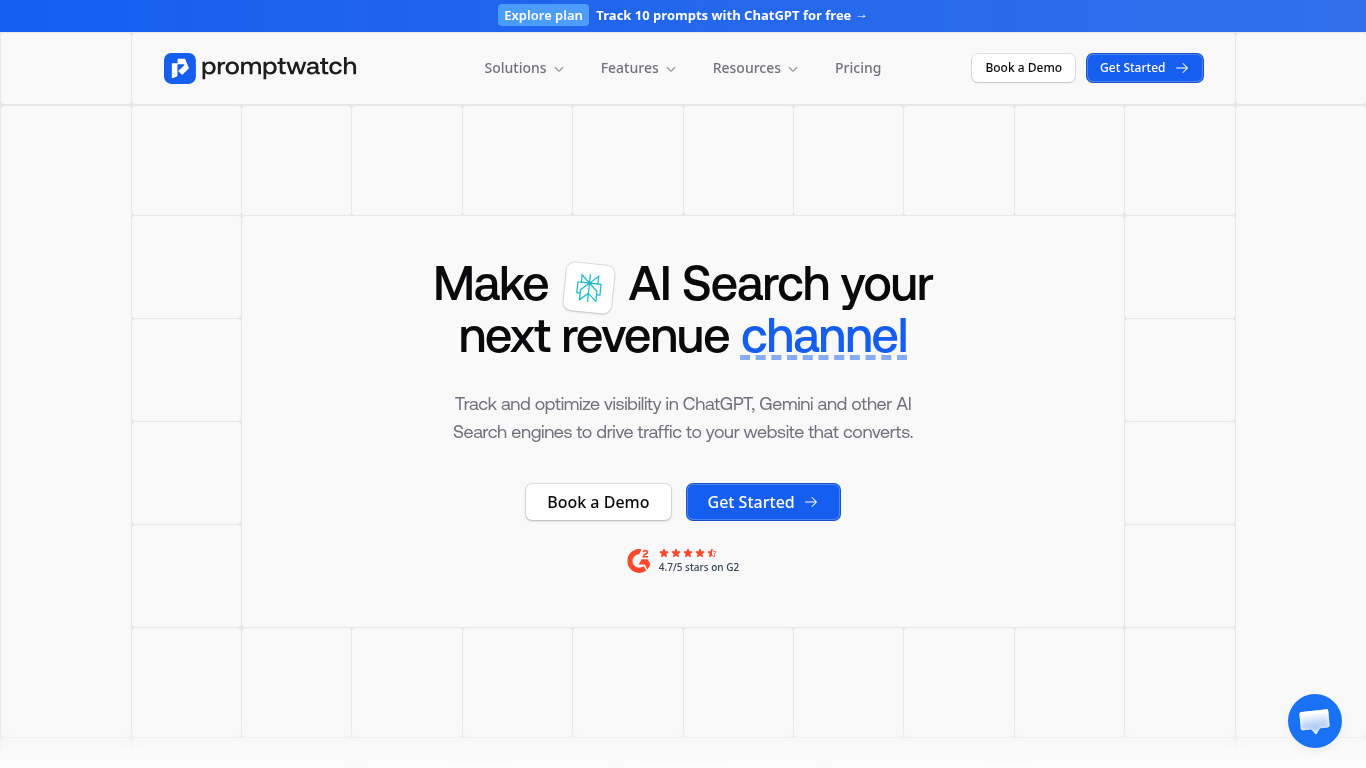
Promptwatch covers Claude alongside eight other AI engines, with daily-refresh tracking on every paid tier and MCP (Model Context Protocol) access from the $99 Essential plan upward. The structural constraint: paid plans track 4 of 9 supported models at a time, so Claude is one of four choices alongside ChatGPT, Perplexity, Gemini, Google AI Mode, AI Overviews, Meta, DeepSeek, and Grok. Customers include Duolingo, Typeform, Yelp, Shutterstock, and Monks.
Key features
- 9 models available; paid plans track 4 (Claude selectable on Essential and above)
- Daily refresh on every paid tier
- MCP access from $99 Essential — rare in this category
- AEO Articles content generation included (5/15/30 articles per month by tier)
- Country-level tracking on Essential; state and city-level on Professional and above
- Agent Analytics and API access on Professional and Business
Pricing
- Explore — free, ChatGPT only, 10 prompts. No Claude on the free tier.
- Essential — $99/mo. 1 project, 50 prompts, 4 chosen models, 5 AEO Articles/mo.
- Professional — $249/mo. 2 projects, 150 prompts, 15 AEO Articles/mo, API access.
- Business — $579/mo. 5 projects, 350 prompts, 30 AEO Articles/mo.
Pros
- Claude on the $99 Essential tier with daily refresh — rare at this price
- Content-generation layer included in the base subscription
- Strong customer logos for the tier
Cons
- 4-of-9 engine cap means tracking Claude trades against another model on the same plan
- 50 prompts on Essential is tight for fully-built prompt libraries
- Less sentiment depth than Peec
4. Mangools AI Search Watcher
Best for solo SEOs who want Claude tracking bundled with a traditional SEO suite under $40.
Tracking types: brand mention, prompt-level.
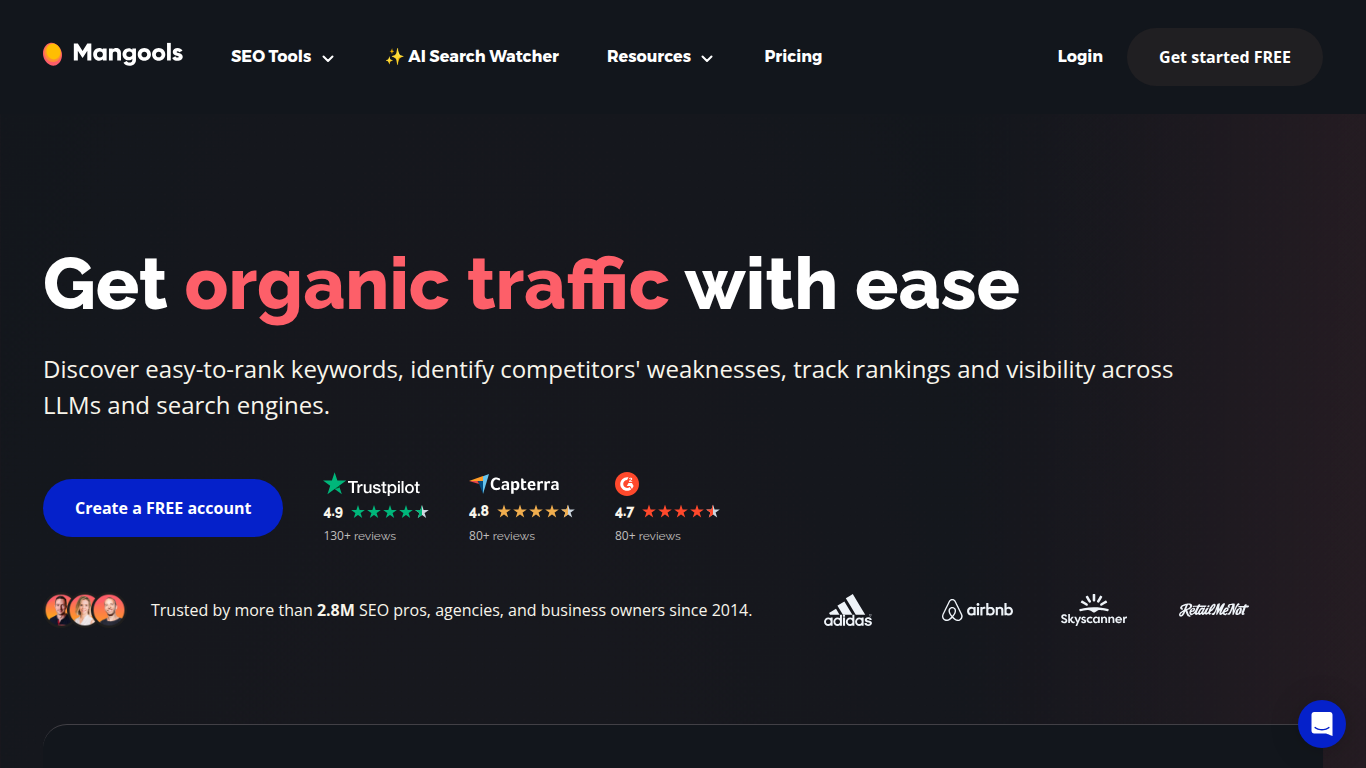
Mangools added AI Search Watcher PRO to its existing SEO bundle (KWFinder, SERPChecker, SERPWatcher, LinkMiner). Claude tracking ships on the Basic tier alongside the full Mangools SEO toolkit, which makes the bundle hard to beat on a per-feature-dollar basis once an SEO already wants Mangools. The trade-off versus dedicated AEO specialists is depth — lighter sentiment analysis and a smaller AEO feature surface — but the price is roughly a third of LLMrefs and a sixth of Promptwatch.
Key features
- Claude, ChatGPT, Gemini, Perplexity, and AI Overviews in AI Search Watcher PRO
- Up to 500 prompts monitored and unlimited monitors on Basic
- Full Mangools SEO suite included with every tier
- Free AI Search Grader for a no-account snapshot across eight LLMs
- Clean UI with low setup overhead
Pricing
- Basic — $30.50/mo monthly ($19.83/mo billed annually). 500 prompts, no extra seats.
- Premium — $40.50/mo. Same Claude tracking; 3 extra seats.
- Agency — $70.50/mo. 5 extra seats; agency-oriented.
- AI Search Grader — free, one-shot snapshot.
Pros
- Cheapest paid bundle on this list once the SEO tools are factored in
- Free AI Search Grader is the lowest-friction Claude demo from any vendor
- Strong fit for SEOs who already want Mangools’ classic toolkit
Cons
- AI Search Watcher PRO is bundle-only — no standalone purchase
- Lighter sentiment and citation depth than dedicated AEO tools
- Less suited as a long-term enterprise tool
5. Rankscale
Best for founders running their own generative-search optimisation at the lowest paid floor.
Tracking types: citation, brand mention, prompt-level.
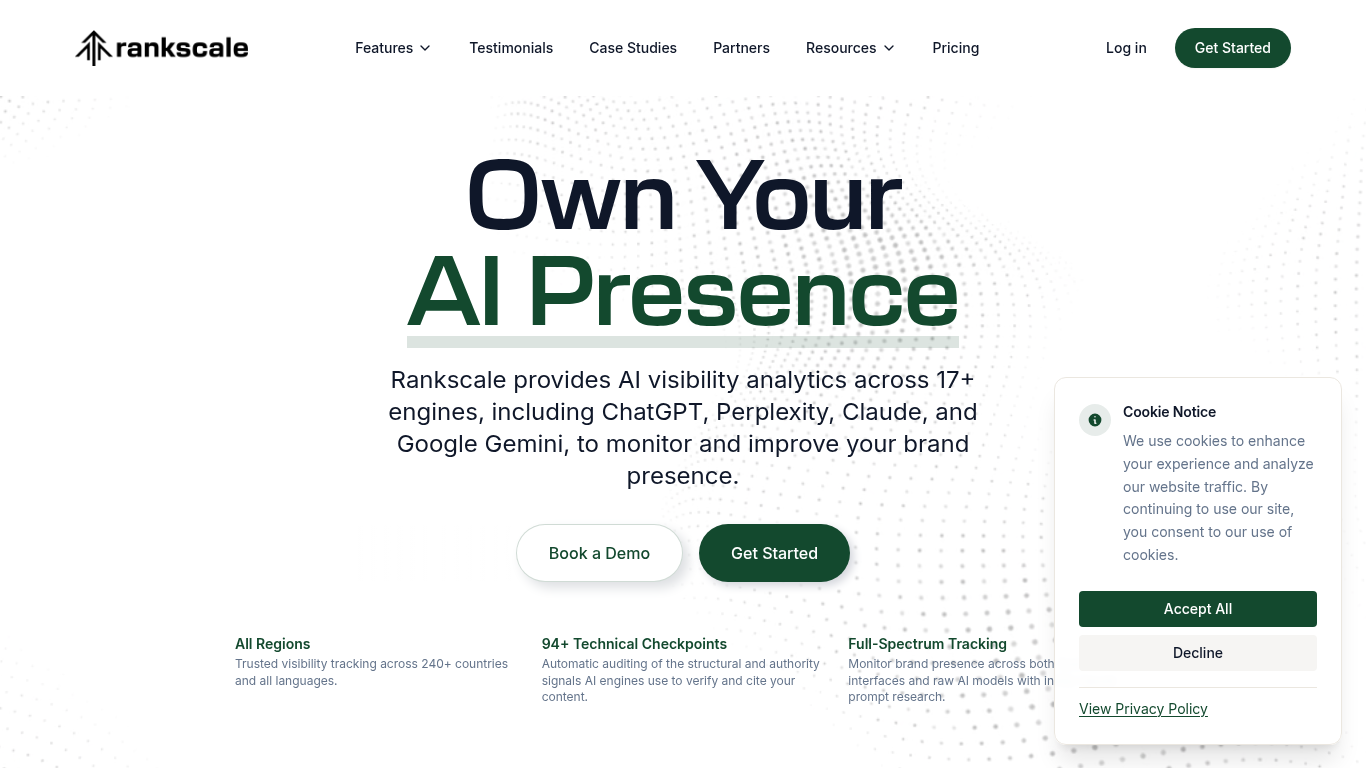
Rankscale offers the cheapest paid entry in the category. Claude is included on the $20 Essentials plan, alongside competitor benchmarking and citation tracking across 17+ AI engines. The catch is the credit-pool model: Pro at $99/mo includes 1,200 credits, but per-engine rates are uneven. ChatGPT, Gemini, Perplexity, and Google AI Mode cost 0.25 credits per run; DeepSeek costs 1; Claude costs 2 — eight times the base rate. A Claude-heavy tracking cadence depletes the pool fast.
Key features
- 17+ engines tracked (including Claude, with credit-cost asymmetry)
- Mention trends, citations, and competitor benchmarking
- Lightweight interface for founders and consultants
- Free trial on Pro
Pricing
- Essentials — $20/mo. Claude included.
- Pro — $99/mo. 1,200 credits per month.
- Growth / Enterprise — custom.
Pros
- Lowest paid floor in the category at $20/mo
- Claude included on the cheapest paid plan
- Quick to set up
Cons
- Credit math means Claude usage scales spend faster than other engines
- Smaller team and ecosystem than the established platforms
- Reporting depth scales quickly past the entry tier
7. Scrunch
Best for SEO and content teams that also need to monitor how AI crawlers access their site.
Tracking types: citation, brand mention, prompt-level, AI-crawler analytics.
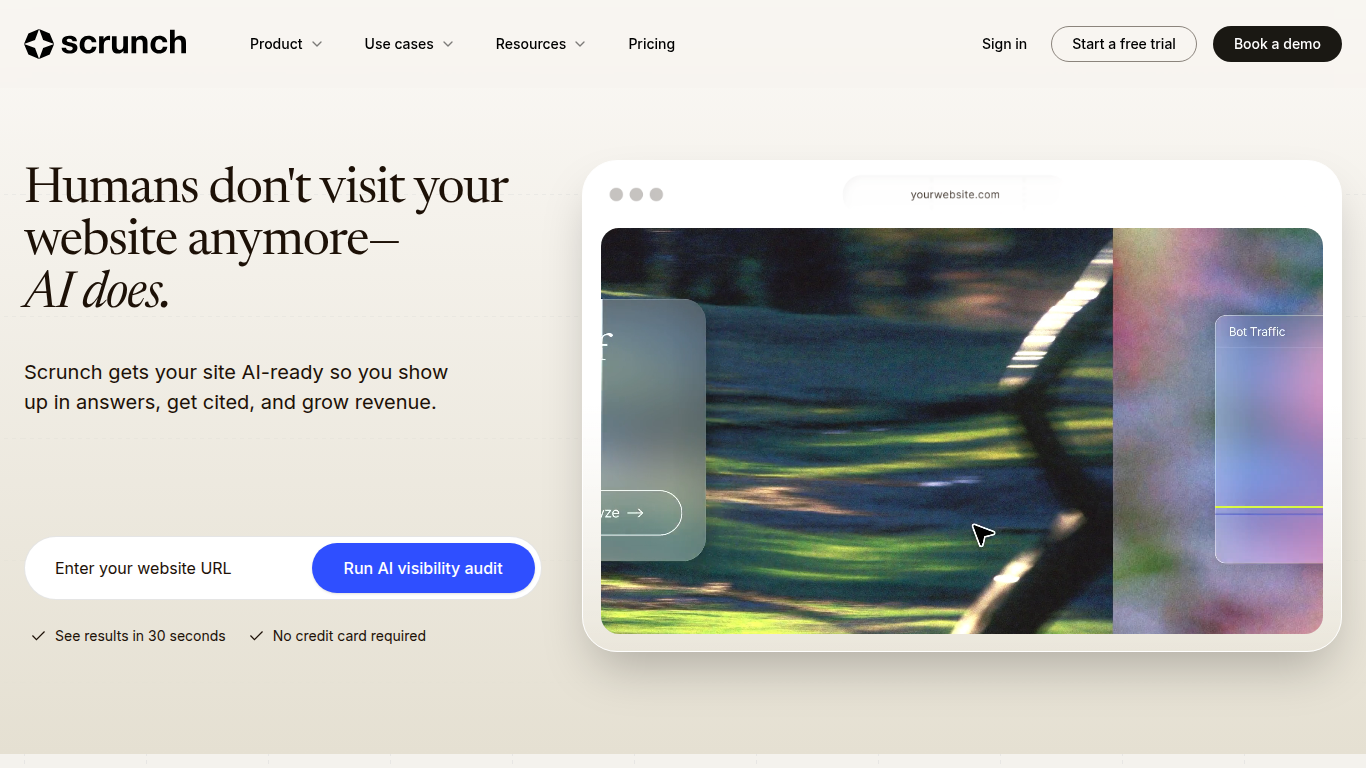
Scrunch is the AI-crawler analytics specialist of this list. It exposes named coverage of ClaudeBot, GPTBot, and PerplexityBot — which pages they crawl, how often, what they extract — alongside citation and mention tracking on ChatGPT, Perplexity, Google AI Overviews, and Copilot on the Core tier. The Claude caveat is significant: Claude visibility tracking is Enterprise-only on Scrunch. Core covers four engines, none of them Claude. For technical SEO teams who want crawler-log data first and Claude visibility second, Scrunch is the strongest fit; for everyone else, the Claude gate is a real friction. See the Scrunch AI alternatives breakdown for the broader comparison.
Key features
- Named ClaudeBot, GPTBot, PerplexityBot crawler analytics on Core
- Citation, mention, and sentiment tracking
- Persona-based prompt sets
- Page-level audits
- Brand-share-of-voice reporting
Pricing
- Core — $300/mo ($250/mo billed annually). 4 engines (ChatGPT, Perplexity, Google AIO, Copilot), 350 custom prompts, 3 seats.
- Growth — $500/mo ($417/mo annually). 5 seats, 700 custom prompts.
- Enterprise — custom. Adds Claude, Gemini, Meta AI, AI Mode, Grok.
Pros
- Best AI-crawler analytics in the category at a published price
- Strong technical SEO orientation (llms.txt, crawler segmentation)
Cons
- Claude requires Enterprise; the published $300 Core tier does not include Claude visibility
- Higher entry price than the dedicated Claude-on-self-serve tools above
- No free trial; sales-led for Enterprise
8. Peec AI
Best for brand teams focused on how Claude describes them, not just whether Claude links them.
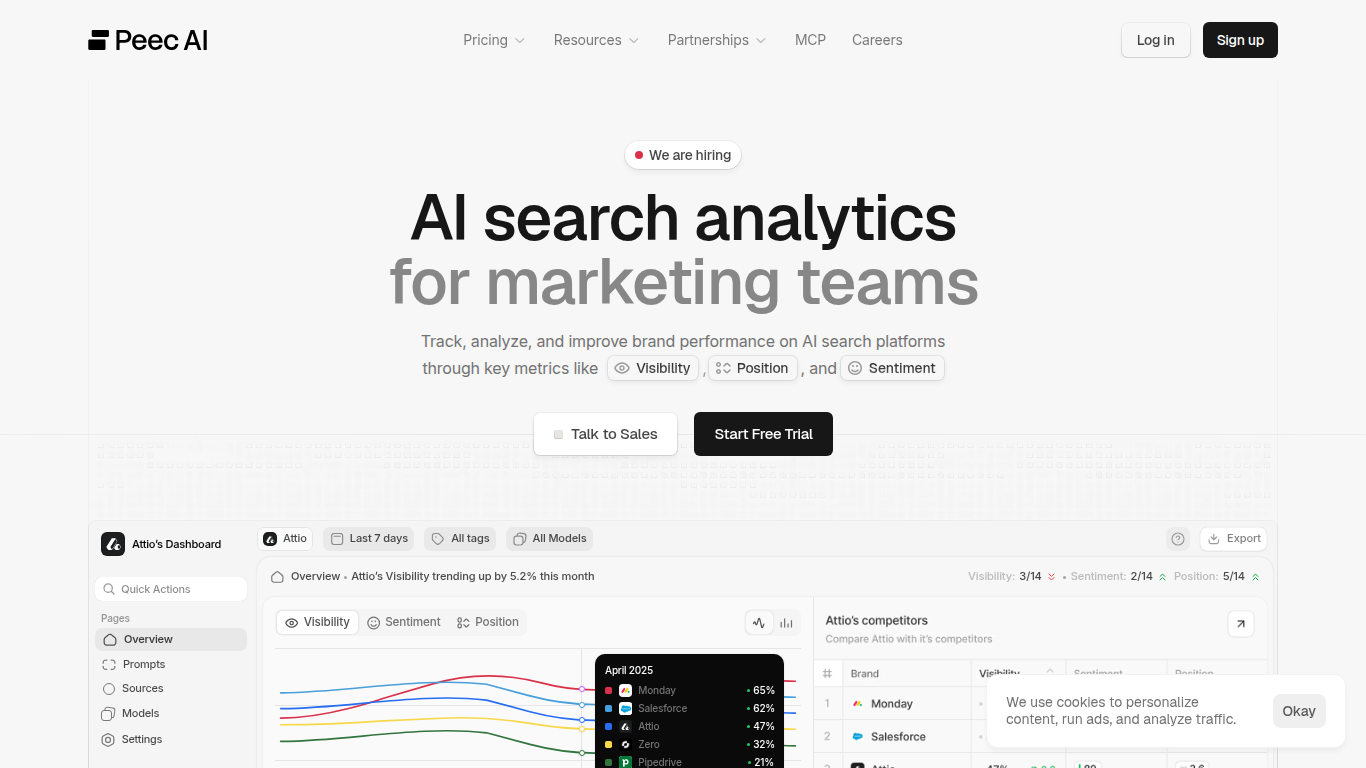
Tracking types: brand mention, prompt-level, sentiment.
Peec’s sentiment scoring is the strongest in this category — it tracks how AI describes a brand (industry leader, budget alternative, cheap knockoff) rather than just whether it names you. The caveat for Claude buyers is the gating model: Peec’s published self-serve tiers cap engine selection at 3 of 7 (ChatGPT, AI Mode, AI Overviews, Copilot, Perplexity, Gemini, Grok), and Claude Sonnet 4 is only available on the Enterprise tier via API access. If sentiment depth is the primary need and budget allows for an Enterprise sales conversation, Peec is the right pick; otherwise the lower-cost tools above ship self-serve Claude. See the Peec AI alternatives comparison for context.
Key features
- Sentiment scoring across answer engines (best-in-list for Claude framing)
- 7 self-serve engines, choose 3 per project
- Claude Sonnet 4 and GPT-5 Search available on Enterprise via API
- Daily prompt updates and competitor benchmarking
- Multi-language and country-level breakdown
- Looker Studio integration; unlimited user seats
Pricing
- Starter — $95/mo (€89/mo). 50 prompts, choose 3 of 7 non-Claude models.
- Pro — $245/mo. 150 prompts.
- Advanced — ~$495/mo. 350 prompts.
- Enterprise — custom. Claude Sonnet 4 and GPT-5 Search via API.
Pros
- Best-in-class sentiment depth — answers “how does Claude frame us?”
- Unlimited user seats on every plan
- Strong multilingual and regional analytics
Cons
- Claude requires Enterprise — never appears on the self-serve tiers
- 3-of-7 cap means engine selection trade-offs even at higher tiers
6. AthenaHQ
Best for brands wanting Claude on a credit-pool model with the broadest self-serve engine list.
Tracking types: citation, brand mention, prompt-level, content optimization.
AthenaHQ ships Claude on its $295 Self-Serve tier alongside seven other engines — one of the few self-serve tools in this category to do so. Pricing is credit-based rather than flat: Self-Serve includes 3,600 monthly credits plus a $300/month free credit allowance, with add-on credits available for higher volumes. Each AI response consumes credits depending on the engine being queried. Customers include SoFi, Coinbase, Twilio, and PagerDuty. See the AthenaHQ alternatives comparison for the wider context.
Key features
- Flexible AI visibility across up to 8 major LLMs including Claude on Self-Serve
- On-page and off-page GEO analysis in one workspace
- Competitor monitoring and impersonation detection
- Granular authority and citation intelligence
- Dynamic AI crawling — finds lost or hidden parts of a website
- AI blindspot detection
- Unlimited seats with role-based access control (RBAC)
Pricing
- Self-Serve — $295/mo. 3,600 credits + $300/mo free credit allowance. Up to 8 LLMs including Claude. Add-on credits available. First-month promo currently 67% off.
- Enterprise — custom. Adds LLM traffic analytics, self-improving content workflows, AI agent with Deep Research, Athena Citation Engine, SAML/OIDC SSO, audit logs, dedicated GEO specialist, API access.
Pros
- Claude on a self-serve, published-price tier — broadest self-serve engine count (8) on this list
- $300/mo free credit allowance softens the headline $295 floor
- Unlimited seats with RBAC on the entry tier is unusual at this price
Cons
- $295 is the highest published self-serve entry price in this category
- Credit-based pricing means usage forecasting is harder than with flat plans
- No free trial; the first-month promo functions as the trial substitute
How to choose the right Claude tracker
The right tool depends on which of the four question types matters most, the team’s existing stack, and budget.
- Multi-engine Claude on a flat-priced entry tier: Geoptie. Claude, ChatGPT, Perplexity, and Gemini on the $49/mo Starter.
- All 11 engines including Claude on a single tier: LLMrefs at €79/mo, with the keyword-led methodology.
- Daily-refresh Claude tracking with MCP access at $99: Promptwatch Essential.
- Cheapest paid Claude tracking when an SEO suite is also wanted: Mangools Basic at $30.50/mo monthly.
- Lowest paid floor at $20/mo: Rankscale Essentials (with the credit-math caveat).
- Broadest self-serve engine list (8 LLMs) including Claude: AthenaHQ Self-Serve at $295/mo, credit-based.
- ClaudeBot crawler analytics: Scrunch, on the Enterprise tier where Claude is unlocked.
- Sentiment depth on how Claude describes a brand: Peec AI Enterprise.
- Agencies tracking many client brands: Geoptie Professional — 10 brand workspaces at $99/mo.
- Free Claude citation and mention tracking: the Claude rank tracker — no credit card, no time limit.
Frequently asked questions
Is there a free Claude rank tracker?
Yes — the Claude rank tracker is free with no credit card and no time limit. It checks brand and competitor visibility across Claude prompts. For multi-engine tracking, the free GEO rank tracker covers Claude alongside ChatGPT, Perplexity, and Gemini. Mangools also offers a free one-shot AI Search Grader. Most paid tools on this list offer 14-day free trials.
What is the difference between citation and brand-mention tracking for Claude?
Citation tracking checks when Claude’s answer links to a URL — typically when Claude’s web tool fires and surfaces a source. Brand-mention tracking checks when Claude names a brand in the answer text without linking it. The gap is wider for Claude than for any other engine: Claude writes long, conversational answers that name brands without dropping links, so citation-only tools systematically miss most of the real Claude visibility. The strongest setups do both.
What is the cheapest Claude rank tracking tool under $100 per month?
The sub-$100 options are Rankscale Essentials ($20/mo, Claude included but at 2 credits per query so volume scales fast), Mangools Basic ($30.50/mo monthly, bundles Claude with the Mangools SEO suite), Geoptie Starter ($49/mo for four engines including Claude), LLMrefs (€79/mo for 11 engines including Claude on a single tier), and Promptwatch Essential ($99/mo with Claude as one of four chosen models). Peec AI Starter at $95/mo does not include Claude — Peec gates Claude to Enterprise.
How does Claude decide which sources to cite?
When Claude’s web tool fires, it pulls from Brave Search and synthesises answers from the highest-quality sources it finds. Clear, well-structured, answer-first content tends to be cited more often, along with recency and demonstrated authority. Claude does not always run live search — baseline answers come from training data, so being represented in established publications and well-indexed documentation also influences whether Claude can name a brand when no web search runs.
How do I get cited by Claude?
Make sure neither ClaudeBot nor anthropic-ai is blocked in robots.txt — the first feeds Claude’s training data, the second its retrieval layer. Get indexed in Brave Search separately from Google, since Brave is the source Claude’s web tool reads from. Then write content that is easy to extract: clear headings, direct answers in the first sentence of each section, lists or tables where they fit, and schema markup to signal entities and relationships.
Can I track Claude rankings in Google Search Console?
No. Google Search Console only reports performance in Google Search and has no view into Claude answers. To see whether a brand is cited or mentioned inside Claude answers, one of the dedicated trackers above is required. The free Claude rank tracker is the no-commitment starting point.
Why do two Claude trackers show different numbers for the same brand?
Usually because they are measuring different things. One may count URL citations from Claude’s web tool while the other counts brand mentions in the answer text — and the two rarely match, because Claude links far less often than it names brands. Differences in prompt sets, timing, refresh frequency, and whether the tool tests the live web-tool path or the training-data-only path add more variance. Trends over time are more reliable than any single snapshot.
What to do next
The first step in any Claude program is seeing where a brand stands today: which prompts surface it, where Claude mentions it, and how it compares to competitors. The fastest way is the free Claude rank tracker or a free GEO audit for the broader four-engine picture.
From there, match the tool to the real question. For broad coverage at the lowest entry price, Geoptie tracks Claude alongside ChatGPT, Perplexity, and Gemini from $49/mo. For deeper background, see AEO vs GEO vs SEO and the sister roundups of the best LLM tracking tools, best AEO tools, and best Perplexity rank tracker tools.