AI Overviews now appear in roughly half of all Google searches (BrightEdge, 2026), and for a growing share of buyers a chat interface is where product research starts rather than a results page. Search is moving from blue links to synthesized answers, and the tools that win in this new shape are not the ones you used to track keyword positions.
Answer Engine Optimization (AEO) is the discipline of getting your brand and pages cited inside AI-generated answers. AEO tools measure whether you appear in those answers, help you optimize content to win them, and at the high end analyze the bots and citations behind the scenes. For background on how AEO compares to traditional SEO and GEO, see our guide on AEO vs GEO vs SEO. The ten platforms below cover the full range of what an AEO tool can actually do today, with real pricing.
TL;DR — best AEO tools by use case
- Geoptie — best overall AEO tracking, built on brand workspaces with white-label reporting and content generation included
- Profound — best for enterprise multi-engine AEO programs
- Ahrefs Brand Radar — best data depth, tracking against 470M+ real-search prompts
If you want the short answer, those three cover most buyers. The full comparison and methodology are below.
Quick comparison table
| Tool | Best for | AI Platforms Covered | Starting Price |
|---|---|---|---|
| Geoptie | Agencies and teams tracking many brands, with white-label reporting | ChatGPT, Claude, Perplexity, Gemini, AI Overviews, AI Mode, Copilot — choose any 4 of 7 on every plan | $49/mo |
| AirOps | Enterprise teams needing tracking and execution in one closed loop | ChatGPT, Claude, Perplexity, Gemini, and others | Custom (enterprise) |
| HubSpot AEO Grader & AEO | Free one-shot diagnostic; low-cost continuous monitoring | ChatGPT, Perplexity, Gemini | Free grader / $50/mo |
| Profound | Enterprise multi-engine AEO programs | ChatGPT only (Starter); 3 engines (Growth); up to 9 (Enterprise) | $99/mo |
| Airefs | Turning visibility gaps into published content and earned mentions | ChatGPT, Google AI Overview (prompt tracking); all major LLMs (crawler + traffic analytics) | $29/mo |
| Ahrefs Brand Radar | Largest real-search prompt database (470M+) | AI Overviews, AI Mode, ChatGPT, Perplexity, Copilot, Gemini (6); Grok on the top tier | $398/mo |
| Semrush | Brands already running SEO on Semrush | ChatGPT, Gemini, Perplexity, SearchGPT, Google AI Mode, AI Overviews (no Claude) | $139/mo |
| SE Ranking AI Search | Combined SEO + AEO in one platform | AI Overviews, AI Mode, ChatGPT, Gemini, Perplexity | $89/mo add-on ($218/mo realistic floor) |
| Scrunch AI | Enterprise AEO with named AI-crawler analytics | 4 engines (Core), 9 (Enterprise) | $250/mo |
| Peec AI | Multilingual tracking and agency credit pooling | 7 engines, choose 3 on self-serve; Claude Enterprise-only via API | $95/mo |
What does “AEO tool” actually mean? Four different jobs
“AEO tool” is an umbrella term that hides four distinct jobs. Picking the wrong category is the most common mistake we see buyers make.
| What you want to do | Job to be done | Tools that focus here |
|---|---|---|
| See if AI engines cite my brand | AEO tracking | Geoptie, Profound, Scrunch AI, Peec AI |
| Optimize content to win AI answers | AEO content optimization | AirOps, Geoptie |
| Get a one-shot diagnostic score | AEO grading | HubSpot AEO Grader, Geoptie GEO Audit |
| Add AEO to my existing SEO stack | Full-suite with AEO module | Semrush, Ahrefs Brand Radar, SE Ranking |
AEO tracking answers the question “when someone asks an AI for the best tool in our category, are we cited?” This is the most common need and where most dedicated platforms concentrate.
AEO content optimization answers a different question: “How do I structure pages so AI engines pull from them when generating answers?” A few platforms, AirOps most clearly, now cover both jobs in one workspace, which is why it appears in two rows.
AEO grading answers a third: “Give me a number and a list of fixes, what should I do first?” Graders are good entry points but rarely replace ongoing tracking.
Full-suite platforms with AEO modules are the right answer if you already own the suite. The integration cost is low; the standalone AEO value varies.
Before you compare features, decide which of these four jobs you need most. Then read the relevant sections below.
How we evaluated these tools
Tested in May 2026, with pricing and engine coverage re-verified against first-party pricing pages in August 2026. We evaluated each tool against six criteria:
- AI platform coverage — how many answer engines the tool actually tracks, and at which tier
- Tracking method — UI scraping, API access, or real search-backed data
- Content workflow integration — does the tool only measure, or also help you fix things?
- Sentiment and citation analysis — depth of analysis beyond raw mention counts
- Actionability — does the tool tell you what to do next?
- Pricing and value — what you get for the entry-level paid tier
Disclosure: Geoptie is included in this comparison. Two categories where competitors beat us: Ahrefs Brand Radar has a far larger prompt database (470M+ monthly prompts derived from real search behavior), and Semrush integrates AEO data more deeply with traditional SEO if you already own that stack. We name those trade-offs in the relevant sections below.
1. Geoptie (best overall for multi-brand tracking with reporting and content built in)
Geoptie is an answer engine optimization platform built around brand workspaces. The $99/mo Professional plan carries 10 of them, each with its own prompt set, competitor set, and engine selection, plus white-label reporting for client-facing deliverables; Enterprise removes the workspace limit. Inside each workspace, the platform tracks seven engines, ChatGPT, Claude, Perplexity, Gemini, Google AI Overviews, Google AI Mode, and Microsoft Copilot, with any four selectable on every plan including the $49/mo entry tier and no per-engine surcharge. Tracked prompts feed a recommendations engine and content generation in the same place, so findings turn into briefs and drafts without a second tool. A separate suite of free GEO tools handles one-off diagnostics. Used by AKQA, Decathlon, Capgemini, Verizon, and Dentsu.
Key features
- Seven engines available: ChatGPT, Claude, Perplexity, Gemini, Google AI Overviews, Google AI Mode, and Microsoft Copilot
- Any four engines on every plan, including Starter, with no per-engine add-on pricing
- Per-brand engine selection, so each workspace tracks its own four
- Per-prompt mention and citation tracking with daily refresh
- Competitor visibility benchmarking with share of voice
- Sentiment scoring on every tracked prompt
- Multi-brand workspaces: 2 on Starter, 10 on Professional, unlimited on Enterprise
- Recommendations engine that turns tracked prompts into prioritized actions
- Content generation pipelines for briefs and drafts, plus a content checker for existing pages
- White-label client reporting on Professional and Enterprise
- Flexible data exports (CSV, PDF) on every paid plan
- Free GEO audit, content checker, keyword finder, and backlink finder
- Dedicated ChatGPT, Claude, and Perplexity rank trackers
Pricing
- Starter — $49/mo monthly ($41/mo billed annually, $490/year). 15 monitoring prompts, 2 brands, any 4 engines.
- Professional — $99/mo monthly ($83/mo billed annually, $990/year). 100 prompts, 10 brands, white-label reporting.
- Enterprise — $399/mo monthly ($333/mo billed annually, $3,990/year). 400 prompts, unlimited brands. Additional 100 prompts at $99/mo.
- Annual billing is 2 months free. No free trial on the platform; the standalone GEO audit and content checker run without a subscription or credit card.
Pros
- 10 brand workspaces with white-label reporting at $99/mo, where most platforms cap self-serve plans at one to five projects
- Per-brand engine selection, so clients in different categories can track different engines on the same account
- Tracking runs through to recommendations and generated drafts in one workspace
- Affordable scaling: Professional lifts the prompt limit almost 7x for roughly 2x the price
- Four engines of your choice on the $49/mo entry plan, with no per-engine surcharge at any tier
- Free standalone tools for diagnostics before paying
Cons
- Four engines at a time rather than all seven at once
- No Grok, DeepSeek, Meta AI, or Mistral in the engine lineup
- No free trial on the platform itself, only the standalone free tools
- Younger platform than long-established SEO incumbents like Semrush and Ahrefs
2. AirOps (best for enterprise teams that need tracking and execution in one closed loop)
AirOps is an enterprise AEO platform built around a closed loop of insight, action, and measurement. Insights track how a brand appears across ChatGPT, Claude, Perplexity, Gemini, and other engines, surfacing citation rate, mention rate, sentiment, and competitive positioning. Page360 ties that signal back to GSC and GA4 at the URL level. Quill, the platform’s AI agent, then runs Playbooks for content creation, refresh, brand monitoring, and offsite mention building against the specific gaps Insights flags, so on-site and third-party surfaces both move inside one system.
Key features
- Multi-engine visibility tracking across ChatGPT, Claude, Perplexity, and Gemini
- Page360 for URL-level performance tied to GSC and GA4
- Quill AI agent running Playbooks for content creation, refresh, and AI search optimization
- Offsite mention building on third-party sources AI engines weigh for consensus
- Content Engineering workflows for enterprise SEO and content teams
- Closed-loop measurement: every campaign reports back against the visibility metrics it targeted
Pricing
- Custom enterprise pricing. Contact sales for a scoped plan.
Pros
- Pairs tracking with an execution system in the same workspace
- Covers both on-site content work and offsite mention building
- Quill scales content operations without adding headcount
- Built for enterprise marketing teams operating at multi-brand or multi-market scale
Cons
- Enterprise-only; no self-serve tier for small teams
- Public pricing is not listed
- Broader scope than teams that only need a visibility dashboard
3. HubSpot AEO Grader & AEO (best free one-shot diagnostic)
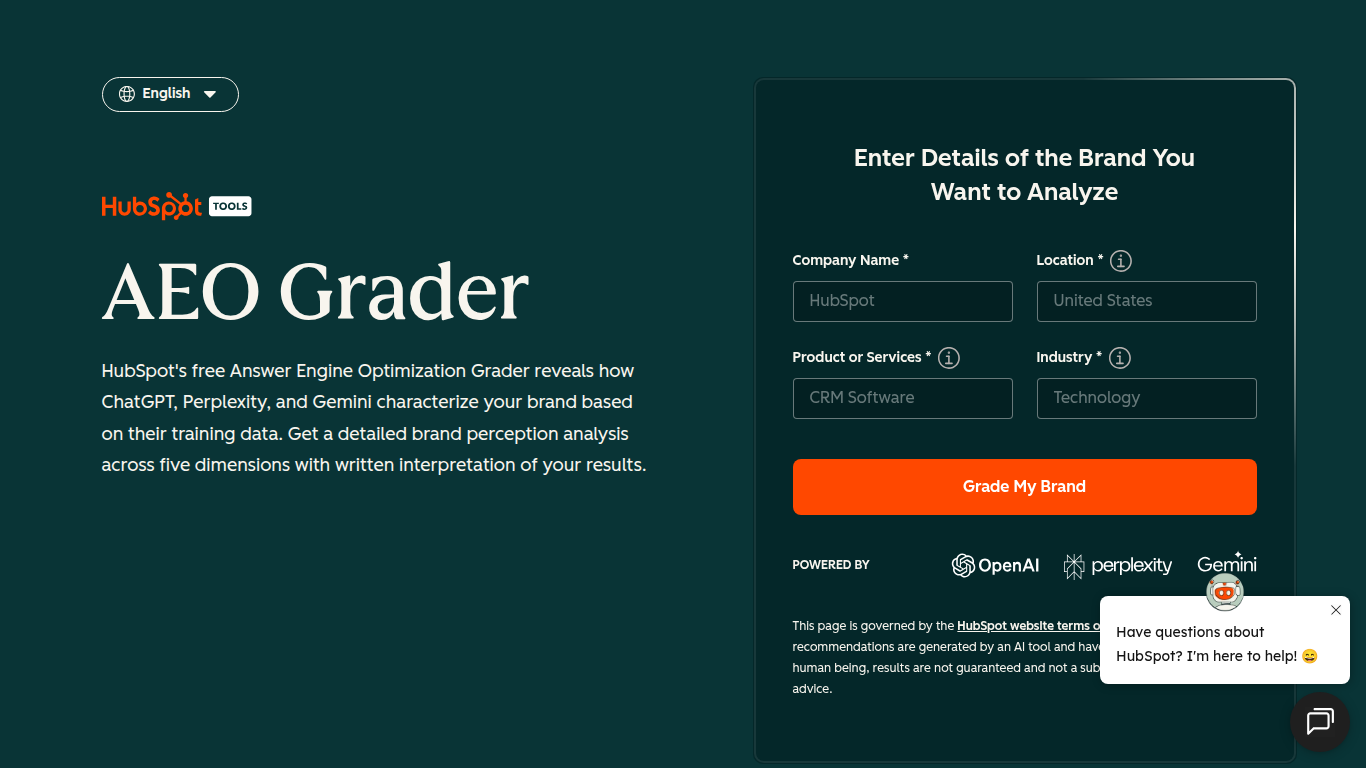
HubSpot’s free AEO Grader scores any brand across five weighted dimensions, sentiment results, presence quality, brand recognition, share of voice, and market competition, based on how ChatGPT, Perplexity, and Gemini describe it. The scan itself needs no account, and it accepts any brand name, so it doubles as a competitor probe. The paid product, HubSpot AEO, extends the grader into continuous monitoring at $50 per month and does not require a HubSpot subscription, which makes it one of the cheapest ways to keep an eye on AI answers month to month.
Key features
- Free one-time brand scoring across 5 weighted dimensions, no account required
- Composite score out of 100 with written interpretation
- Market Competition dimension classifies category role and innovation perception
- Continuous monitoring across ChatGPT, Perplexity, and Gemini (paid tier)
- Week-over-week tracking, competitor comparison, and prioritized recommendations on the paid tier
- Free “Implementing AEO” certification via HubSpot Academy
Pricing
- AEO Grader — Free. One-time diagnostic, no account required.
- HubSpot AEO — $50/mo standalone with no HubSpot subscription required, free trial available, or bundled with Marketing Hub Pro and Enterprise.
Pros
- Low monthly cost for continuous monitoring ($50/mo) with no HubSpot subscription required
- Free grader gives a real diagnostic with no account and no credit card
- Runs in under two minutes and works on any brand, including competitors
- Native integration with HubSpot CRM and Marketing Hub
Cons
- Only 3 answer engines tracked (no Claude, Copilot, Grok, or Google AI Mode)
- Best value if you already use HubSpot; less compelling standalone
- Narrower prompt customization than dedicated AEO platforms
4. Profound (best for enterprise multi-engine AEO programs)
Profound is an enterprise-leaning platform that monitors AI visibility across up to nine answer engines on its Enterprise tier, including Claude. The self-serve plans are much narrower: Starter tracks ChatGPT only, and multi-engine coverage begins at Growth. What Growth adds beyond engines is the part worth paying for, namely Agent Analytics crawler data and the Conversation Explorer prompt dataset. If you are weighing Profound against alternatives, see our deeper Profound alternatives comparison.
Key features
- Up to nine answer engines on Enterprise, including Claude
- Agent Analytics for AI-crawler visibility, with Cloudflare integration
- Conversation Explorer built on a large real-prompt dataset
- Prompt Volumes: relevant keywords on Growth, full search data on Enterprise
- Profound Agents for content and optimization work, metered in credits
- SSO/SAML and SOC 2 compliance on Enterprise
Pricing
- Starter — $99/mo. 50 prompts, ChatGPT only, 1 seat, 100 Agent credits/mo.
- Growth — $399/mo. 100 prompts across three answer engines, 3 seats, 400 Agent credits/mo, 4 opportunities per week. Self-serve “Try for free” signup.
- Enterprise — custom. Up to nine engines, multiple workspaces, dedicated Slack support, SSO/SAML and SOC 2.
- Annual billing is 2 months free on Starter and Growth.
Pros
- Widest answer-engine coverage on this list at the Enterprise tier
- Agent Analytics shows how AI crawlers interact with your site
- Conversation Explorer and Prompt Volumes add demand data most competitors lack
- Strong fit for global enterprise brands tracking multiple markets
Cons
- Starter tracks ChatGPT only; multi-engine coverage starts at $399/mo Growth
- Claude requires Enterprise, so there is no self-serve path to it
- The content layer is credit-metered, which makes output per month harder to predict
5. Airefs (best for turning AI visibility data into published content and earned mentions)
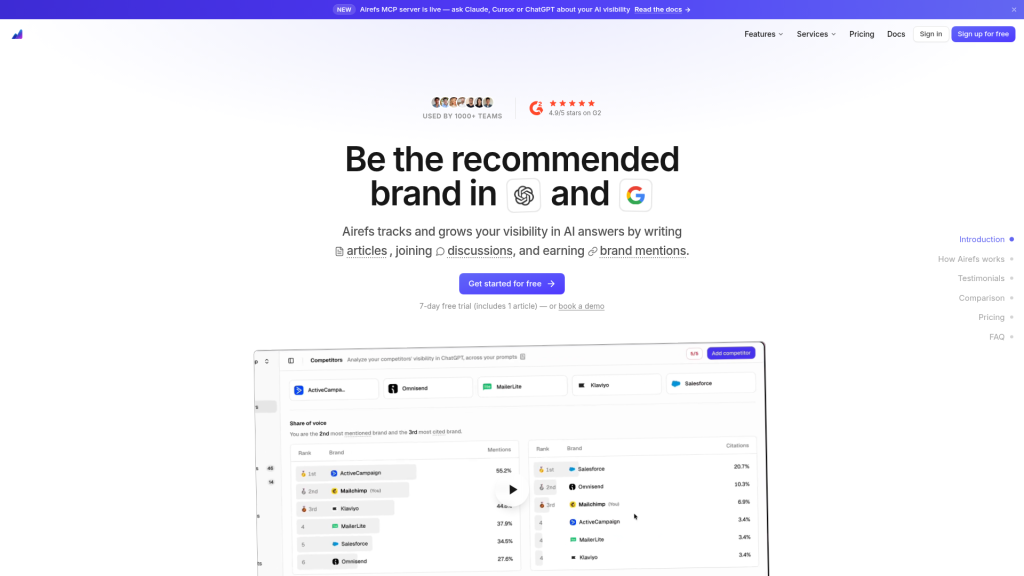
Airefs is an AEO platform built around a single argument: to be in the answer, you need to be in the sources the answer is built from. It tracks brand mentions in ChatGPT and Google AI Overview, then works backwards, showing which articles, Reddit threads, and third-party pages AI actually cited when it left you out, and producing the work needed to get you into them. The platform writes publish-ready AEO articles, drafts comments for the discussions AI cites, and prepares outreach emails for the domains that keep showing up as sources.
Key features
- Prompt tracking across ChatGPT and Google AI Overview, with daily refresh on Pro and above
- Citation-source analysis: every URL AI cited on your tracked prompts, not just whether you were mentioned
- AI crawler analytics showing which AI bots (GPTBot, ClaudeBot, PerplexityBot, Google-Extended, and others) hit your site and how often
- AI traffic analytics for real visitor clicks arriving from ChatGPT, Perplexity, Google AI Overview, and other AI surfaces
- AEO and SEO articles written and delivered on a schedule, chosen from citation-backed content gaps
- Discussions queue combining AI-cited threads with Reddit keyword alerts, each with a draft comment
- Backlink opportunities on AI-cited domains, with contact details and a drafted outreach email
- Competitor benchmarking, sentiment, and segmentation by country, language, and prompt category
- MCP server (Pro and above) for querying your visibility data from Claude, ChatGPT, or any AI assistant
- Done-for-you options: Airefs Done-For-You from $300/mo, Brand Mentions placements from $100 each
Pricing
- Lite — $29/mo ($288/year, or $24/mo billed annually). 1 domain, 1 seat, 25 prompts, 1 article/mo, 3 Reddit alerts.
- Pro — $59/mo ($588/year, or $49/mo billed annually). 3 domains, 2 seats, 60 prompts, daily refresh, 3 articles/mo, 10 Reddit alerts, MCP server.
- Expert — $99/mo ($996/year, or $83/mo billed annually). Unlimited domains, 20 seats, 150 prompts, 6 articles/mo, 30 Reddit alerts, dedicated AEO strategist.
- Google AI Overview tracking is an add-on at +$10/$20/$30 per month depending on tier. Additional articles are $7 each on Pro and Expert. Agency plans are custom-quoted, the managed service starts at $300/mo, and Brand Mentions is $250/mo flat or $100 per placement. A 7-day free trial is available.
Pros
- Ships the work, not just the report: articles, comment drafts, and outreach emails come out of the same citation data used for tracking
- Cheapest entry point of any tracking platform in this list at $29/mo, or $24/mo billed annually
- Unlimited opportunities on every plan, so discussions, backlinks, and article recommendations aren’t metered
- Combines AI-cited threads and Reddit keyword alerts in one queue rather than requiring two subscriptions
- Crawler and traffic analytics cover all major LLMs, so you see AI-driven visits even for engines not in prompt tracking
- MCP server on the $59 plan puts your visibility data inside your own AI assistant
- Clean upgrade path from self-serve to fully managed without switching vendors
Cons
- Prompt tracking covers ChatGPT and Google AI Overview only, with no Claude, Gemini, or Perplexity prompt coverage on self-serve
- Google AI Overview tracking is a paid add-on rather than included in the base price
- 25 prompts on the entry plan is tighter than some competitors at similar pricing
- Younger platform than the established SEO suites
6. Ahrefs Brand Radar (best for the largest real-search prompt database)
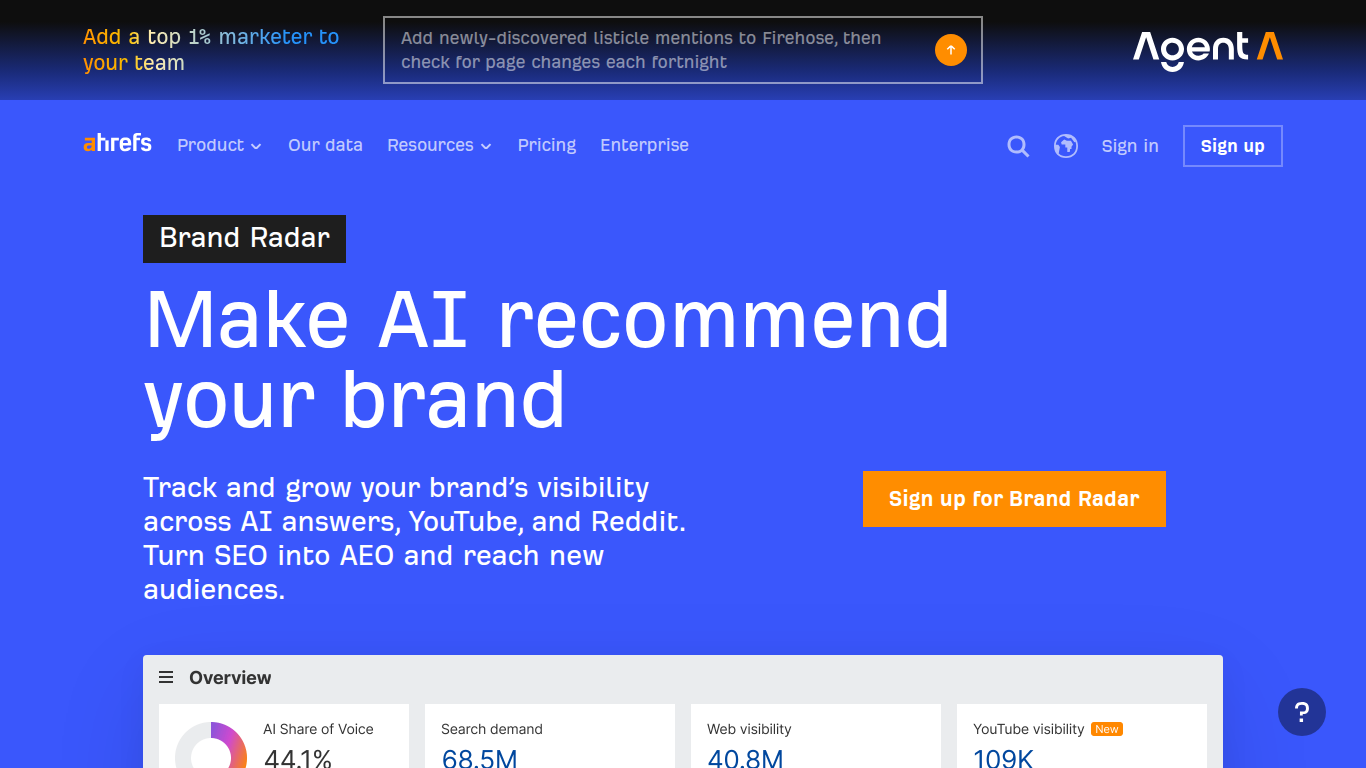
Brand Radar is an add-on to the Ahrefs SEO platform that tracks brand visibility across AI Overviews, AI Mode, ChatGPT, Perplexity, Copilot, and Gemini, with Grok on the top tier. Its differentiator is the prompt database: 470 million monthly prompts derived from real search behavior rather than synthetic prompt sets. For AEO that distinction matters, because the prompts tracked reflect what people actually ask. Ahrefs also publishes per-engine prompt volumes, and a free AI Visibility Checker handles a single lookup with no paid plan. Worth knowing before you price it: tracking your own custom prompts now comes bundled with any paid Ahrefs plan, and the $398/mo Brand Radar add-on is what buys access to the real-search prompt index on top of that.
Key features
- 470M+ monthly organic prompts indexed, the only dataset in this category derived from real search queries
- Brand mention, citation, and share-of-voice tracking with 90-day history
- Citation source analysis across the web, YouTube, TikTok, and Reddit
- Sentiment analysis across multiple brand variations
- Custom prompt tracking included in every paid Ahrefs plan, from 150 checks/mo on Lite to 2,500 on Enterprise
- Integrated with Ahrefs’ keyword, traffic, and backlink data
Pricing
- Select platforms — $398/mo. Six engines: AI Overviews, AI Mode, ChatGPT, Perplexity, Copilot, Gemini.
- All platforms — $699/mo. Adds Grok for seven total, plus 2,500 custom prompt checks per month and YouTube, TikTok, and Reddit visibility (free during beta).
- Custom prompts — included in every paid Ahrefs plan: 150 checks/mo on Lite ($129/mo), 300 on Standard ($249/mo), 600 on Advanced ($449/mo), 2,500 on Enterprise ($1,499/mo). Extra check packs run $50/mo for 2,500, $100/mo for 7,000, or $250/mo for 25,000.
- No free trial. Brand Radar sits on top of an Ahrefs subscription.
Pros
- Largest prompt database in the category, and the only one built on real search queries
- Visibility tracking on YouTube, TikTok, and Reddit, sources answer engines cite heavily
- Free AI Visibility Checker for a single lookup before paying
- Strong fit for teams already paying for Ahrefs
Cons
- $398/mo for the prompt index is the steepest add-on price on this list, on top of an existing Ahrefs subscription
- No Claude tracking on any tier
- The 470M+ prompt index is a $398/mo add-on, separate from the custom-prompt tracking bundled into the SEO plans
7. Semrush (best for brands already running SEO on Semrush)
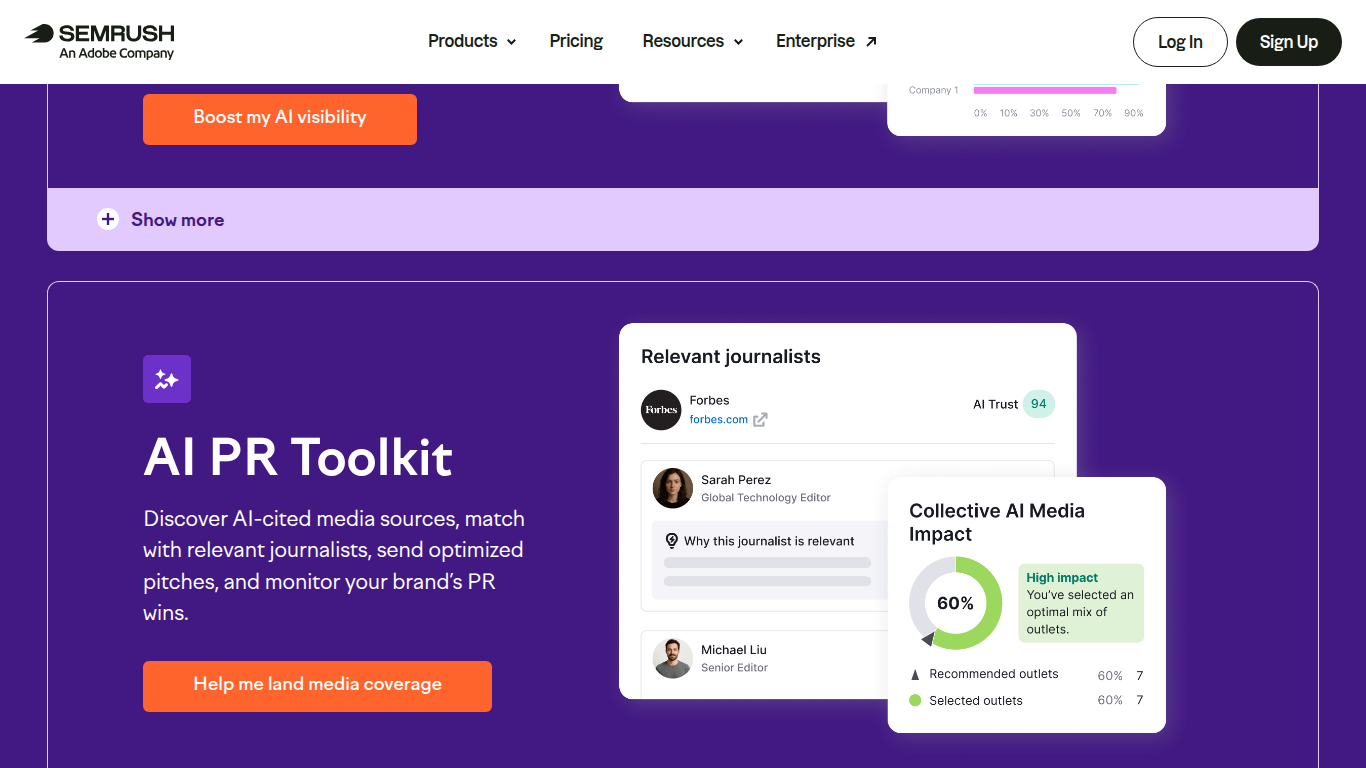
Semrush no longer sells AI visibility as a bolt-on. It now ships inside the main subscription tiers: the $139/mo SEO plan carries AI search performance, sentiment monitoring and custom prompts, and the plans branded SEO + AI Search add dedicated daily prompt quotas on top. Brand tracking covers ChatGPT, Gemini, Perplexity, SearchGPT, Google AI Mode and AI Overviews in the same dashboard used for keywords and backlinks, which is the whole argument for it: one subscription, both jobs, no second login.
Key features
- AI Visibility Score across ChatGPT, Gemini, Perplexity and Google AI, benchmarked against a competitor median and updated daily
- Daily prompt tracking on ChatGPT, Google AI Mode and Gemini, with 50 prompts on Starter, 100 on Pro+ and 200 on Advanced
- Brand sentiment and narrative tracking across 68,000+ location and language combinations, refreshed weekly
- Competitor Research for the prompts where rivals get cited and you do not
- AI Search Site Audit that checks whether major AI bot crawlers can reach your content
- AI Search Optimizer for prioritized content recommendations tied to your visibility data
- White-label reporting, scheduled email reports and shareable exports
- MCP access for piping Semrush data into AI assistants
Pricing
- SEO — $139/mo monthly ($117.33/mo billed annually). 5 sites, 500 keywords, plus AI search performance, AI sentiment and custom prompt monitoring.
- Starter (SEO + AI Search) — $199/mo monthly ($165.17/mo annually). 50 prompts tracked daily, 1 domain for AI brand performance, 300 AI visibility reports per day, AI-ready site audit, MCP access.
- Pro+ — $299/mo monthly ($248.17/mo annually). 15 sites, 1,500 keywords, 100 daily prompts, content optimization, multi-location tracking.
- Advanced — $549/mo monthly ($455.67/mo annually). 40 sites, 5,000 keywords, 200 daily prompts, SEO share of voice, API access.
- Enterprise — custom, with large-scale prompt tracking and multi-brand AI visibility.
- Annual billing saves up to 17%. Extra users are an add-on from $45/mo. 7-day free trial.
Pros
- Strong fit for teams already paying for Semrush, since AI visibility is now in the plan rather than a separate line item
- AI tracking sits next to existing keyword and backlink data
- AI Search Site Audit identifies pages that answer engines cannot crawl or easily parse
- Sentiment and narrative data at a location and language granularity nothing else on this list matches
- 7-day free trial on the self-serve plans
Cons
- No Claude anywhere in the engine list
- Prompt quotas are modest next to dedicated platforms at similar money: 50 daily prompts at $199, 100 at $299
- Extra seats cost from $45/mo each on top of the plan
- Significant overlap if you only need AEO and not full SEO
8. SE Ranking AI Search (best for combining traditional SEO and AEO in one platform)
SE Ranking is a full SEO platform with an AI Search add-on that tracks AI Overviews, AI Mode, ChatGPT, Gemini, and Perplexity. Covering both Google surfaces is the notable part: for local and service businesses, AI Overviews and AI Mode matter more than the chat interfaces, and few tools at this price track both. The combined plans pair rank tracking, keyword research, and site audits with AI visibility monitoring, so one subscription covers both jobs. Data is collected by UI-based monitoring rather than APIs, capturing responses as a real user would see them.
Key features
- Full SEO suite: rank tracking, keyword research, backlinks, site audit
- AI Results Tracker across 5 answer engines, including both Google AI surfaces
- Unlimited AI competitor research across the tracked engines
- Coverage across 7 markets, filterable across 5 languages
- GA4 and Google Search Console integration, plus Looker Studio, AgencyAnalytics, and Whatagraph reporting
- API and MCP access for pulling AI visibility data
- Free public AI visibility checker: your domain plus 5 competitors, all 5 engines, 5 checks per day
Pricing
- Core (SEO) — $129/mo monthly ($103.20/mo annual). 10 projects, 100 prompts per day for GEO research.
- Growth (SEO) — $279/mo monthly ($223.20/mo annual). 30 projects, 250 prompts per day.
- AI Search add-on — $89/mo monthly ($71.20/mo annual). 200 prompts, includes the SE Visible dashboard.
- Realistic SEO + AEO floor — $218/mo monthly ($174.40/mo annual) for Core plus the AI Search add-on.
- Agency Pack add-on — from $69/mo on annual billing, adds white-label reporting.
- 14-day free trial on Core, no credit card.
Pros
- Combined SEO and AEO in one platform reduces tool sprawl
- Both Google AI surfaces (AI Overviews and AI Mode) tracked, which matters for local and service categories
- Free public AI visibility checker before you buy
- 14-day free trial with no credit card
Cons
- The $89 add-on is not the real entry price; the practical floor is $218/mo with Core
- No Claude, Copilot, or Grok in the engine list
- Learning curve is steep if all you want is AEO
9. Scrunch AI (best for enterprise AEO with named AI-crawler analytics)
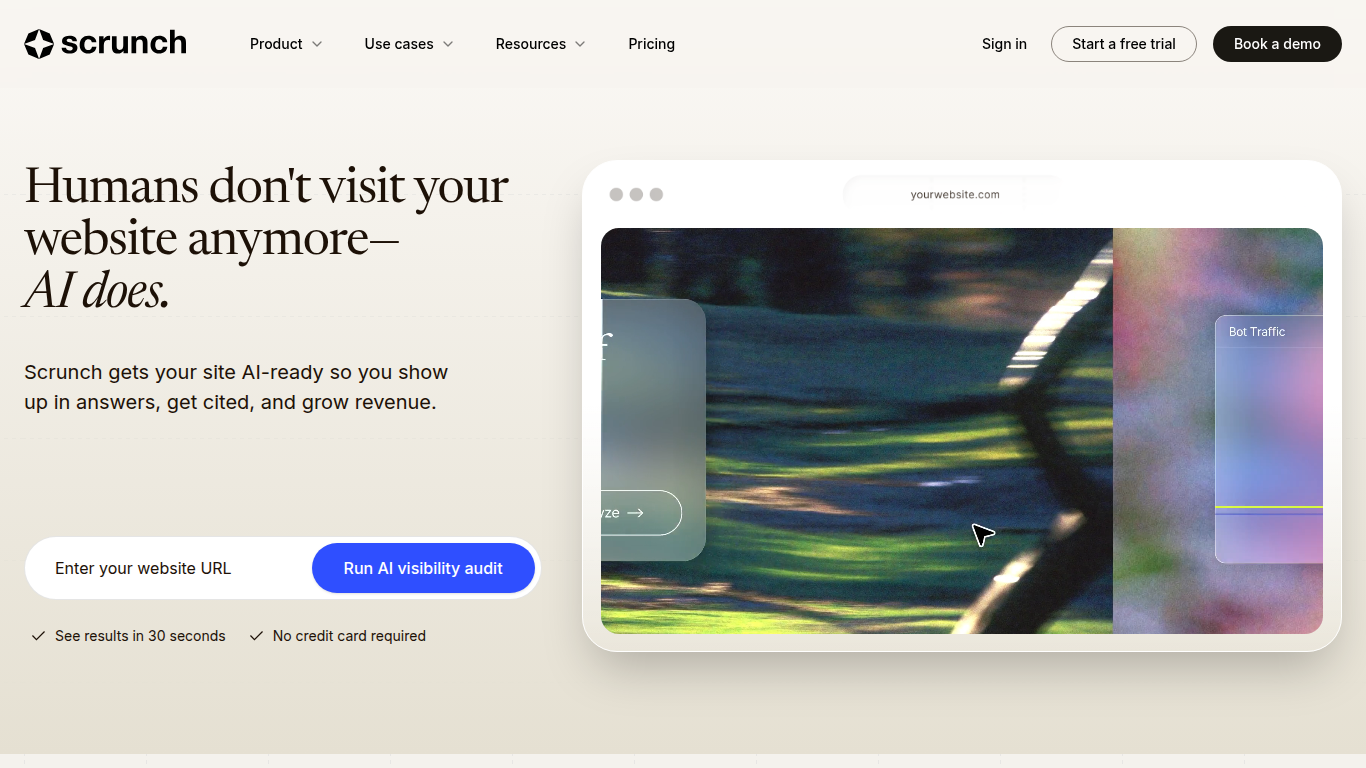
Scrunch AI sits at the enterprise end of the market, combining brand visibility tracking with AI-crawler analytics that name the bots individually: ClaudeBot, GPTBot, PerplexityBot, which pages they crawl, how often, and what they extract. That technical-SEO angle is its real differentiator. Core covers four answer engines and Enterprise expands to nine, adding Claude along with the Agent Experience Platform, API access, and SSO. There is a separate agency flow with its own tier. For a side-by-side look against other AEO platforms, see our Scrunch AI alternatives roundup.
Key features
- Named AI-crawler analytics (ClaudeBot, GPTBot, PerplexityBot) with page-level crawl detail
- Brand monitoring across 4 answer engines on Core, 9 on Enterprise
- Persona-based prompt sets and page-level audits
- Citation, mention, and sentiment tracking with share-of-voice reporting
- llms.txt and crawler segmentation guidance
- Agent Experience Platform (AXP), API, Looker Studio, MCP, and SSO on Enterprise
Pricing
- Core — $250/mo. 125 unique prompts, 4 engines, 5 site audits/mo, 1 brand workspace, 5 user licenses. 7-day free trial.
- Agency Core — $500/mo. 250 unique prompts, 4 engines, unlimited seats, 3 brand workspaces, 3 pitch workspaces. 7-day free trial.
- Enterprise — custom. 9 engines including Claude, AXP, full site audit, API and Looker Studio, SSO, dedicated account team.
Pros
- Named AI-crawler analytics that most competitors do not offer
- 5 user licenses on Core and unlimited seats on Agency Core
- Pitch workspaces on the agency tier for running a prospect’s brand before they sign
- 7-day free trial on both Core flows
Cons
- $250/mo Core is steep for smaller teams, and Agency Core doubles that
- Claude and AXP both require Enterprise
- Core covers four engines, the same count as platforms costing a fifth as much
10. Peec AI (best for multilingual tracking and agency credit pooling)
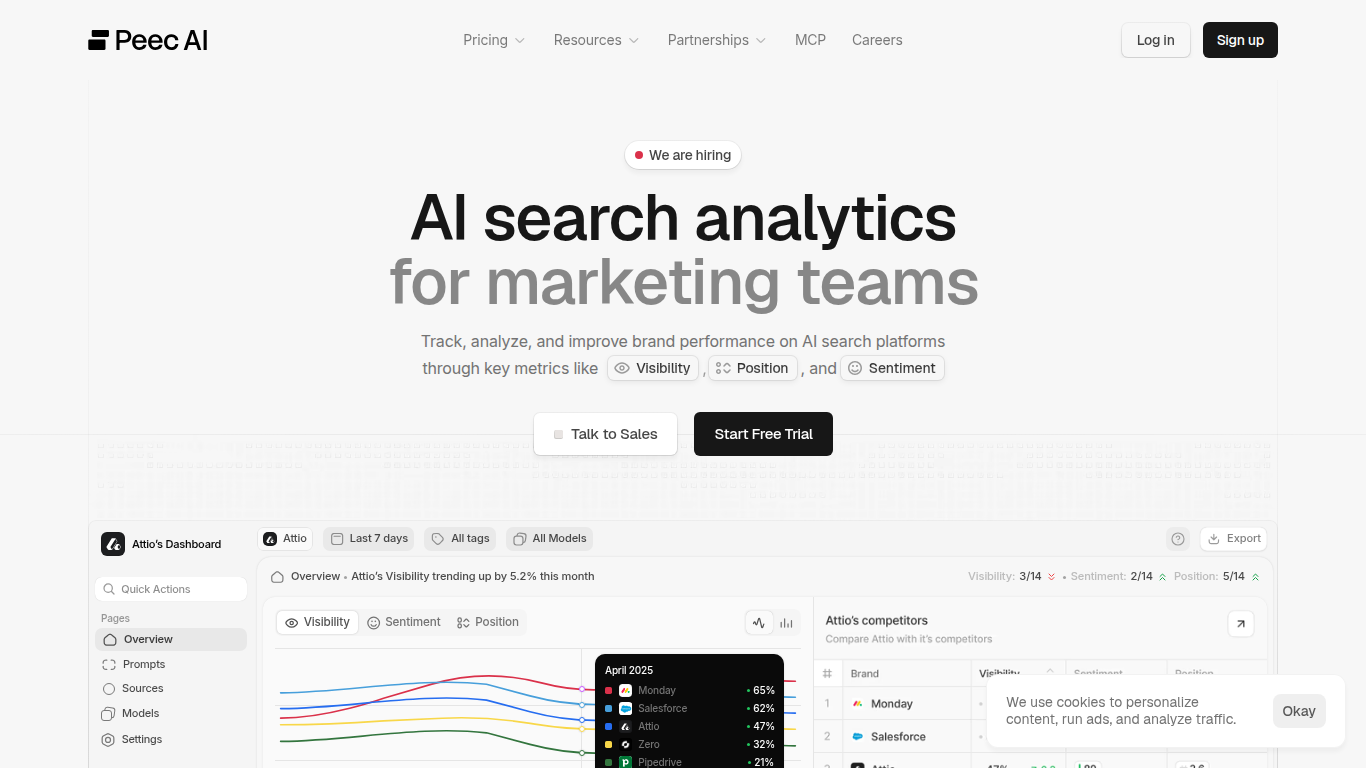
Peec AI is a Berlin-built monitoring platform that tracks visibility, position, and sentiment across ChatGPT, AI Mode, AI Overviews, Copilot, Perplexity, Gemini, and Grok. It scrapes the engines’ web interfaces rather than calling APIs, so the data reflects what a real user sees, and its multilingual and country-level breakdowns are among the strongest in the category. Two structural details matter before you buy: self-serve plans cap engine selection at three of the seven, and Claude is Enterprise-only via API. Peec is also the rare competitor with a dedicated agency price page built on a shared credit pool. If Peec is on your shortlist, also see our Peec AI alternatives breakdown.
Key features
- Seven self-serve engines, choose 3 per project on Starter, Pro, and Advanced
- Claude Sonnet 4 and GPT-5 Search on Enterprise via API
- Daily prompt updates and sentiment analysis on every tier
- Multilingual analytics across 14+ languages with country-level citation share
- Separate agency plans with a shared credit pool, white-label reporting, client seats, and pitch projects
- Looker Studio integration and API access on higher tiers
Pricing
- Starter — $95/mo (€89). 50 prompts, choose 3 of 7 engines, 1 project, 1 country.
- Pro — $245/mo. 150 prompts, 2 projects, 3 countries.
- Advanced — $495/mo. 350 prompts, 5 projects, 3 countries.
- Enterprise — custom. All engines including Claude Sonnet 4 and GPT-5 Search via API.
- Extra engine add-ons — $35/mo (Starter), $85/mo (Pro), $165/mo (Advanced) per additional engine. These draw from the same seven-engine self-serve pool, so they do not unlock Claude.
- Agency plans — Essential $245/mo, Growth $495/mo, Scale $795/mo, credit-based.
- 15% discount on annual billing. 7-day free trial, no credit card.
Pros
- Strongest multilingual and country-level breakdown in this list
- UI scraping captures what real users see rather than API output
- Unlimited user seats on every paid plan
- Agency page adds white-label reporting, client seats, and pitch projects on a shared credit pool
Cons
- Three of seven engines on every self-serve tier, so selection trade-offs persist even at $495/mo
- Extra engines cost $35 to $165/mo each and still do not unlock Claude
- Claude requires an Enterprise conversation
- Two parallel pricing structures make like-for-like comparison harder
How to choose the right AEO tool
The right tool depends on your stack, budget, and which of the four jobs from earlier matters most. Use this scenario list to narrow your shortlist:
- For tracking more than one brand: Geoptie. 10 brand workspaces with white-label reporting at $99/mo, each picking its own four engines, with recommendations and content generation in the same workspace. Start with the free GEO audit.
- For enterprise teams that want tracking and execution in one closed loop: AirOps. Page360 ties AI citations to GSC and GA4 at the URL level, and Quill runs the content work against the gaps Insights flags.
- For a free one-shot diagnostic before committing: HubSpot AEO Grader. Real score across five dimensions, no account needed.
- For enterprise multi-engine AEO programs: Profound. Up to nine answer engines on Enterprise, plus crawler analytics and prompt demand data.
- For turning tracking data into actual work: Airefs. It writes the AEO articles, drafts the Reddit and forum replies, and prepares the outreach for the domains AI already cites, from $29/mo, with a managed option from $300/mo if you would rather hand it over.
- For brands already paying for Ahrefs or Semrush: their own AI visibility features. Saves a tool even if the standalone AEO value isn’t best-in-class.
- For combined SEO and AEO in one platform: SE Ranking AI Search. One subscription, both jobs, and both Google AI surfaces covered.
- For agencies managing multiple brands: Geoptie Professional or Peec AI’s agency plans. Geoptie’s Professional plan covers 10 brand workspaces with white-label reporting at $99/mo; Peec’s agency tiers pool credits across clients from $245/mo.
- For AI crawler and bot traffic visibility on top of AEO: Scrunch AI.
Frequently asked questions
What is the difference between AEO, GEO, and SEO?
SEO optimizes for ranking on traditional search results. GEO (generative engine optimization) optimizes for being surfaced inside generative AI platforms like ChatGPT and Perplexity. AEO (answer engine optimization) is the broader umbrella: it covers everything that produces a direct answer, including AI Overviews, Featured Snippets, voice assistants, and AI chatbots. For a deeper walkthrough, see our guide on AEO vs GEO vs SEO.
Are there any real free AEO tools?
Yes. HubSpot’s AEO Grader is fully free and needs no account. Ahrefs offers a free AI Visibility Checker for single lookups, and SE Ranking publishes a free checker covering five engines with five checks per day. Geoptie offers a free GEO audit, a content checker, a keyword finder, and a backlink finder, all usable without a paid plan. For broader free options, see our roundup of free GEO tools.
What are the best AEO tools under $100/month in 2026?
The sub-$100 tier includes Airefs Lite ($29/mo, ChatGPT with Google AI Overview as a paid add-on), Geoptie Starter ($49/mo, any four of seven engines), HubSpot AEO ($50/mo, three engines), the SE Ranking AI Search add-on ($89/mo, five engines, though $218/mo with the required Core plan), Peec AI Starter ($95/mo, three of seven engines), and Profound Starter ($99/mo, ChatGPT only). Airefs is the cheapest way in, and it bundles a set number of written articles per month into the plan. Geoptie gives you the most engine choice per dollar.
HubSpot AEO vs Ahrefs Brand Radar vs Semrush AI Toolkit vs Profound — which one?
These four are the most-compared AEO tools in 2026 search data. HubSpot AEO is the cheapest at $50/mo but tracks only three engines. Ahrefs Brand Radar has the largest prompt database but starts at $398/mo and has no Claude. Semrush suits teams already on Semrush, with AI visibility included in plans from $139/mo. Profound has the widest engine coverage on Enterprise but its $99 Starter is ChatGPT-only, with multi-engine tracking starting at $399/mo. If you want engine choice without paying enterprise rates, Geoptie covers any four of seven engines from $49/mo.
Do I need an AEO tool if I already use Ahrefs or Semrush?
If you only need AEO tracking inside the platform you already pay for, the Ahrefs and Semrush AEO add-ons are reasonable. If you need engine choice at a lower entry price, a dedicated AEO platform like Geoptie covers any four of seven engines from $49/mo, versus $139/mo for the cheapest Semrush plan with AI search included or $398/mo for Ahrefs Brand Radar’s six-engine prompt index.
What are the best practices for AEO in 2026?
The fundamentals: write answer-shaped content with clear headings and direct first-paragraph answers, structure pages so a single fact can be extracted without surrounding context, use schema markup that signals entities and relationships, and earn citations on sources that AI engines treat as authoritative (Reddit, YouTube, established publications). Our generative engine optimization guide covers the practices that move the needle.
How is AEO tracking different from regular SEO rank tracking?
Traditional rank trackers monitor keyword positions on Google. AEO tracking monitors whether your brand or pages appear inside AI-generated answers across multiple platforms: ChatGPT, Claude, Perplexity, Gemini, AI Overviews. The queries tracked are conversational prompts, not short keywords, and the metrics include mention rate, citation count, and sentiment in addition to position.
What to do next
Mapping how your brand shows up across answer engines is the first step in any AEO program. The fastest way to see where you stand is to run a free GEO audit: it scans your site, scores your AI readiness, and shows you which prompts you appear for in about 60 seconds.
From there, the right tool depends on which of the four jobs you need most: tracking, content optimization, grading, or full-suite integration. Use the table above and the decision list to narrow down to a shortlist, then trial one or two before committing.
For deeper reading, our guides on AEO vs GEO vs SEO and generative engine optimization cover the underlying disciplines, and our sister roundup of the best LLM tracking tools focuses specifically on the brand-visibility tracking job if that’s the only AEO problem you need to solve.