


Keyword-led AI tracking gives an SEO team a broad picture fast, and then a narrower question takes over: which exact questions mention you, and what should change this week. LLMrefs is the clearest example of the keyword-led model. It turns an SEO keyword list into prompts, tracks them across nine AI engines on one plan, and lets an agency put every client under one subscription with unlimited projects and seats. No tool on this list matches its 500 prompts for $79 a month. What teams run into is the rest of the routine: data refreshes weekly, the prompts are generated from keywords and reported per keyword, the plan stops at the dashboard, and the single plan is labelled "Limited time only".
The nine LLMrefs alternatives below were picked for those four gaps: daily data, prompts you write, a way to act on what the data shows, or a bigger suite. Prices were checked on each vendor's site in November 2026.
Key takeaways
- Best overall swap: Geoptie tracks your own prompts daily on seven engines, Claude included, and adds unlimited audits, recommendations and content drafts, from $49 a month.
- Cheapest daily tracker: Otterly AI at $29 a month for 15 prompts on four engines.
- Enterprise depth: Profound and Scrunch, both priced for larger contracts.
- Inside an SEO suite: SE Ranking and Semrush put AI tracking next to rank tracking and keyword data.
- The honest trade: no alternative gives 500 prompts for $79. Leaving LLMrefs buys daily data, control over prompts or a layer that acts on findings, and costs prompt volume.
What LLMrefs costs in 2026, and why teams look elsewhere
LLMrefs sells one plan, All in One, at $79 a month for US buyers and 79€ in Europe. It includes 500 prompts, about 50 keywords, across ChatGPT, Google AI Overviews, Google AI Mode, Gemini, Perplexity, Claude, Grok, Microsoft Copilot and Meta AI, with no per-engine fees. Seats and projects are unlimited, geo-targeting covers more than 50 countries, and CSV export and an API are included. A 7-day trial and a free account let teams look before paying. Few tools cover this many engines and prompts for the price.
Four things push teams to look further.
Weekly data. Every keyword updates at least once a week. That suits trend reporting and slows down anyone checking whether last Tuesday's page update changed what ChatGPT says.
Prompts generated from keywords. LLMrefs creates the prompts from each keyword and rolls the results up per keyword. It saves setup time, and it means less control over the exact questions tracked and less detail on any single one.
It stops at the dashboard. The plan reports share of voice, position and citations. It does not include recommendations or content work, so deciding what to change happens somewhere else. Free side tools, such as a crawlability checker and an llms.txt generator, cover part of the technical side.
One plan with an expiry label. The $79 price carries a "Limited time only" note, and more keywords come through an upgrade with no published price.
LLMrefs alternatives compared
Every tool below tracks prompts you write and reports each one on its own, except Profound's trial, which runs a recommended prompt set.
| Tool | Best for | Refresh | Acts on findings | Starting price (monthly) | Prompts at that price | Claude at that price |
|---|---|---|---|---|---|---|
| LLMrefs (for reference) | SEO teams and agencies that plan in keywords and want the widest weekly view | Weekly | Reporting only; free side tools | $79 | 500 | Yes |
| Geoptie | Teams that want daily data on their own prompts and the content work to act on it | Daily | Unlimited audits, recommendations and content drafts | $49 | 15, 2 brands | Yes |
| Otterly AI | Small teams that want daily tracking at the lowest price | Daily | Prioritized fixes, GEO audits, content briefs | $29 | 15 | $29 add-on |
| Peec AI | Teams that want a dedicated daily tracker with unlimited users | Daily | Recommended actions and an agent that drafts content | $95 | 50 | No (Enterprise) |
| Scrunch | Enterprise and technical teams focused on how AI agents read their site | Set by a monthly response quota | Site audits and basic content generation; Agent Experience Platform on Enterprise | $250 | 125 | No (Enterprise) |
| Profound | Enterprises that want the deepest analysis on one contract | Daily | Credit-based AI agents for content | Free 7-day trial, then custom | 50 a day on the trial | On Enterprise |
| AthenaHQ | Teams that want many engines on one plan and budget in credits | Credit-based | Action Center and a content workspace | Free; $295 for Starter | 300 credits free; 3,600 on Starter | On Starter |
| Rankscale | Teams that like LLMrefs' engine breadth and want to set their own cadence | Hourly to monthly, paid in credits | Page audits and Scout recommendations | $99 | 1,200 credits | Yes, at 2 credits an answer |
| SE Ranking (SE Visible) | SEO teams that want AI tracking inside an SEO suite | Daily | AI Writer and briefs on the SEO plans | $89 | 75 | No |
| Semrush AI Visibility Toolkit | Teams that already report in Semrush | Daily | AI checks in Site Audit; Content Toolkit extra | $99 per domain | 25 | No (Enterprise AIO) |
Monthly prices for each vendor's entry plan, as listed in November 2026.
How these alternatives were picked
The list follows the tools named most often across 23 LLMrefs alternatives pages, plus Geoptie, which publishes this guide and comes first. Prices, prompt limits and engines come from each vendor's own pages. The order runs from the closest swap to the suites.
1. Geoptie (best for daily data on your own prompts, with the content work to act on it)
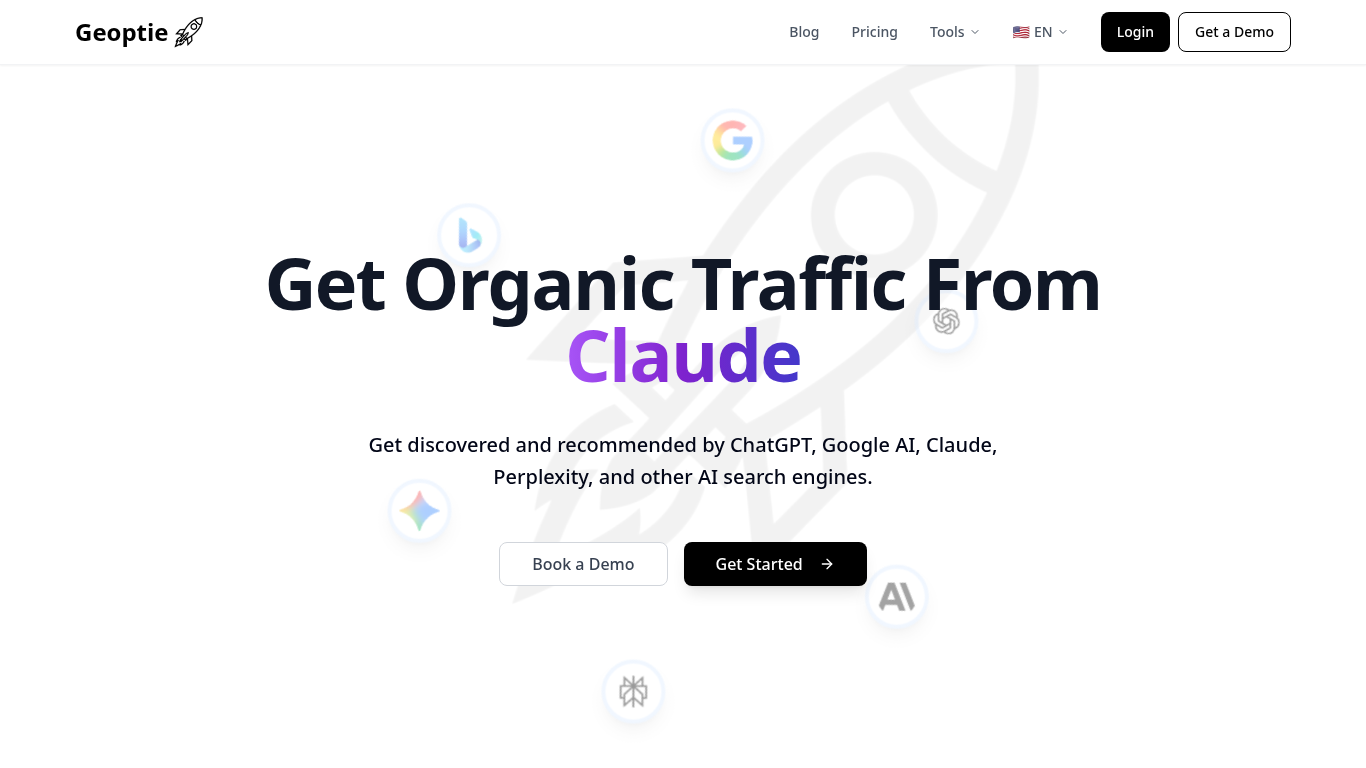
At a glance: from $49 a month, seven engines with Claude included, daily refresh, no free plan or trial.
Pick this over LLMrefs if you want to know which exact questions name you each day, and what to publish next.
Geoptie tracks the prompts you write, every day, on ChatGPT, Claude, Perplexity, Gemini, Google AI Overviews, Google AI Mode and Microsoft Copilot. Each answer gets its own row: whether the brand was mentioned, its sentiment, the competitors named and the pages cited, in the order the engine cited them. That is the per-question detail a keyword rollup averages away. From the same dashboard, a team runs audits, gets prompt-level recommendations and generates or optimizes briefs and drafts, all unlimited on every plan. AI Traffic connects GA4 and shows visits from AI assistants next to the visibility data. The trade against LLMrefs is volume: Starter tracks 15 prompts and Professional 100, where LLMrefs tracks 500 for $79, and Geoptie does not cover Grok, Meta AI or DeepSeek.
Key features
- Daily mentions, citations, sentiment and competitor share of voice for every prompt
- Cited pages and domains, in the order each engine cited them
- Unlimited audits, recommendations, content briefs and drafts on every plan
- White-label PDF reports, a REST API and an MCP server from Professional
- Tracking in 123 countries, unlimited seats
Pricing
- Starter: $49/mo ($41/mo annually): 15 prompts, 2 brands
- Professional: $99/mo ($83/mo annually): 100 prompts, 10 brands, white-label reports, API and MCP
- Business: $249/mo ($208/mo annually): 300 prompts, unlimited brands
- No free plan or trial; the free AI rank tracker shows how engines answer before you subscribe. Details on Geoptie's plans.
Pros
- Daily data on the exact questions you choose
- Content work with no monthly quota
- Claude on every plan with no add-on
Cons
- Far fewer prompts per dollar than LLMrefs
- No Grok, Meta AI or DeepSeek
- No free trial
Verdict: the closest replacement for teams that liked LLMrefs' all-in-one plan but need daily, per-question data and a way to act on it.
2. Otterly AI (best for small teams that want daily tracking at the lowest price)
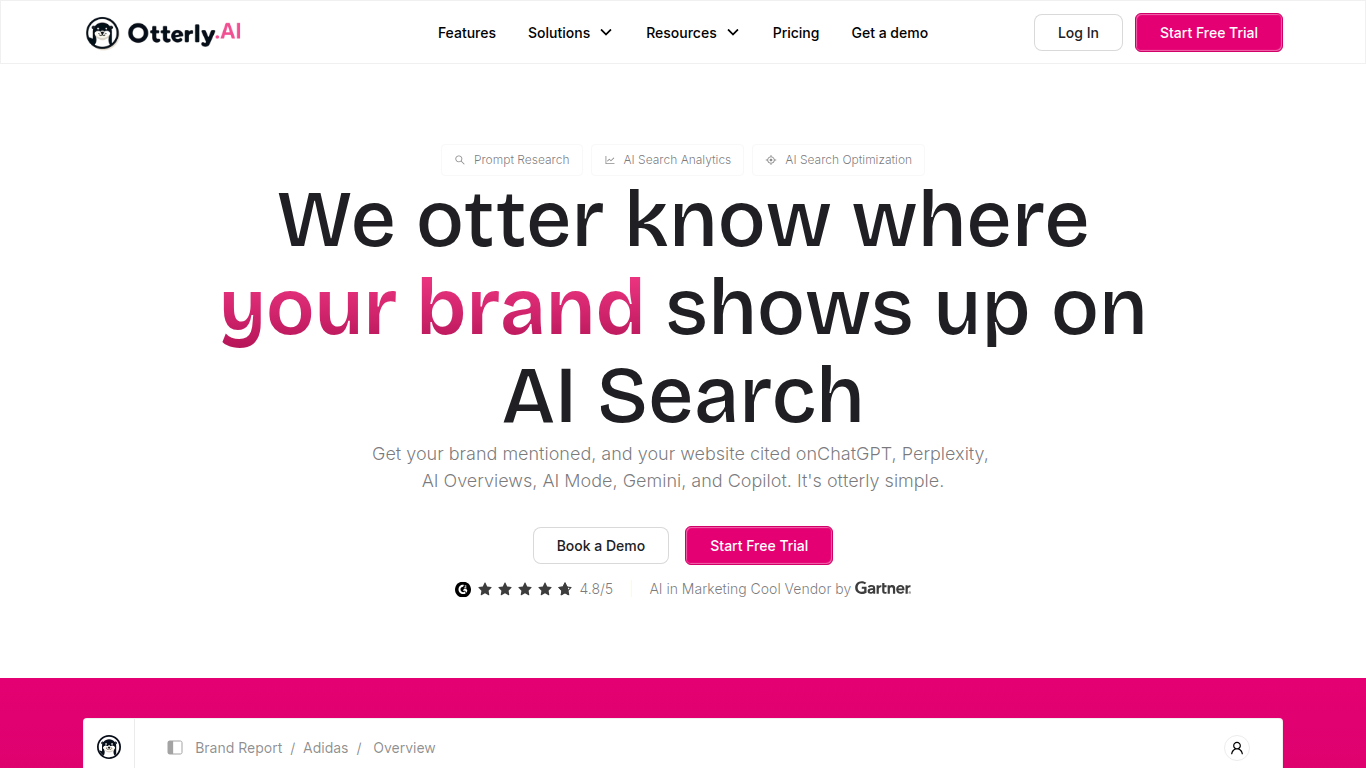
At a glance: from $29 a month, four engines included, Claude, Gemini and AI Mode as add-ons, free trial.
Pick this over LLMrefs if weekly data is the problem and the budget is small.
Otterly AI is the cheapest way to move from weekly to daily data. Every plan tracks ChatGPT, Google AI Overviews, Perplexity and Microsoft Copilot each day, and every cited URL is stored per prompt and engine, with link positions followed over time. Claude costs $29 a month on Lite, and Gemini and Google AI Mode $9 each, so matching LLMrefs' core engines takes a few add-ons. Volume is the limit. Lite stops at 15 prompts and one workspace, and a 100-prompt program starts on Standard at $189. Its paid plans give prioritized fixes, GEO audits and content briefs but do not draft articles; a free standalone GEO Content Creator writes drafts. Its own competitors are compared in the Otterly AI alternatives guide.
Key features
- Every cited URL per prompt and engine, with link positions over time
- GEO audits and prioritized fixes on every plan
- Brand sentiment, share of voice and a brand visibility index
- Unlimited countries, languages and team members
Pricing
- Lite: $29/mo ($25/mo annually): 15 prompts, 1 workspace
- Standard: $189/mo ($160/mo annually): 100 prompts, unlimited workspaces, API and MCP
- Premium: $489/mo ($422/mo annually): 400 prompts
- Add-ons: Claude $29, $109 or $439; Gemini and Google AI Mode $9, $59 or $149 each. Free trial available.
Pros
- The lowest paid entry on this list
- Daily tracking from the first plan
- Detailed citation and link-position data
Cons
- Lite stops at 15 prompts and one workspace
- Claude, Gemini and AI Mode cost extra
- Paid plans do not draft articles
Verdict: the budget route to daily data, for one brand with a short prompt list.
3. Peec AI (best for teams that want a dedicated daily tracker with unlimited users)
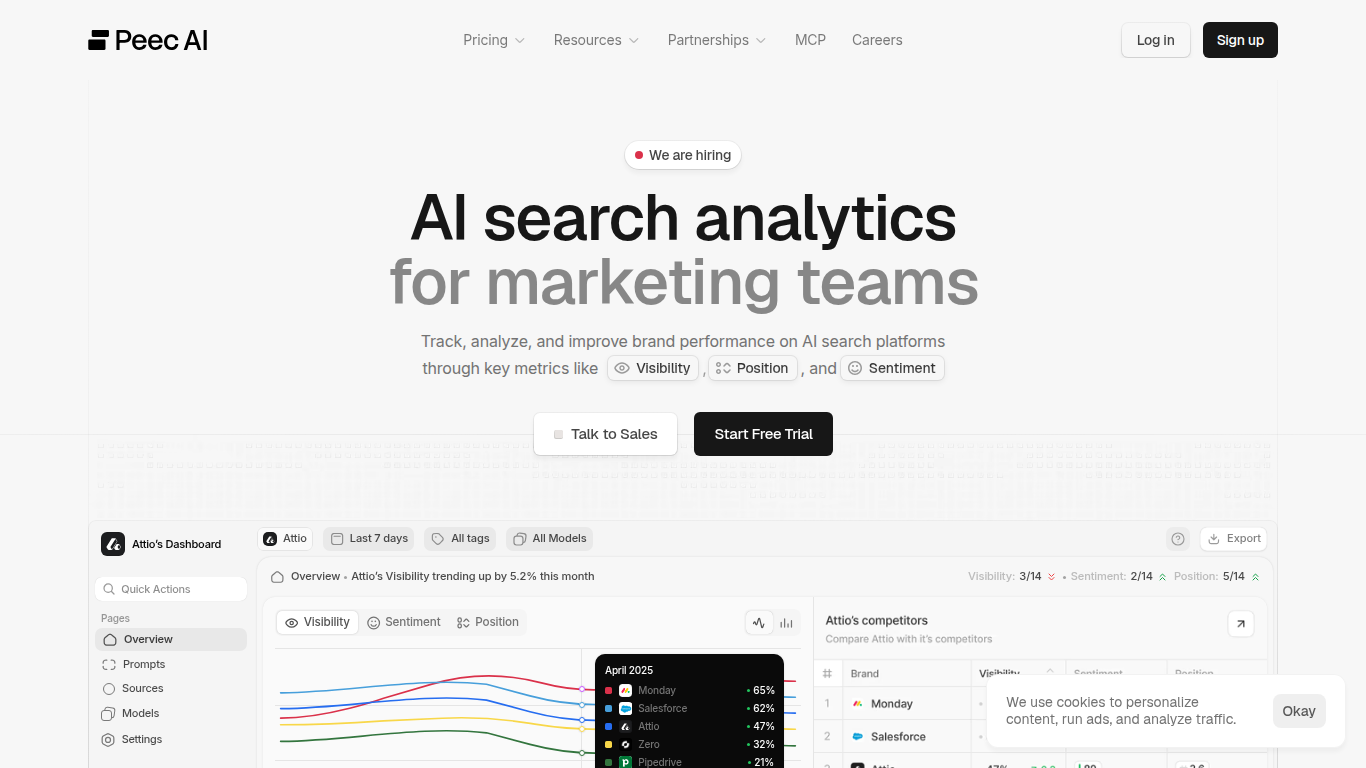
At a glance: from $95 a month, three models per plan, daily tracking, Claude on Enterprise only, free trial.
Pick this over LLMrefs if you want polished source analysis on prompts you control.
Peec AI appears on 13 of the 23 LLMrefs alternatives pages reviewed for this guide, and it suits teams that want a tracker done thoroughly. Each plan tracks three models daily, chosen from ChatGPT, Perplexity, Google AI Overviews, Google AI Mode, Gemini and regional engines such as Naver; another model costs $35 a month on Starter. Its strength is sources: cited URLs, citation share and the sources that name competitors but not you. Peec Agent, included on every plan with 500 agent credits on Starter, turns that data into recommended actions and content drafts. Users are unlimited, as on LLMrefs. The narrower engine set is the cost: Claude is Enterprise-only, and Starter's 50 prompts are a tenth of LLMrefs' allowance. More options are in the Peec AI alternatives guide.
Key features
- Gap analysis of sources that cite competitors but not your brand
- Sentiment and brand-perception reporting
- Peec Agent for recommended actions and content drafts
- MCP on every plan; API from Pro
Pricing
- Starter: $95/mo: 50 prompts, 1 project, 3 models
- Pro: $245/mo: 150 prompts, 2 projects
- Advanced: $495/mo: 350 prompts, 5 projects
- Enterprise: custom, with Claude and more models
- Annual billing saves 15%. Free trial available.
Pros
- Unlimited users on every plan
- Strong source and citation analysis
- An agent that drafts content from the data
Cons
- Claude only on Enterprise
- Three models per plan unless you pay for more
- One project on Starter, against unlimited on LLMrefs
Verdict: a polished daily tracker for teams that can live without Claude; not a cheaper route to LLMrefs' breadth.
4. Scrunch (best for enterprise and technical teams focused on how AI agents read their site)
At a glance: Core from $250 a month on four engines, Claude on Enterprise, seven-day free trial.
Pick this over LLMrefs if the question is how AI crawlers and agents read your site, not only what the answers say.
Scrunch's Core plan costs $250 a month for 125 prompts, 5,000 responses, five site audits, one brand and five users, on ChatGPT, Perplexity, Google AI Overviews and Microsoft Copilot. The response quota sets the real rhythm: 125 prompts on all four engines use 500 responses a run, so Core covers about 10 full runs a month. Citation reporting is detailed, with citation share by owner and an influence score for each source, and AI bot traffic reporting comes with Core. Its Agent Experience Platform, which serves AI agents a version of the site built for them, is Enterprise-only, as are Claude, Gemini and Google AI Mode. For a keyword-led SEO team used to LLMrefs, Scrunch is a step up in price and technical depth. The Scrunch alternatives guide covers its competitors.
Key features
- Citation share by owner and an influence score for each source
- AI bot traffic reporting from Core
- Persona-based prompt sets, site audits and basic content generation
- Agent Experience Platform on Enterprise
Pricing
- Core: $250/mo: 125 prompts, 5,000 responses, 1 brand, 5 users
- Agency Core: $500/mo: 250 prompts, 10,000 responses, 3 brands
- Enterprise: custom: 9 engines, API, SSO
- Seven-day free trial on Core and Agency Core.
Pros
- Strong technical layer on AI crawlers and agents
- Detailed source influence reporting
- Agency plan with three brands
Cons
- Claude, Gemini and AI Mode only on Enterprise
- A response quota rather than a fixed daily refresh on Core
- Five users on Core, against unlimited on LLMrefs
Verdict: a specialist for teams whose priority is how AI agents read and use their site.
5. Profound (best for enterprises that want the deepest analysis on one contract)
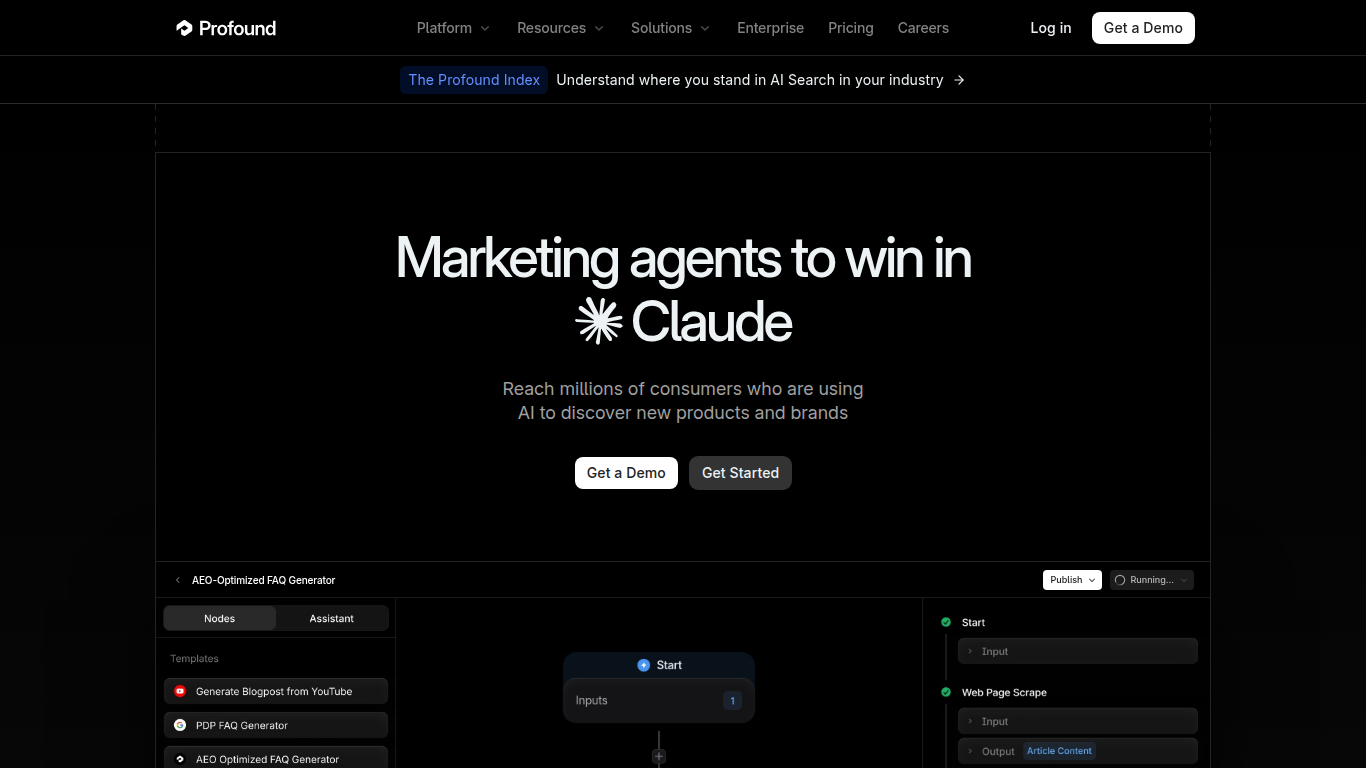
At a glance: free seven-day trial, then custom Enterprise pricing for brands, Claude included on Enterprise.
Pick this over LLMrefs if the budget is enterprise-sized and you want analysis, agents and controls on one contract.
Profound sits at the opposite end of the market from LLMrefs. Brands get a free seven-day trial with 50 recommended prompts a day on ChatGPT, Gemini and Google AI Overviews, and everything after it is a sales-priced Enterprise plan: up to ten answer engines including Claude, Perplexity and Google AI Mode, all-time history, exports, an API, SSO and unlimited seats. Prompt Volumes estimates what people ask AI assistants, and credit-based agents turn findings into research and content. Agencies can buy Agency Growth at $99 a month plus $399 per client workspace. Where LLMrefs publishes one price, Profound publishes none for brands, so the comparison is about depth, not cost. More options are in the Profound alternatives guide.
Key features
- Prompt Volumes data on what people ask AI assistants
- Agent Analytics for AI crawler traffic
- Source categories for every cited URL
- Credit-based AI agents for research and content
- SSO/SAML and SOC 2 on Enterprise
Pricing
- Trial: free for 7 days: 50 prompts a day on three engines
- Enterprise: custom: up to ten engines including Claude
- Agency Growth: $99/mo plus $399/mo per client workspace
Pros
- One of the deepest enterprise feature sets in the category
- Claude and Perplexity on one contract
- Agents that act on the data
Cons
- No published price for brands
- No Microsoft Copilot
- No history or exports on the trial
Verdict: worth the sales process for large brands; far more contract than a team leaving a $79 plan needs.
6. AthenaHQ (best for teams that want many engines on one plan and budget in credits)
At a glance: free tier on five engines, Starter at $295 a month with 11 models including Claude, billed in credits.
Pick this over LLMrefs if you want LLMrefs-style engine breadth with content work built in.
AthenaHQ goes past LLMrefs on engine count on its paid plan, 11 against nine, with a different meter. The free Essential tier gives 300 credits a month on ChatGPT, Perplexity, Google AI Overviews, Gemini and Copilot. Starter, at $295, adds Google AI Mode, Claude, Grok, DeepSeek, Meta AI and Mistral, with 3,600 credits a month. One answer costs one credit on most engines and five on the heavier ones, Claude included, so a broad engine set on a long prompt list uses credits quickly. Where LLMrefs stops at reporting, AthenaHQ's Action Center surfaces what to fix and its content workspace drafts and optimizes pages. The AthenaHQ alternatives guide lists more options.
Key features
- 11 models on Starter, more on request
- Action Center and a content workspace for writing and optimizing pages
- Prompt volume estimates
- Unlimited seats with role-based access
Pricing
- Essential: free: 300 credits a month, 5 engines
- Starter: $295/mo ($245/mo annually): 3,600 credits, 11 models
- Enterprise: custom: multi-region, SSO, API included
- API is a paid add-on on Starter.
Pros
- A free tier with five engines
- Claude, Grok and DeepSeek on one self-serve plan
- Content drafts in the same tool
Cons
- Credits are harder to budget than a prompt count
- Long prompt lists outgrow Starter
- Almost four times LLMrefs' price for the paid entry plan
Verdict: the pick when engine breadth and content work matter more than prompt volume.
7. Rankscale (best for teams that like LLMrefs' engine breadth and want to set their own cadence)
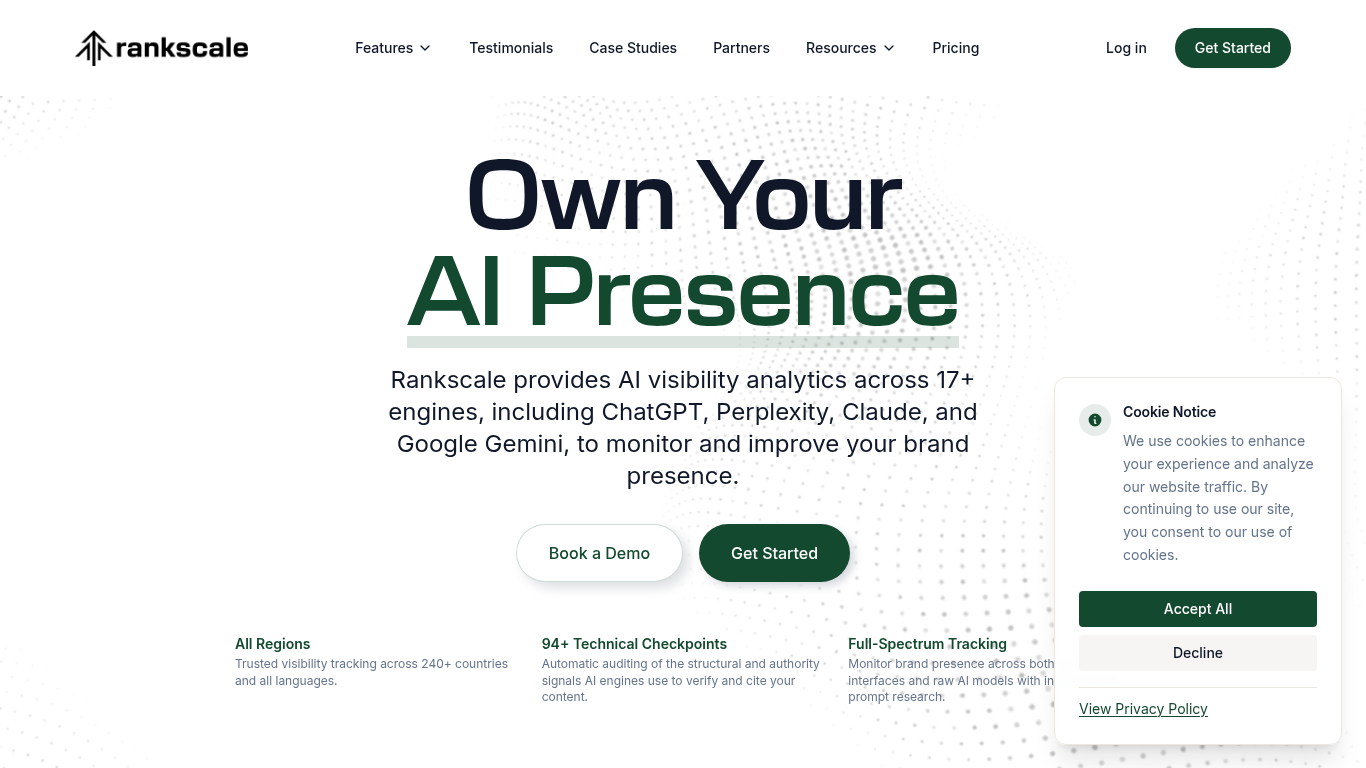
At a glance: from $99 a month, 17+ engines on every plan, scheduling from hourly to monthly, billed in credits.
Pick this over LLMrefs if you want to choose how often tracking runs instead of accepting a weekly cycle.
Rankscale answers LLMrefs' weekly cadence with a dial. Every plan can track 17+ engines, and tracking can be scheduled anywhere from hourly to monthly, paid from a credit pool. ChatGPT, Perplexity, Gemini and Google AI Mode cost a quarter of a credit per answer, DeepSeek one and Claude two. Pro, at $99, gives 1,200 credits a month with 10 brand dashboards and unlimited seats, and unused credits roll over. A team that needs daily data can have it, where LLMrefs runs one weekly cycle for everyone. Page audits and Rankscale Scout recommendations add a light action layer. More options are in the Rankscale alternatives guide.
Key features
- 17+ AI engines on every plan
- Scheduling from hourly to monthly
- Page audits, citation analysis and Scout recommendations
- MCP on every plan; REST API from Pro+
Pricing
- Pro: $99/mo ($84/mo annually): 1,200 credits, 10 brand dashboards
- Pro+: $229/mo ($195/mo annually): 3,000 credits, 25 brand dashboards
- Growth: $385/mo ($327/mo annually): 5,500 credits, 50 brand dashboards, white-labeled links
- "Try Pro for Free" on the pricing page.
Pros
- The widest engine list on this page
- Cadence from hourly to monthly
- 10 brand dashboards on the $99 plan
Cons
- Credit costs differ by engine, so bills are harder to predict
- Claude costs eight times ChatGPT per answer
- REST API starts at $229
Verdict: the most flexible option for teams that want LLMrefs' breadth with control over timing.
8. SE Ranking (best for SEO teams that want AI tracking inside an SEO suite)
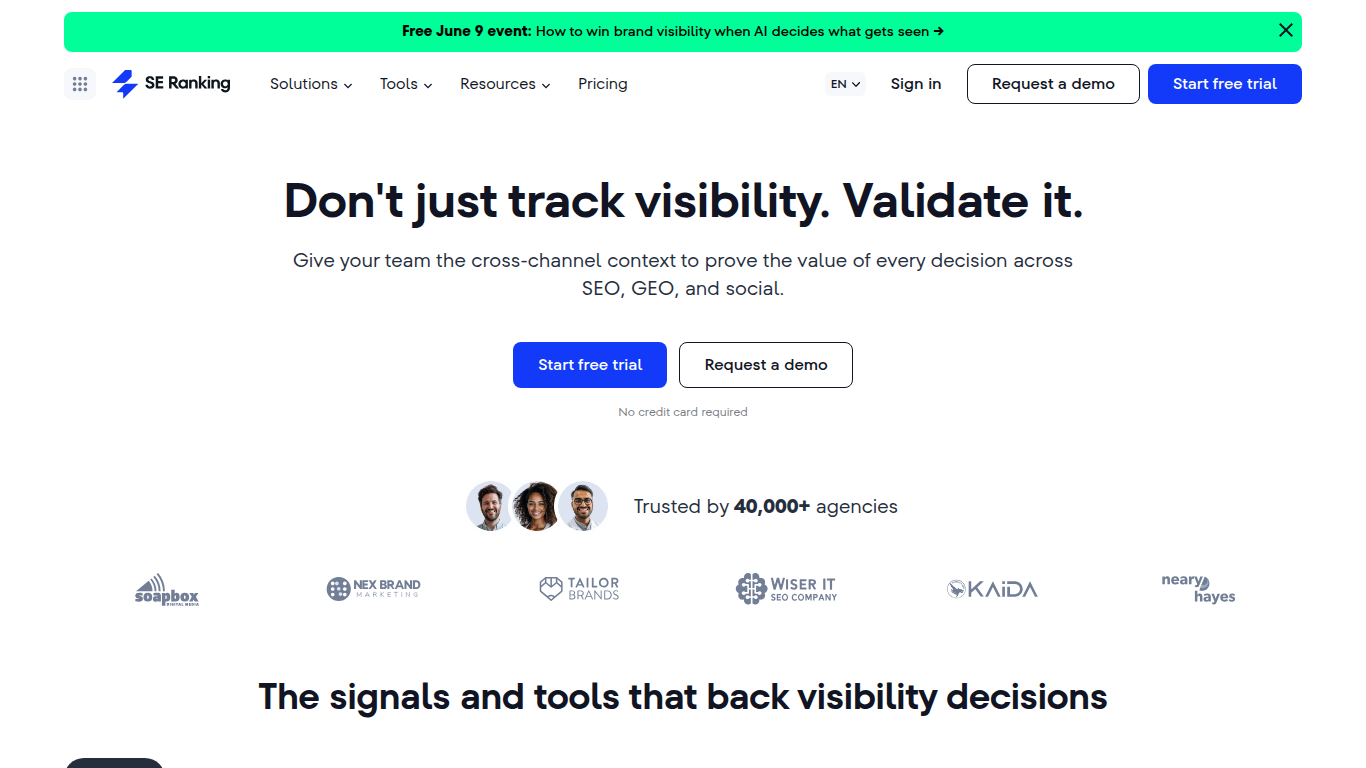
At a glance: SE Visible from $89 a month, five engines, daily refresh, no Perplexity or Claude, 10-day free trial.
Pick this over LLMrefs if you would rather keep keywords, rankings and AI visibility with one vendor.
LLMrefs is built for SEOs, and SE Ranking is where many of them already work. Every SEO plan from $129 includes 25 daily AI prompts, and SE Visible, its AI visibility product, adds more: 75 prompts and five projects for $89, 200 prompts and 10 projects for $189. Each prompt runs daily on ChatGPT, Google AI Overviews, Google AI Mode, Gemini and Microsoft Copilot. The SEO plans also include an AI Writer and SERP-based briefs, with 25 articles a month on Core, so finding a gap and writing the page happen in one account. Perplexity and Claude are not tracked, both of which LLMrefs includes. Users are unlimited, and clients can log in to see only their brand.
Key features
- Mentions, citations, sentiment and competitor visibility for each prompt
- Client access and weekly email reports
- Data Studio connector, API and MCP
- Keyword research, rank tracking and content tools in the same suite
Pricing
- SE Visible Basic: $89/mo ($71/mo annually): 75 prompts, 5 projects
- SE Visible Core: $189/mo ($151/mo annually): 200 prompts, 10 projects
- SE Visible Agency: $399/mo ($319/mo annually): 1,000 prompts, 30 projects
- SEO plans: from $129/mo, with 25 daily AI prompts
- 10-day free trial on SE Visible.
Pros
- Daily data on five engines for $89
- SEO, AI tracking and content in one vendor
- Unlimited users and client logins
Cons
- No Perplexity or Claude
- SEO and AI visibility are separate products
- One location per project on Basic
Verdict: the value pick for SEO teams that want daily AI data next to their rankings and can drop Perplexity and Claude.
9. Semrush AI Visibility Toolkit (best for teams that already report in Semrush)
At a glance: from $99 a month per domain, four engines in daily tracking, Claude only on Enterprise AIO, no trial on the standalone toolkit.
Pick this over LLMrefs if your reporting already lives in Semrush and one domain is enough.
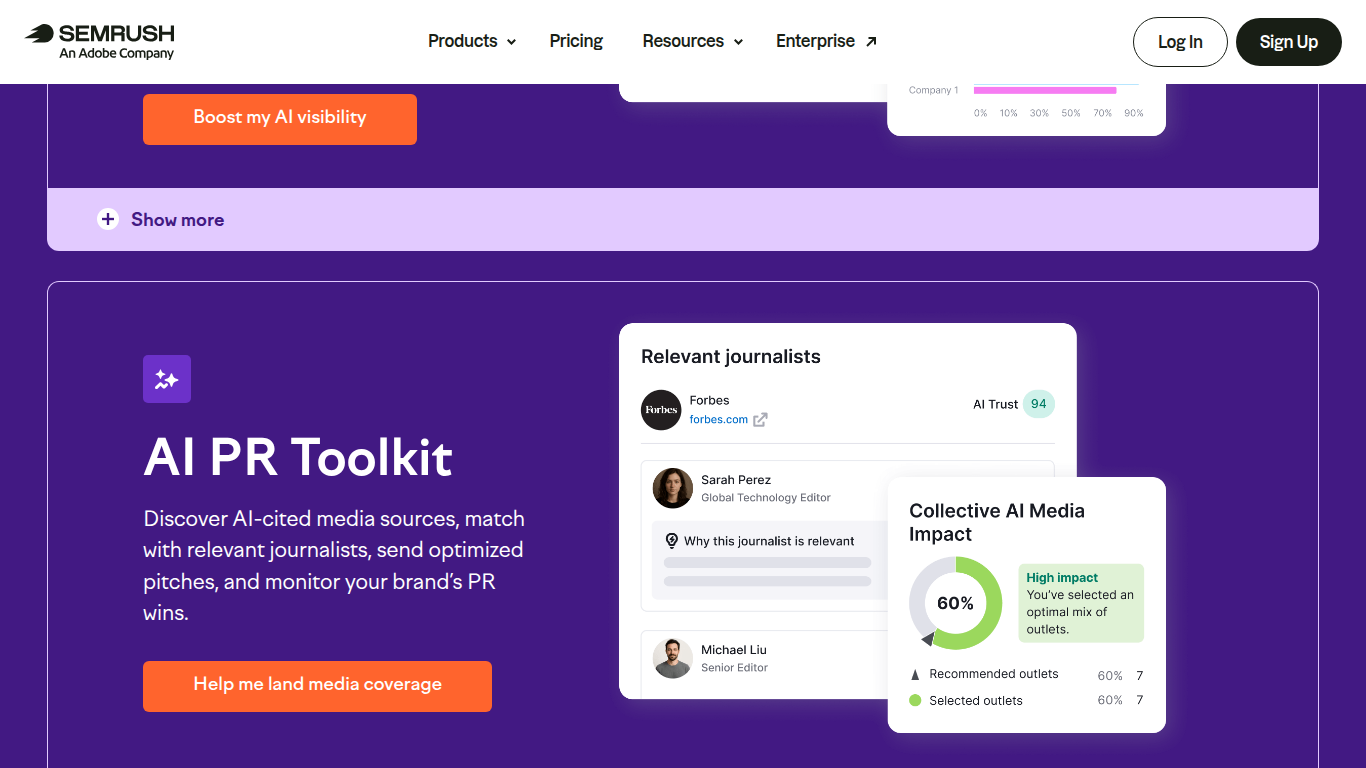
Semrush's toolkit tracks 25 prompts a day on one domain for $99 a month, on ChatGPT, Google AI Overviews, Google AI Mode and Gemini. Perplexity appears in its brand reports but not in daily prompt tracking, and Claude and Copilot sit on Enterprise AIO, Semrush's custom-priced enterprise product. Bundled with the SEO suite as Semrush One, it costs $199 for 50 prompts or $299 for 100. Its edge is sentiment and narrative reporting across more than 68,000 location and language combinations, plus Prompt Research for AI search demand, inside the tool many SEO teams already open every day. Against LLMrefs, it is daily but far smaller: 25 prompts on one domain cost more than 500 prompts across unlimited projects. The Semrush AI Visibility Toolkit alternatives guide prices it in detail.
Key features
- Daily prompt tracking on four Google and OpenAI surfaces
- Sentiment and narrative drivers across 68,000+ locations and languages
- Prompt Research for AI search demand
- Keyword, backlink and audit data in the same platform
Pricing
- AI Visibility Toolkit: $99/mo per domain: 25 prompts
- Semrush One Starter: $199/mo: 50 prompts plus the SEO suite
- Semrush One Pro+: $299/mo: 100 prompts
- Enterprise AIO: custom, with Claude and Copilot
- Extra prompts $60 per 50; each extra toolkit user $99/mo.
Pros
- AI visibility next to Semrush's SEO data
- Deep sentiment reporting
- Daily tracking on Google AI Mode and Gemini
Cons
- Priced per domain and per extra user
- Claude only on Enterprise AIO
- 25 prompts on the base plan
Verdict: a sensible move for Semrush-first teams with one domain; not a route to more prompts or more engines.
How to choose an LLMrefs alternative
Is weekly data enough? If yes, LLMrefs is hard to beat on price. If not, Otterly AI is the cheapest daily option, Geoptie and Peec AI are the main daily trackers, and Rankscale lets you set the cadence yourself.
Do you want to write your own prompts? Every paid alternative here tracks the exact questions you enter. If your team still thinks in keywords, SE Ranking and Semrush keep keyword data next to the prompts.
Do you need the tool to say what to change? For a full loop from data to drafts, Geoptie, AthenaHQ, Peec AI, Profound and SE Ranking (on its SEO plans) include content work. Otterly AI and Rankscale give fixes and recommendations, and Scrunch adds basic content generation.
- Daily data and content work on a small budget: Geoptie Starter or Professional.
- Daily tracking for the lowest price: Otterly AI Lite.
- Many engines on one plan: AthenaHQ or Rankscale.
- SEO suite first: SE Ranking or Semrush.
- Enterprise contract: Profound or Scrunch.
For agencies, the GEO tools for agencies guide compares client workloads, and the AI visibility tools under $100 guide covers LLMrefs alongside other low-cost plans.
When LLMrefs is still the right choice
LLMrefs remains the better buy for teams that plan in SEO keywords and want the widest view for the least money: 500 prompts across nine engines, Grok and Meta AI included, for $79. Agencies with many small clients get unlimited projects and seats on one bill, which few tools here match. If a weekly read is what the client report needs, there is little reason to pay more.
For teams that need daily answers on specific questions and a plan for what to publish, Geoptie's plans start at $49, and the free GEO audit shows how AI engines read your site today.