
Buyers no longer shortlist brands from a list of blue links. They ask ChatGPT “what’s the best CRM for a 10-person sales team?” or open Perplexity and type “alternatives to HubSpot under $50 a user,” and they get three to five named companies back. If your brand is not in that shortlist, you do not exist for that buyer.
That shift created an entire software category in under two years. More than eighteen AI search visibility tools launched in the last twelve months. Entry pricing now ranges from $29 a month at Otterly to $499 a month at Profound’s Starter tier. The marketing copy on every homepage reads the same — “track your AI visibility,” “win in generative search,” “outrank competitors in ChatGPT.” Founders trying to pick one are drowning in look-alike feature lists.
This article is an honest, hands-on comparison of the ten ai search visibility tools that are actually worth your money in 2026. All pricing is current as of May 2026. Customer counts and funding figures come from each company’s public reporting. Strengths and weaknesses reflect real product testing, customer reviews, and what each platform can and cannot do — not marketing claims.
If you only have thirty seconds: Geoptie at $49 a month is the best value for agencies and growing brands that want to do something about their AI visibility, not just measure it.
At-a-glance comparison of the top AI search visibility tools
| Tool | Starting price | Engines tracked | Best for | Free trial | Notable feature |
|---|---|---|---|---|---|
| Geoptie | $49/mo | 4 | Agencies and growing brands | Yes — free GEO audit | Unlimited audit reports at every tier |
| Profound | $499/mo | 10 (Enterprise) | Fortune 500 with data teams | No | Real prompt volume data |
| Peec AI | €75/mo (~$87) | 4+ | PLG B2B SaaS teams | Yes | Prompt-centric dashboard |
| AIclicks | $59/mo | 10+ | SEO and content agencies | Yes | UI-scraped (not API) results |
| Spotlight | Free; $199/mo paid | 8 | WordPress content teams | Yes — full free audit | Country-level VPN tracking |
| Otterly AI | $29/mo | 4 (+2 add-ons) | Solo founders and freelancers | Yes — free plan | Cheapest entry tier |
| Scrunch AI | ~€89/mo (~$95) | 3 | Reputation teams | Yes | Hallucination detection alerts |
| AthenaHQ | $295/mo | 8 | Enterprise PR and brand teams | No | Narrative positioning analysis |
| ZipTie | Tiered | 3 | Technical SEO teams | Yes | Indexation audits for LLM bots |
| Brandlight | $500+/mo | Multiple | Multi-brand enterprises | No | Multi-brand analytics |
How we evaluated these AI visibility tools
Six criteria drove the scoring for every tool below:
- Engine coverage — how many of the major LLMs are tracked, and at what tier
- Entry-tier accessibility — what the cheapest usable plan actually includes
- Action versus monitoring — whether the platform helps you fix what it finds, or only reports it
- Multi-language and multi-region support — table stakes for any non-US brand
- Customer traction — funding, named customers, and review-site signal
- Team fit — agency, in-house marketing, technical SEO, or enterprise PR
Every claim about pricing, funding, and customer base in the reviews below is sourced from each company’s public reporting and verified at the time of writing.
The 10 best AI search visibility tools in 2026
1. Geoptie
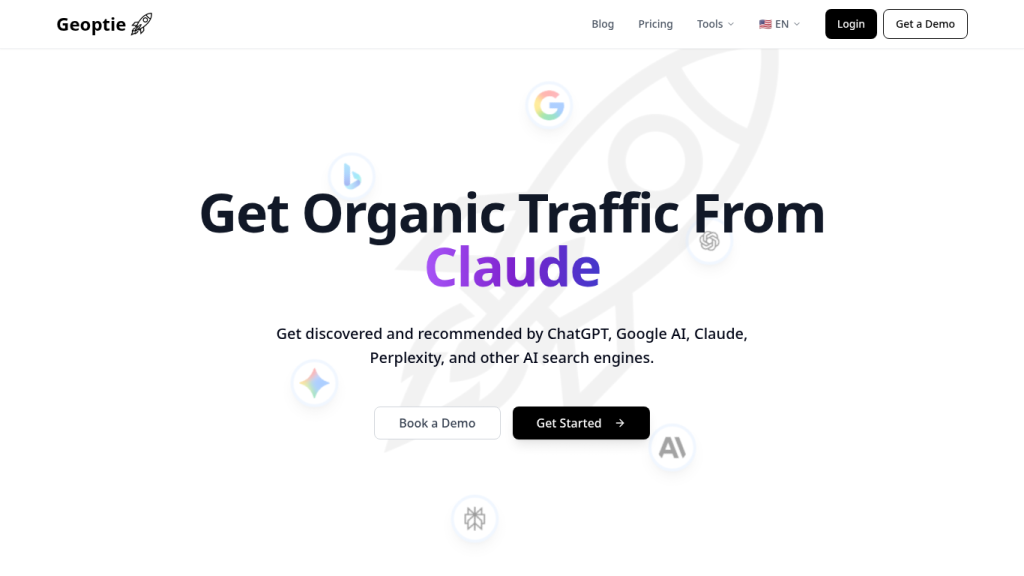
Best for: Agencies and growing brands that need execution — content production and audits — alongside AI search monitoring.
Pricing: $49/mo Starter (15 prompts, 2 brands); $99/mo Pro (100 prompts, 10 brands); $199/mo Enterprise (400 prompts, unlimited brands). A free GEO audit is available with no credit card.
What it does: Geoptie tracks brand mentions across four AI engines — ChatGPT, Claude, Perplexity and Gemini — and pairs that monitoring with a Content Studio that produces AI-optimized articles. Every paid plan includes unlimited audit reports, which is unusual at this price.
Key features:
- Six-engine monitoring (ChatGPT, Claude, Perplexity, Gemini)
- Built-in Content Studio at every paid tier, not as an add-on
- Multi-brand support starting at $49/mo (2 brands on Starter, 10 on Pro, unlimited on Enterprise)
- Companion tools including the GEO Content Checker, Keyword Finder, Rank Tracker, Cannibalization Checker, and Backlink Finder
Strengths:
- Lowest entry price among full-featured tools in this comparison — $49/mo versus $295 at AthenaHQ and $499 at Profound
- The only sub-$50 tool that combines monitoring with content production
- Unlimited audit reports on every plan, including Starter
Where it falls short:
- Less brand recognition than Profound or Peec AI
- Smaller customer logo book than VC-funded competitors
Verdict: Pick Geoptie if you need to do something about what you find, not just measure it. The combination of multi-engine tracking, a built-in Content Studio, and unlimited audits at $49/mo is what places it at the top of this list. Run a free GEO audit before paying for anything to confirm the data is useful for your category.
2. Profound
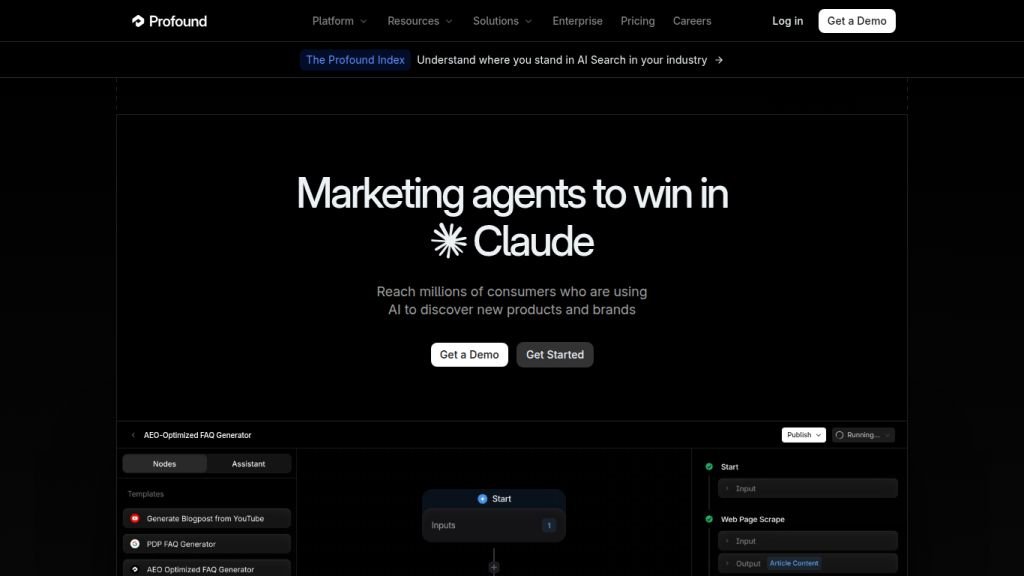
Best for: Fortune 500 brands with dedicated data and analytics teams and a five-figure annual budget for visibility tooling.
Pricing: $499/mo Starter (50 prompts, ChatGPT only); $399/mo Growth (100 prompts, 3 engines, $332.50/mo billed annually); Enterprise on request.
What it does: Profound is the most heavily funded company in this category — $155M raised at a $1B valuation as of February 2026, with Sequoia, Kleiner Perkins, Khosla Ventures, and Lightspeed on the cap table. It tracks visibility across ten engines (ChatGPT, Perplexity, Google AI Mode, Gemini, Microsoft Copilot, Meta AI, Grok, DeepSeek, Anthropic Claude, and Google AI Overviews — full coverage on Enterprise tier only) and adds two features competitors do not have: Prompt Volumes for real AI search volume data, and Agent Analytics for AI crawler tracking.
Key features:
- Prompt Volumes — actual search volume for buyer prompts across LLMs
- Agent Analytics — tracks AI crawler hits to your site
- Conversation Explorer — example queries that surface your brand and competitors
- Content Agents for AI-targeted content production
- Agency mode for white-label resale
Strengths:
- Most comprehensive engine coverage in the category
- The only platform with real prompt volume data at this scale
- Anchor customers including Ramp, US Bank, Indeed, MongoDB, DocuSign, Chime, Target, Walmart, Figma, and Charlotte Tilbury
Where it falls short:
- Starter tier at $499/mo covers ChatGPT only — locking SMBs out of the multi-engine view they actually need
- No free trial — you commit to a plan before testing
- Some users report a fragmented UX across Agent Analytics, Prompt Volumes, and Conversation Explorer
Verdict: If you have a $6,000+ annual budget, a data team, and Fortune 500–scale stakes, Profound is defensible. For everyone else, the entry price alone disqualifies it. Looking for a more accessible alternative with similar engine coverage? Start with a free GEO audit or compare ChatGPT rank tracker options before committing.
3. Peec AI
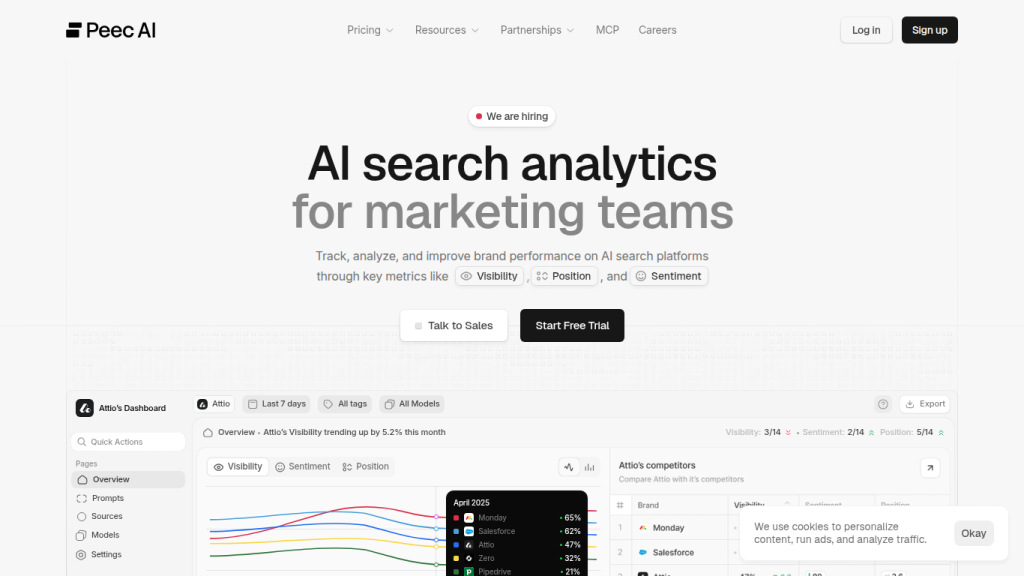
Best for: Fast-growing B2B SaaS brands that want the leanest, fastest-iterating prompt-tracking dashboard.
Pricing: €75/mo (~$87, 25 prompts); €169/mo (~$196, 100 prompts); €424/mo (~$493) Enterprise.
What it does: Peec AI is the breakout product of 2025–2026 — €7M seed in July 2025, $21M Series A in November 2025 led by Singular ($29M total), and a customer count past 1,300 brands and agencies including n8n, Attio, ElevenLabs, Chanel, TUI, Axel Springer, Peak Ace, and DEPT. The product is built around prompts rather than keywords, with strong sentiment and source-citation analysis.
Key features:
- Prompt-centric dashboard (not keyword-centric)
- Sentiment analysis and source insights
- Reddit and community recommendation tracking
- Multi-language tracking across major markets
- Clean, design-led UI consistently praised in reviews
Strengths:
- Hypergrowth — 300+ new customers a month and $4M+ ARR in ten months
- Opinionated, simple interface
- One of the better source-citation analyses in the category
Where it falls short:
- Young product (launched February 2025) — fewer integrations than older suites
- Less enterprise data depth than Profound at the high end
- No on-platform content production — you still need a tool like the GEO Content Checker to act on the data
Verdict: Best for PLG-focused B2B SaaS teams who want a clean monitoring dashboard and trust a product team that is shipping fast. Pair it with content tooling — Perplexity rank tracking and a writing workflow — for end-to-end execution.
4. AIclicks
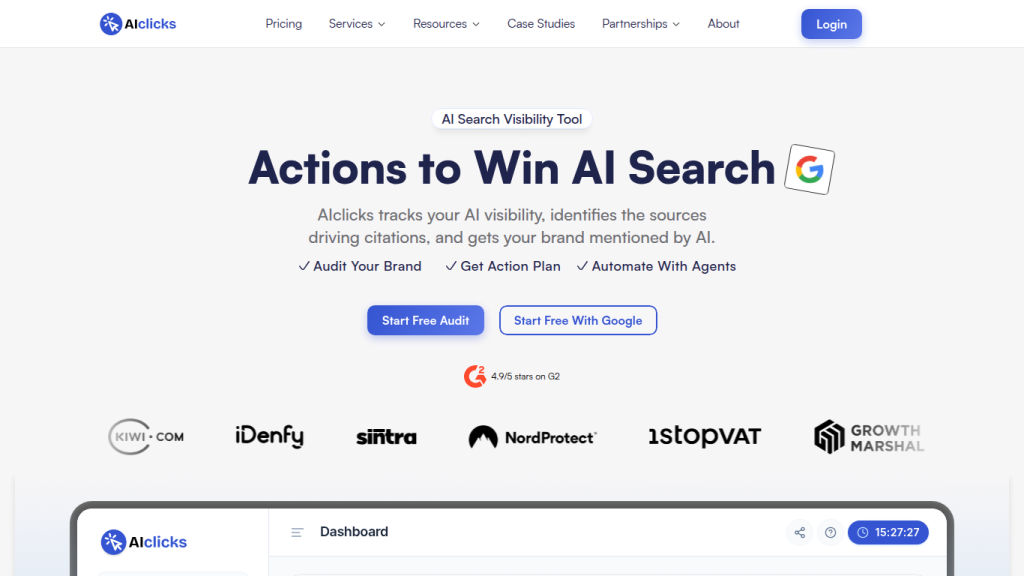
Best for: SEO and content marketing agencies managing multiple client accounts who need the most accurate ChatGPT data.
Pricing: $59/mo Starter (30 prompts, 3 platforms); $189/mo Pro (150 prompts, 4 platforms); $499/mo Business (300+ prompts, 6 platforms); custom Enterprise.
What it does: AIclicks tracks ten-plus engines (ChatGPT, Perplexity, Gemini, Google AI Overviews, Google AI Mode, Claude, Grok, DeepSeek, Meta AI, and Microsoft Copilot) by scraping the actual user interfaces rather than calling APIs. Self-reported customer base is 1,000+ brands and 400+ agencies. The Recommendations Tab surfaces content, source, and Reddit ideas for fixing visibility gaps.
Key features:
- UI scraping — queries platforms through real user interfaces, not APIs, which often produces results closer to what users actually see
- Recommendations Tab with content, source, and Reddit suggestions
- GA4 integration
- Agency partner program with revenue share
- Active founder-led brand presence on LinkedIn
Strengths:
- UI-scraped data is typically more representative than API responses on ChatGPT
- Strong agency channel program with rev-share
- Multi-client workspaces at a price agencies can pass through
Where it falls short:
- No usage-based pricing — locked into preset tiers
- Limited historical data depth
- No public API
- Smaller team than VC-backed rivals — execution risk on roadmap
Verdict: Best for SEO and marketing agencies that need multi-client workspaces and the most accurate ChatGPT data without enterprise pricing. If you also want execution tooling alongside monitoring, compare against Geoptie’s pricing — both are agency-friendly, but the bundles are different.
5. Spotlight
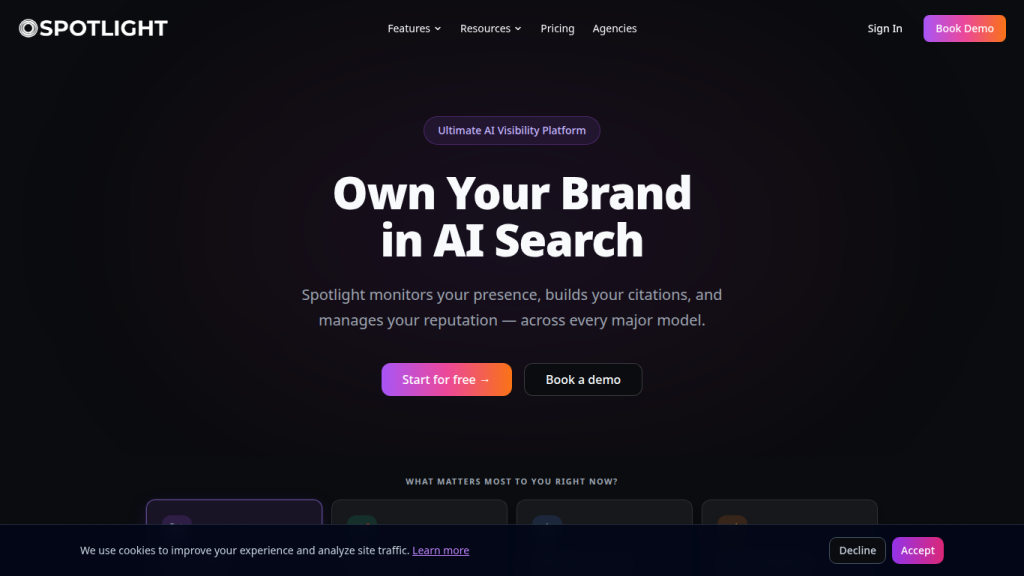
Best for: Content-focused brands and WordPress publishers who want a free tier to test AI visibility before committing.
Pricing: Free tier with a full audit; $199/mo self-serve; full managed service on request.
What it does: Spotlight is led by Michael Hermon, formerly head of Innovation and AI at monday.com. It tracks eight platforms — ChatGPT, Google AI Overviews, Google AI Mode, Grok, Gemini, Claude, Perplexity, and Copilot — and stands out for two things: a proprietary prompt volume index built on Google Search Console, Trends, and AdWords data, and country-level VPN tracking that returns true local results rather than US-defaulted ones.
Key features:
- Free tier with a complete audit (real value, not a teaser)
- Proprietary prompt volume index from GSC, Trends, AdWords
- Country-level VPN tracking for local results
- 47-feature content analysis
- Free WordPress plugin for one-click AI-optimized publishing
Strengths:
- Genuinely generous free tier — useful as a standalone audit, not just a sales tool
- Only tool offering true country-level VPN tracking
- Tight content marketing distribution and a credible founder
Where it falls short:
- Less established brand than the top-funded competitors
- Smaller team than Profound or Peec
- Less actionable execution layer outside the WordPress plugin
Verdict: Best for content teams that publish on WordPress and want a free tier to test before paying anyone. Use it to triangulate findings against a tool with deeper content workflows — Geoptie’s GEO Content Checker is a natural pair if you publish outside WordPress as well.
6. Otterly AI
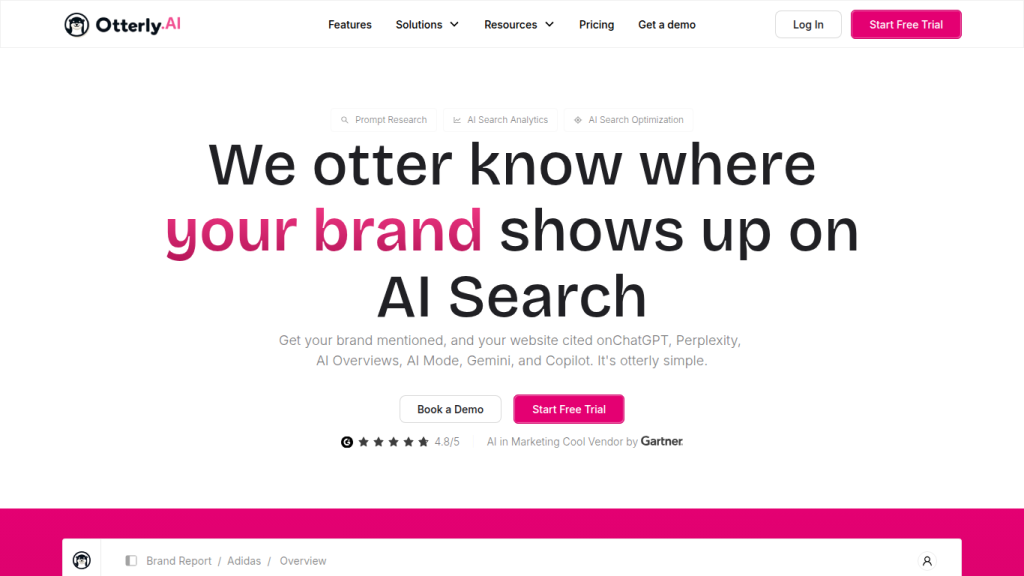
Best for: Solopreneurs, freelancers, and budget-conscious teams of one to three.
Pricing: Free plan available; paid plans from $29/mo.
What it does: Otterly is the cheapest entry point into the category. The free plan covers basic mention tracking across four engines (ChatGPT, Claude, Perplexity, Gemini), with two more available as add-ons. Paid features include citation analysis, sentiment, keyword research, prompt generation, and a GEO audit tool.
Key features:
- Free plan with real tracking, not a trial
- Brand mention and citation analysis
- Sentiment scoring
- Keyword research and prompt generation
- Built-in GEO audit tool
Strengths:
- Cheapest entry price in the category
- Simple, low-bloat interface
- Frictionless free plan — useful for confirming the category before spending
Where it falls short:
- Only four engines on the base plan
- No content production workflow
- No dedicated agency plan or multi-workspace features
- Feature set is shallow compared to $99+/mo competitors
Verdict: Best lightweight option for solo founders, freelance marketers, or teams who want to test the AI visibility category before investing more. As you grow past one brand and a handful of prompts, compare against the broader best GEO tools roundup to see what you’re missing.
7. Scrunch AI
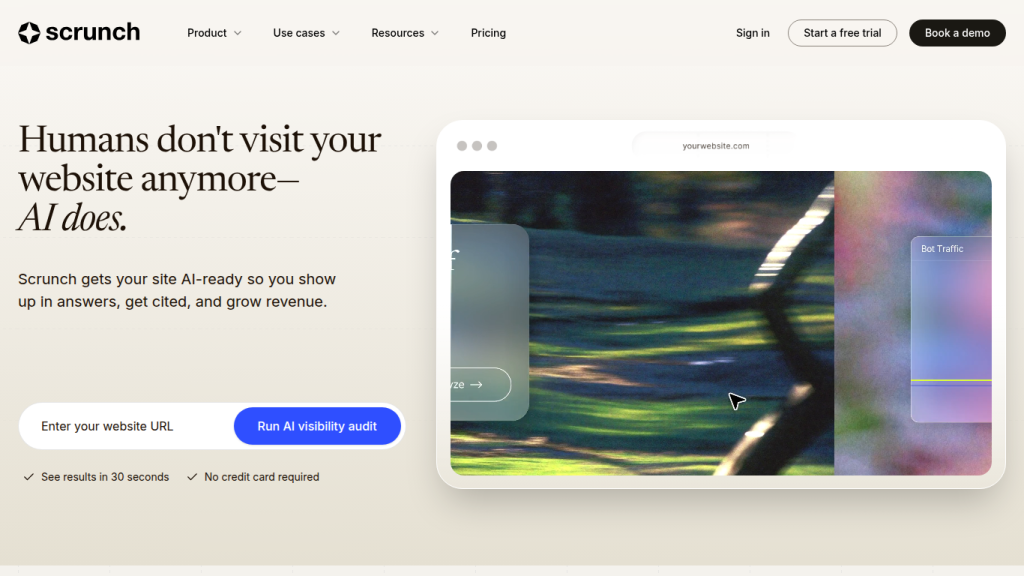
Best for: Reputation management teams whose primary concern is AI hallucinations and misinformation about their brand.
Pricing: ~€89/mo (~$95).
What it does: Scrunch AI has been operating since 2023 and has raised $19M. The product covers ChatGPT, Perplexity, and DeepSeek, with a customer base of 500+ brands. It is the only major platform with dedicated hallucination detection alerts — the system flags when an LLM says something factually wrong about your company.
Key features:
- Hallucination detection alerts (unique to Scrunch)
- Content gap analysis
- Misinformation flagging with source tracing
- GA4 integration
- Multi-platform brand monitoring
Strengths:
- The only major platform purpose-built for hallucination detection
- Longer operating history than most competitors (since 2023)
- Strong fit for regulated and high-stakes industries
Where it falls short:
- Engine coverage is limited to three platforms
- Less developed UX than newer competitors
- Lacks the actionable optimization recommendations you get from AIclicks, Peec, or Geoptie
Verdict: Worth buying when your primary concern is AI accuracy and misinformation, not pure visibility growth. Pair it with a visibility-focused tool — a Claude rank tracker or full GEO platform — to cover the growth side too.
8. AthenaHQ
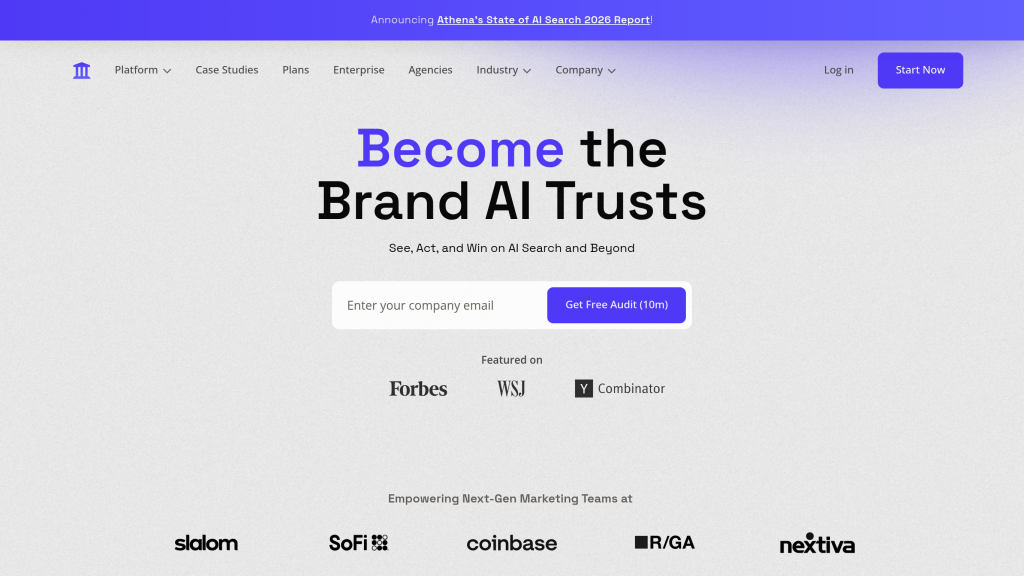
Best for: Mid-to-large enterprises, PR teams, and brand teams who care more about how AI describes them than whether it mentions them.
Pricing: $295/mo Self-Serve (3,500 credits, 8 LLMs); $545/mo Growth (10,000 credits); Enterprise from $2,000/mo; $100 per 1,250 extra credits.
What it does: AthenaHQ’s positioning is narrative-first. It does not just count mentions — it analyzes the language LLMs use to describe your brand, your competitors, and your category. The product covers eight LLMs and integrates with major analytics and BI tools.
Key features:
- Narrative positioning analysis (how AI describes you)
- Share-of-voice analytics against competitors
- Prompt-level monitoring with deep filtering
- Strong analytics and BI integration
- Credit-based usage model
Strengths:
- The clearest “narrative framing” view in the category
- Strong for strategic communications, PR, and category-creation teams
- Good fit for enterprises measuring brand perception, not just mentions
Where it falls short:
- Pricing skews premium for the value if you only need monitoring
- Some reviews flag AI-generated content quality issues
- Smaller integration ecosystem than older suites
- Credit-based pricing can produce unpredictable monthly bills
Verdict: Best for enterprise PR and brand teams that care about how AI describes them, not just whether. If you mainly need visibility tracking plus content execution, save the money and start with a free GEO audit before evaluating AthenaHQ.
9. ZipTie
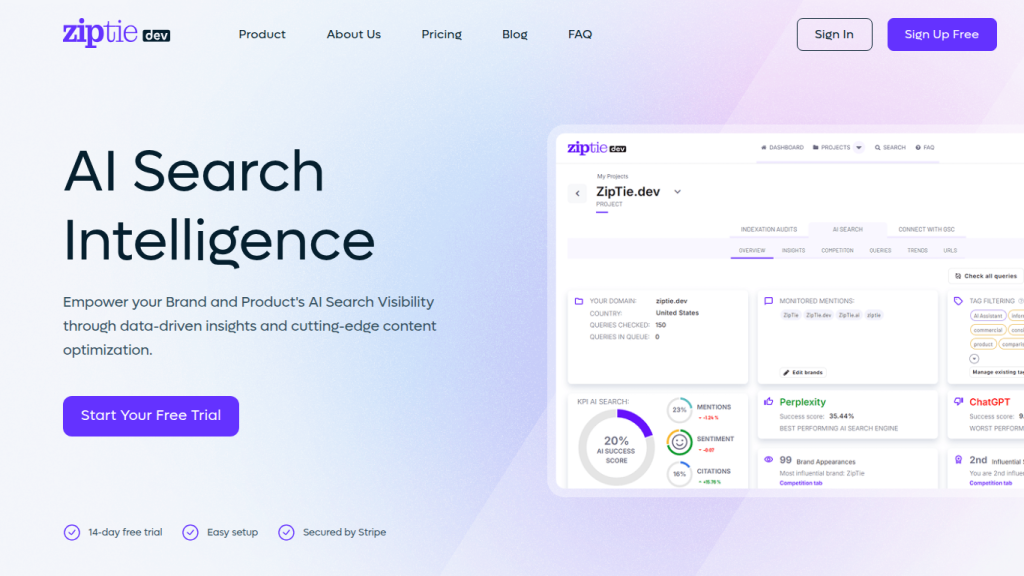
Best for: Technical SEO teams who want indexation auditing for AI crawlers as much as visibility tracking.
Pricing: Tiered — check the site for current numbers.
What it does: ZipTie covers three engines — Google AI Overviews, ChatGPT, and Perplexity — and is the most technical product in this list. It uses real-user-mimicking methods rather than pure API calls, runs LLM-bot indexation audits, and produces a proprietary AI Success Score on top of mention and sentiment tracking.
Key features:
- Proprietary AI Success Score
- LLM-bot indexation audits (which pages AI crawlers can and cannot see)
- In-platform content optimization
- Mentions and sentiment tracking
- Real-user-mimicking query methods
Strengths:
- The most technically rigorous data collection in the category
- Strong indexation and crawler-accessibility tooling
- Good fit for technical SEO practitioners
Where it falls short:
- Only three engines tracked
- No conversation data or prompt volume metrics
- No add-on engines available — you cannot expand coverage
Verdict: Best for technical SEO practitioners willing to trade engine breadth for technical depth. If your team also runs traditional rank tracking, compare against a unified GEO Rank Tracker that covers more engines.
10. Brandlight
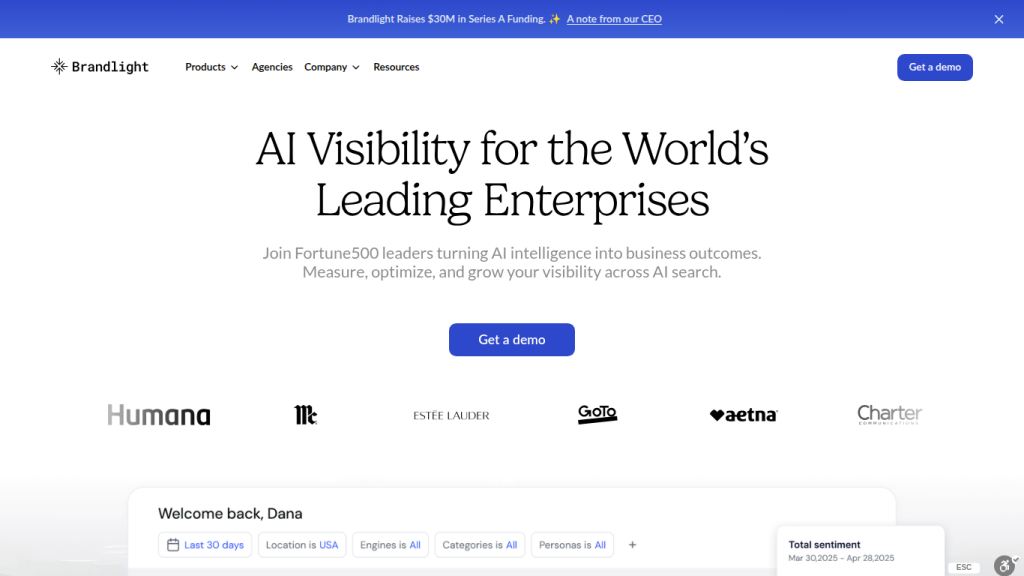
Best for: Large enterprises with extensive monitoring and multi-brand requirements.
Pricing: $500+/mo, custom enterprise quotes.
What it does: Brandlight came out of stealth in April 2025 with $5.75M raised. It targets enterprises that operate portfolios of brands and need analytics, reporting, and integrations at scale. Engine coverage spans the major AI platforms.
Key features:
- Multi-brand portfolio management
- Advanced analytics and reporting
- Deep integrations with enterprise stacks
- Enterprise-grade access controls
Strengths:
- Enterprise-grade analytics and reporting depth
- Multi-brand capability for holding companies and portfolio operators
Where it falls short:
- Premium-only pricing — no SMB tier
- Smaller customer base than Profound
- Younger company than most enterprise competitors
Verdict: Worth evaluating if Profound feels too monitoring-focused but you still need enterprise-tier analytics across multiple product brands. For single-brand teams, the price is hard to justify against a $49 starting tier elsewhere.
How to choose the right AI search visibility tool for your team
The right tool depends less on feature comparison than on what you plan to do with the data. A short decision framework:
- Enterprise with budget and a data team → Profound. The price is high, but the prompt volume data and engine coverage justify it at Fortune 500 scale.
- SEO agency or content team → AIclicks or Geoptie. AIclicks for the most accurate ChatGPT scraping; Geoptie for monitoring plus a built-in Content Studio at a lower entry tier.
- Budget-conscious startup → Otterly or Geoptie. Otterly at $29 is the cheapest start; Geoptie at $49 unlocks meaningfully more.
- You need execution, not just monitoring → Geoptie. It is the only sub-$50 platform that includes content production alongside tracking.
- Reputation and hallucination concerns → Scrunch AI. It is the only major platform purpose-built for misinformation detection.
- Pure monitoring with a clean UI → Otterly for solo use, Peec AI for B2B SaaS at scale.
- WordPress publishers → Spotlight. The free WordPress plugin is unique.
- Enterprise PR and brand teams → AthenaHQ for narrative analysis; Brandlight for multi-brand portfolios.
- Technical SEO → ZipTie for indexation auditing.
For a wider comparison that includes specialist tools, see the best GEO tools roundup and the primer on GEO vs SEO.
FAQ: AI search visibility tools in 2026
An AI visibility tool tracks whether and how your brand appears in answers from AI search engines like ChatGPT, Claude, Perplexity, and Gemini. Unlike traditional SEO tools that monitor keyword rankings on Google, an ai visibility tracker queries LLMs with buyer prompts (“best CRM for startups,” “alternatives to HubSpot”) and records whether your brand is mentioned, what is said about it, and which sources are cited. Most tools also track sentiment, share of voice against competitors, and the URLs that LLMs cite when describing your brand.
Traditional SEO ranks pages in a list of ten blue links. AI search produces a synthesized answer that names three to five brands and cites a handful of sources. Winning in AI search means being one of those three to five brands, which depends on what the LLM has read about you across the web — third-party reviews, listicles, Reddit threads, and your own pages — not your position in a ranked list. The GEO vs SEO primer covers the differences in more depth.
The four that matter most in 2026 are ChatGPT, Google Gemini (and AI Overviews), Perplexity, and Anthropic’s Claude. ChatGPT drives the most volume by a wide margin, but Perplexity converts above average for B2B and Gemini owns most mobile searches via Android. Beyond those four, Microsoft Copilot, Grok, DeepSeek, and Meta AI are worth tracking if your audience uses them. Most paid tools cover the top four; tracking eight or more usually requires a higher tier.
Entry pricing in 2026 ranges from free (Otterly’s free plan, Spotlight’s free audit, Geoptie’s free GEO audit) to $499 a month at Profound’s Starter tier. Most usable paid plans sit between $49 and $199 a month. Pricing scales with three things: the number of prompts you track, the number of brands or workspaces, and the number of AI engines covered. Enterprise tiers run $500 to $2,000+ a month and add API access, custom reporting, and account management.
If your buyers ask LLMs for recommendations in your category, yes — even at small scale. The cost of being invisible compounds. A free GEO audit or a $29–$49 tier from Otterly, Spotlight, or Geoptie will tell you whether you appear for your top ten prompts. If you do not, you have a concrete content and PR problem to solve. If you do, monitor monthly and reinvest the budget elsewhere. Small businesses rarely need the $300+ enterprise tiers.
AEO stands for Answer Engine Optimization and refers to optimizing for direct-answer features — featured snippets, voice assistants, and AI Overviews — where one answer wins. GEO stands for Generative Engine Optimization and refers specifically to optimizing for generative AI engines that produce paragraph-length, multi-source answers. In practice the two overlap heavily and most current “ai visibility tools” cover both. Use AEO when talking to SEO teams and GEO when talking to founders or marketers building for ChatGPT and Perplexity. The GEO definitive guide goes deeper.
Partially. GA4 will show referral traffic from chat.openai.com, perplexity.ai, and gemini.google.com, but it does not tell you which prompts surfaced your brand, whether competitors were named alongside you, or what the AI said about you. The visibility — the share of voice inside the answer itself — is invisible to GA4. That is the gap AI visibility tools fill. Several (AIclicks, Scrunch AI, Profound) integrate with GA4 so you can correlate visibility data with downstream conversion.
LLMs refresh their training data on long cycles and their retrieval indexes on shorter ones. New content typically surfaces in Perplexity within days, in ChatGPT search within weeks, and in core ChatGPT and Claude answers within one to three months, depending on retrieval signals. Backlinks from authoritative third parties and mentions in well-indexed listicles accelerate this. Plan for a 60- to 90-day cycle to see measurable change, not the 6- to 12-month timeline of traditional SEO.
Yes. Otterly AI offers a free plan with limited prompts. Spotlight provides a full free audit before any paid commitment. Geoptie offers a free GEO audit with no credit card. These are good starting points to understand your current visibility before paying for ongoing tracking. Fully free tools that match the depth of paid monitoring do not exist yet — the API costs of running queries against ChatGPT, Claude, and Perplexity make a fully free product economically difficult to sustain.
For most teams, one tool is enough. Combining tools is worth it only when there is a specific gap — pairing a monitoring-only product with a content tool, or running Scrunch AI alongside another monitor specifically for hallucination detection. Watch for duplicate prompt-tracking costs: you do not need two tools querying the same 100 prompts against ChatGPT. Most agencies and brands settle on one primary tool within six months and use companion utilities (a Keyword Finder, a Rank Tracker) around it.
Start with your own data
The best way to understand AI search visibility is to see your own. Run a free GEO audit on Geoptie to see where your brand stands across ChatGPT, Perplexity, Gemini, and more — no credit card required. Once you know what is missing, the decisions in this guide get a lot easier to make.