

Teams that write for search now have a second question to answer: does that content show up when a buyer asks ChatGPT, Gemini or Perplexity for a recommendation? Writesonic answers both halves in one product, an AI search visibility platform with an AI article writer, site audits and content optimization built in, and that bundle is a real strength. The self-serve plans, though, start at $99 a month, track three AI engines, keep Claude and Perplexity for Enterprise, and cap AI articles at 15 to 50 a month.
The ten Writesonic alternatives below cover the same two jobs. Most now track AI visibility and create content, so this guide compares them on the engines each plan tracks and on how each one limits the content it produces. It is written for teams that use Writesonic for AI visibility and for teams that mainly used its writer. Each tool below was reviewed in November 2026 against the same criteria: the engines on each plan, how content is limited and the monthly price, all checked on the vendor's own site.
Key takeaways
- Writesonic costs $99, $249 or $499 a month on monthly billing. Every self-serve plan tracks ChatGPT, Gemini and Google AI Overviews only, and AI articles are capped at 15, 25 or 50 a month.
- Geoptie is the closest swap for the whole bundle: seven engines, Claude and Perplexity included, with unlimited articles and audits from $49 a month.
- Peec AI (from $95) and Profound (custom Enterprise) lead with tracking, and both now draft content through agents paid for in credits.
- Surfer and Frase suit writers who want an editor first and AI tracking beside it.
- Teams that only used Writesonic to write can move to Jasper, which starts at $69 per seat and leaves AI visibility tracking to its custom Business plan.
What Writesonic costs in 2026, and where it stops
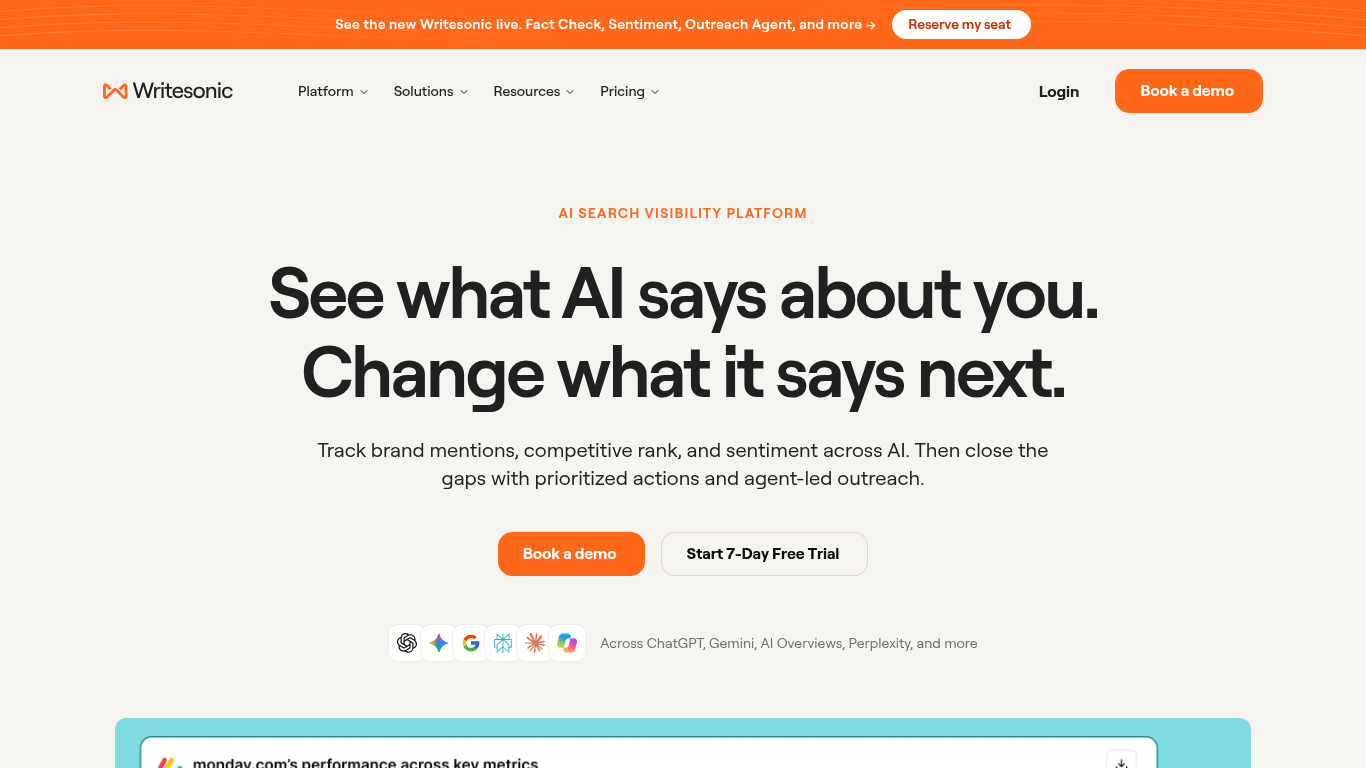
Writesonic sells three self-serve plans. Starter is $99 a month for 50 prompts, one user and one project. Basic is $249 for 100 prompts and two users. Growth is $499 for 200 prompts, three users and two projects. Annual billing takes 20% off, which is where the $79, $199 and $399 figures come from. Every plan includes the AI Article Writer, site audits and content optimization, and new accounts get a seven-day free trial with no credit card.
Three limits push teams to look at other tools.
Three engines below Enterprise
Starter, Basic and Growth all track ChatGPT, Gemini and Google AI Overviews. Perplexity, Claude, Microsoft Copilot, Google AI Mode and the rest of Writesonic's nine platforms come only with the custom-priced Enterprise plan.
Content is capped by plan
AI articles are limited to 15, 25 or 50 a month, and site audits to 10, 20 or 50. Growth teams can buy 20 more articles for $100 a month. A team publishing a few posts a week reaches the Starter cap quickly.
Analysis and actions are held back
Sentiment analysis starts on Growth at $499. The Action Center, which turns findings into on-page and off-page tasks, runs as a limited trial on Growth (five of each a month) and opens fully only on Enterprise.
Writesonic alternatives compared
| Tool | Best for | Starting price | Engines at that price | Claude | Content creation |
|---|---|---|---|---|---|
| Writesonic (for reference) | Teams that want articles and tracking on one bill | $99/mo | ChatGPT, Gemini, AI Overviews | Enterprise only | 15 AI articles a month on Starter |
| Geoptie | Teams that want tracking and content work at a low monthly price | $49/mo | 4 of 7, chosen per brand | Every plan | Unlimited articles |
| Peec AI | Brands that want a dedicated tracker with public prices | $95/mo | 3, chosen from 8 (Perplexity included) | Enterprise only | Agent drafts content on 500 credits a month |
| Profound | Enterprises that want deep analysis and content agents on one contract | Custom (free 7-day trial) | Trial: ChatGPT, Gemini, AI Overviews | Enterprise | Agents draft full articles, credit-metered |
| AthenaHQ | Teams that want Claude and many engines on one plan | Free tier; $295/mo | 5 free; 11 on Starter | Starter | Articles and briefs on content credits |
| Surfer | SEO writers who want a tracker beside the content editor | $59/mo | None; 5 on the $95 tracking plan | Not tracked | 120 documents on Discovery |
| Frase | Small content teams that want articles and tracking in one tool | $49/mo | ChatGPT, Google AI | Scale ($299) | 10 articles a month on Starter |
| AirOps | Content teams that build their own workflows | Not published (14-day trial) | ChatGPT on Solo | Pro | Workflows on a shared task balance |
| Otterly AI | Small teams that want the lowest paid entry | $29/mo | ChatGPT, AI Overviews, Perplexity, Copilot | Paid add-on | Briefs and fixes; separate free content creator |
| Semrush AI Visibility Toolkit | SEO teams that already work in Semrush | $99/mo per domain | ChatGPT, Gemini, AI Overviews, AI Mode (Perplexity in weekly Brand Performance) | Enterprise AIO only | Separate Content Toolkit, $60/mo |
| Jasper | Marketing teams that only used Writesonic to write | $69/mo per seat | No AI tracking on Pro | No tracking on Pro | Writing agents, brand voice |
Prices are monthly billing on each vendor's site in November 2026. "Engines at that price" is what the cheapest plan with AI tracking covers before add-ons.
How this list was built
The list covers the AI visibility and content tools closest to what Writesonic sells today. Each one is judged on what a team gets on its own plans: engines, content limits and the work involved in running it week to week, with plans and prices checked on every vendor's site and onboarding walkthroughs used where the team has them. Geoptie, which publishes this guide, is listed first.
1. Geoptie
Tracking and content work from $49/mo.
Best for: teams that want AI visibility tracking and the content work that follows, at a low monthly price.
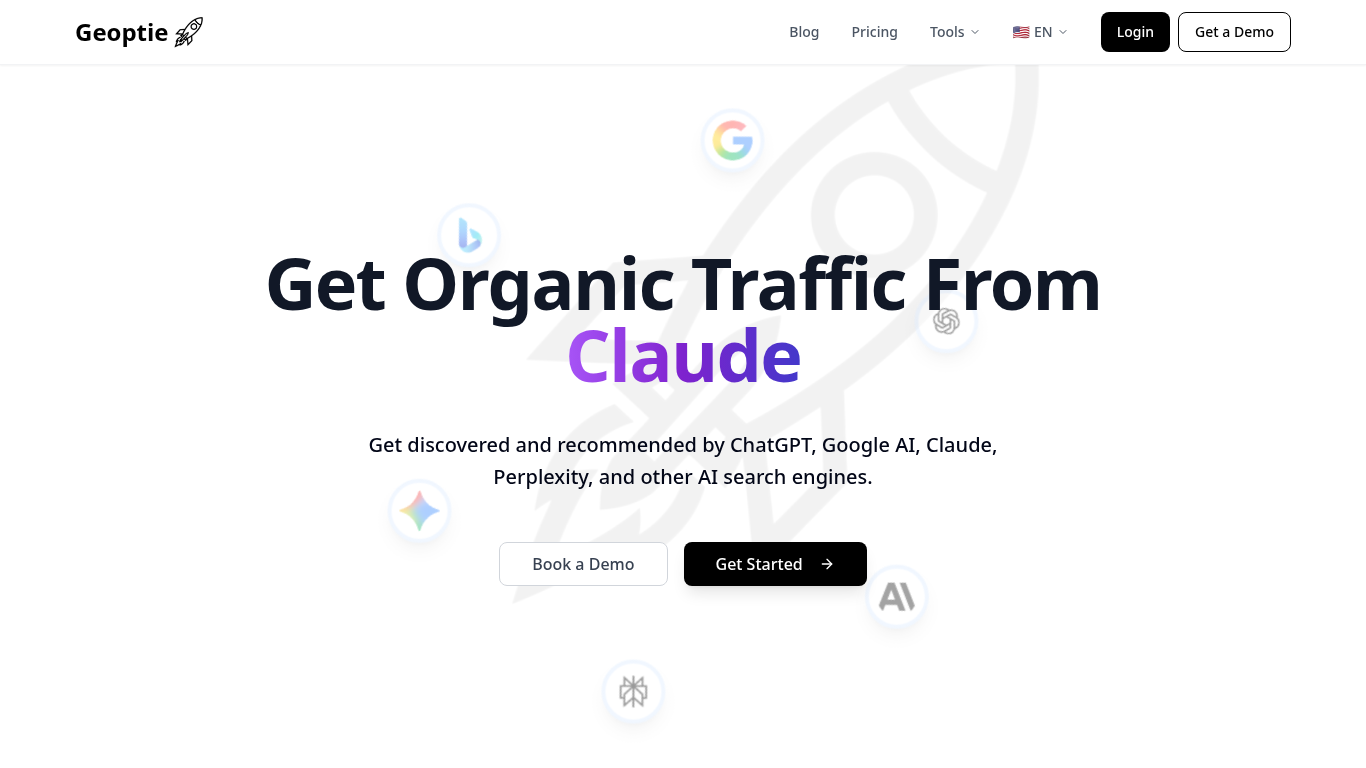
If Writesonic's limit for you is the article cap or the three-engine ceiling, Geoptie keeps the same bundle and removes both. It tracks seven engines: ChatGPT, Claude, Perplexity, Gemini, Google AI Overviews, Google AI Mode and Microsoft Copilot, with any four running per brand. The difference shows up in the weekly routine. When a prompt shows a competitor cited instead of you, the audit, the recommendation and the article to answer it all come from the same account, and none of it counts against a quota, so nobody rations articles toward the end of the month. Professional raises the plan to 10 brands and adds white-label AI visibility reports, an API and an MCP server.
Tracking and content
- Daily tracking of mentions, citations, sentiment and competitor share of voice for every prompt
- Unlimited AI articles and content optimization, with no monthly quota or credits
- Unlimited audits and prioritized recommendations for every brand
- Unlimited seats on every plan
Pricing
- Starter: $49/mo ($41/mo billed annually): 15 prompts, 2 brands
- Professional: $99/mo ($83/mo billed annually): 100 prompts, 10 brands, white-label reports, API and MCP
- Business: $249/mo ($208/mo billed annually): 300 prompts, unlimited brands
- No free plan or trial; the full comparison is on Geoptie's pricing page
Strengths and drawbacks
- Strengths: Claude and Perplexity on the $49 plan, where Writesonic keeps them for Enterprise; no article cap; published prices on every plan.
- Drawbacks: no free trial (the free tools are the way to try it first); white-label reports and the API start on Professional.
Verdict: the most direct replacement for Writesonic's bundle, with more engines and no content limit at half the entry price.
2. Peec AI
A dedicated tracker with public prices and an agent on top.
Best for: brands that want a polished dedicated tracker and can choose three engines.
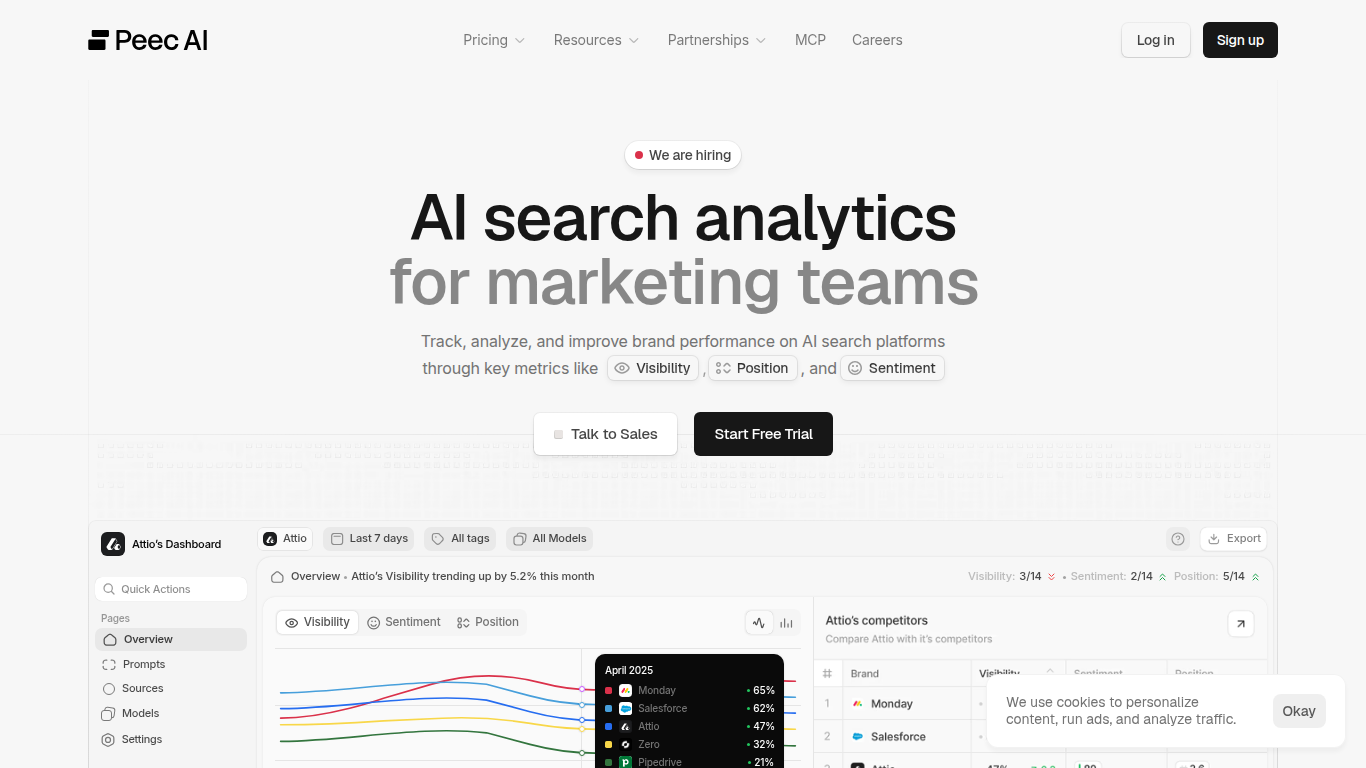
Peec AI is built for teams whose gap with Writesonic is tracking depth rather than writing, and its setup is one of the most considered in the category. A team weights three buyer personas and the generated prompts follow that mix, and once target markets are narrowed below Global, Peec writes the country into each prompt. One thing to check early: Peec derives competitors instead of asking for them, and in a walkthrough of its onboarding it read a GEO software brand as geographic and suggested mapping companies as rivals, so review that list before trusting share-of-voice numbers. Self-serve plans pick three models from ChatGPT, Perplexity, Google AI Overviews, Google AI Mode, Gemini, Naver, ERNIE and Bing AI Mode; Claude sits on Enterprise. The Peec AI alternatives guide covers the tools around it.
Tracking and content
- Source analytics on every plan: cited domains and URLs, citation share and gap analysis
- Sentiment and brand-perception reporting
- Peec Agent with 500, 750 or 1,000 agent credits a month by plan
- MCP server on every plan; API from Pro
Pricing
- Starter: $95/mo: 50 prompts, 3 models, 1 project
- Pro: $245/mo: 150 prompts, 3 models, 2 projects
- Advanced: $495/mo: 350 prompts, 3 models, 5 projects
- Enterprise: custom, with Claude and the wider model list
- Annual billing saves 15%; seven-day free trial
Strengths and drawbacks
- Strengths: deep source and gap analysis on the entry plan; unlimited users; Perplexity without Enterprise.
- Drawbacks: Claude requires Enterprise; three models per plan; agent work draws on a monthly credit allowance.
Verdict: a tracking-first tool with public prices and unlimited users; content help is real but metered.
3. Profound
Enterprise citation data, with agents that write.
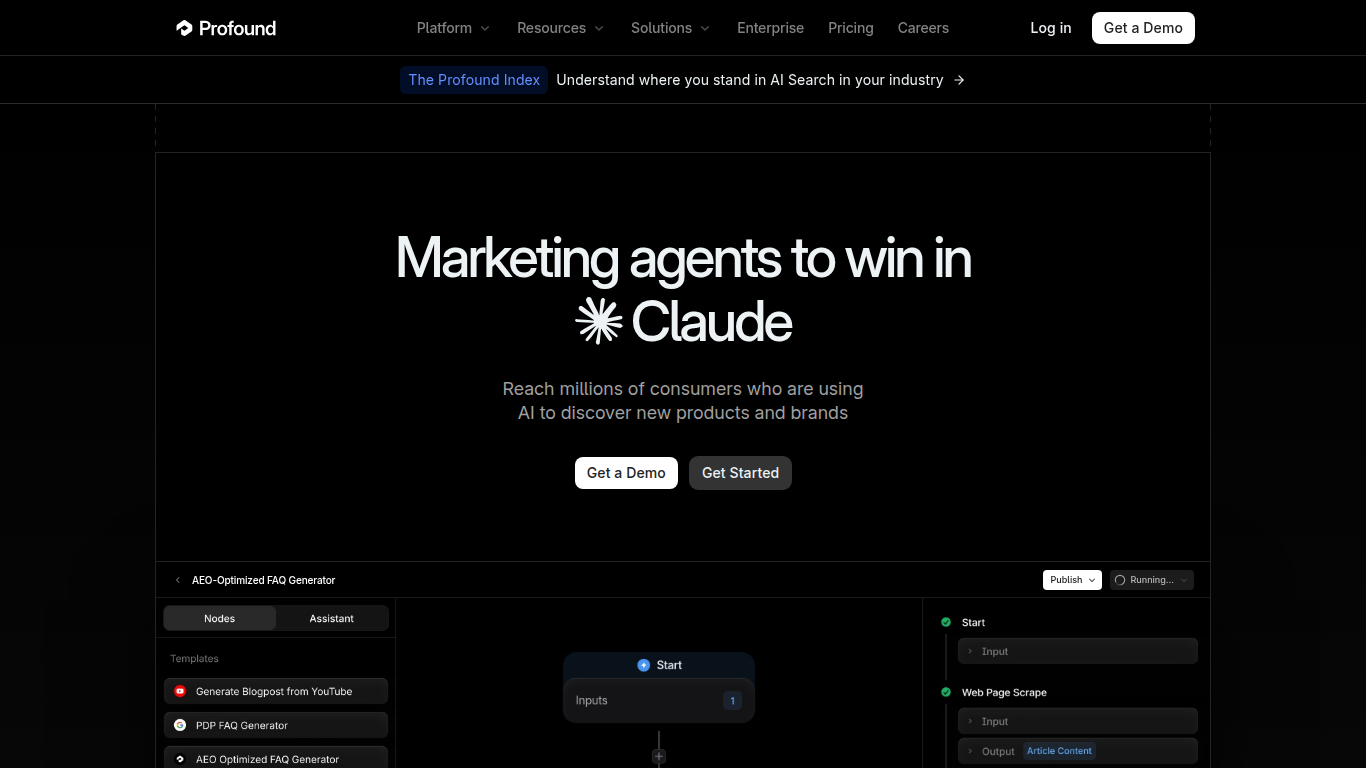
Best for: enterprises that want deep AI search analysis and content agents on one contract.
If Writesonic's Enterprise tier is where your needs already sit, Profound is the closest enterprise alternative, and it suits a team with an analyst who will actually dig into the data: every cited URL per prompt, AI crawler visits and prompt volumes. Enterprise tracks up to ten answer engines, Claude and Perplexity among them, with SSO, SOC 2, history, exports and an API. Its agents turn findings into a content brief and then a full article, and other templates refresh pages and build FAQ sections, all on credits. The friction is buying it: brands go through a sales conversation, with a free seven-day trial before it. The Profound alternatives guide compares the options.
Tracking and content
- Every cited URL per prompt, with source categories
- Agent Analytics for AI crawler traffic
- Prompt volume data for planning
- Content agents: Generate Article, Content Brief Creation, content refresh, FAQ generator, translation
Pricing
- Trial: free for seven days, 50 recommended prompts a day on ChatGPT, Gemini and Google AI Overviews, limited agent credits
- Enterprise: custom, up to ten engines
- Agencies: Agency Growth $99/mo plus $399/mo per client workspace (400 agent credits each)
Strengths and drawbacks
- Strengths: mature citation and crawler data; agents that produce finished drafts; enterprise controls such as SSO and SOC 2.
- Drawbacks: no self-serve paid plan for brands; agent output is limited by credits; no published price to budget against.
Verdict: worth the sales process for large brands; more contract than a team leaving Writesonic over price needs.
4. AthenaHQ
Many engines on one plan, billed in credits.
Best for: teams that want Claude and a long engine list on a plan they can buy today.
AthenaHQ's Starter plan answers the three-engine limit directly: 11 models, including Claude, Perplexity, Google AI Mode, Grok and DeepSeek, for $295 a month. It also writes, with flows that draft new articles from an approved brief, optimize existing pages and target competitors' most cited pages, on content credits. The practical question is forecasting. Tracking spends one credit per AI response and five for heavier models such as Claude, so a long engine list run daily uses the allowance faster than the plan name suggests, and a team should model its prompt count before committing. A free Essential tier covers five engines. The AthenaHQ alternatives guide covers the rest of the field.
Tracking and content
- 11 models on Starter, more on request
- Prompt volume estimates and competitor monitoring
- Write, Optimize and Snipe content flows
- Shopify and Webflow integrations
- Unlimited seats
Pricing
- Essential: free, 300 credits, five engines
- Starter: $295/mo ($245/mo billed annually), 3,600 credits plus $300 a month in free credit
- Enterprise: custom credits, multiple regions, SSO
Strengths and drawbacks
- Strengths: Claude and 10 other models on one published plan; a free tier to start; article writing built in.
- Drawbacks: credit-based tracking makes the monthly cost harder to forecast; API access is a paid add-on on Starter; one region on Starter.
Verdict: a strong pick when engine breadth matters most, for teams comfortable budgeting in credits.
5. Surfer
A content editor first, with an AI Tracker beside it.
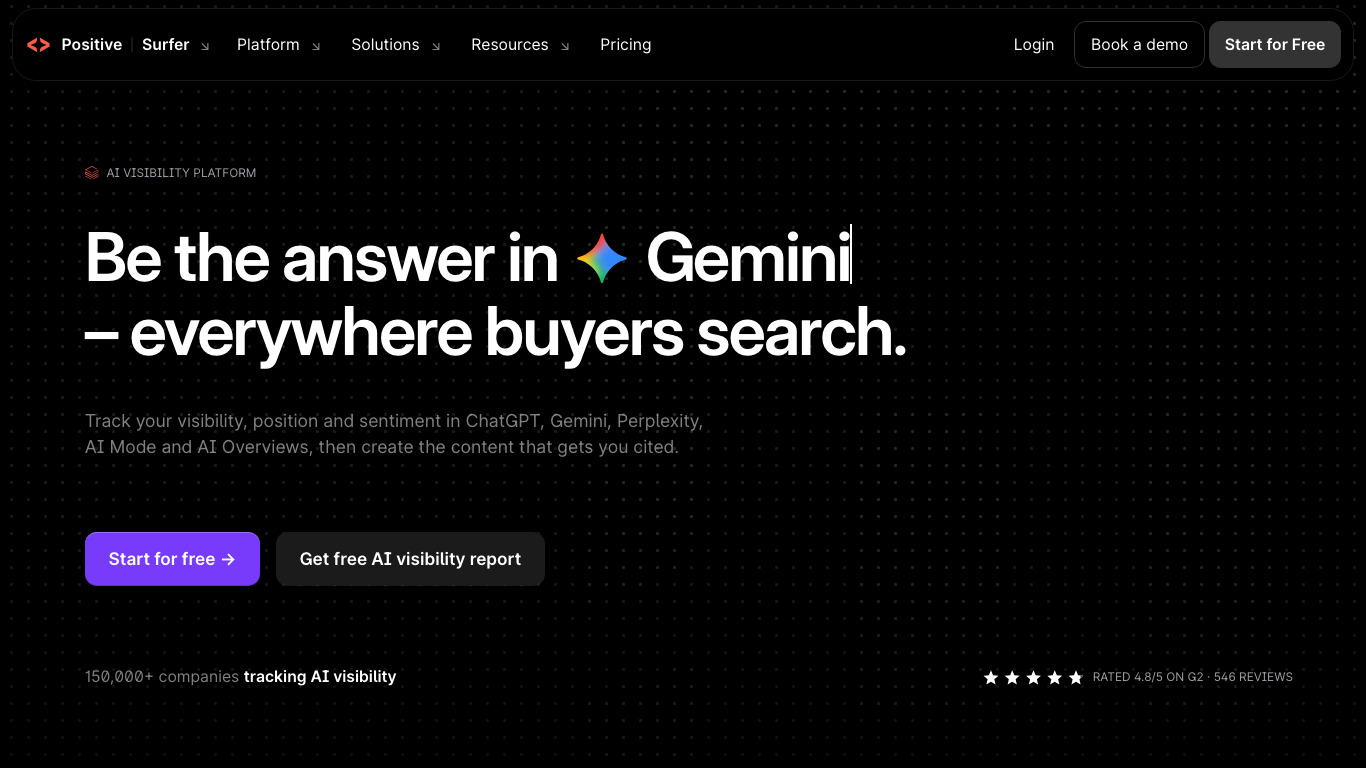
Best for: SEO writers who optimize pages for search and want AI visibility in the same tool.
If you mostly used Writesonic to write and optimize articles, Surfer is the editor-first alternative. Its Content Editor scores a draft against the pages that already rank while you write, which gives a writer something concrete to aim at, and Surfy, Topical Map and Content Audit sit around it. The AI Tracker adds visibility score, mention gaps, share of voice and sentiment across ChatGPT, Perplexity, Google AI Mode, Google AI Overviews and Gemini. Plan choice matters here: Standard tracks ChatGPT only, weekly, so teams that care about AI visibility should go straight to Pro or the tracking-only plan. Claude is not tracked on any plan.
Tracking and content
- Content Editor with Content Score and real-time guidelines
- Surfy writing assistant, humanizer and plagiarism check
- AI Tracker with mention gaps and competitor share of voice
- WordPress and Google Docs integrations
Pricing
- Discovery: $59/mo, 120 documents, no AI tracking
- AI Search Analytics: $95/mo, tracking only, 50 prompts on five engines
- Standard: $119/mo, 360 documents, ChatGPT only, weekly
- Pro: $219/mo, 360 documents, five engines daily
- Peace of Mind: $359/mo, unlimited documents (fair use)
- Seven-day free trial
Strengths and drawbacks
- Strengths: a mature on-page editor; a tracking-only plan for teams that write elsewhere.
- Drawbacks: no Claude; multi-engine daily tracking starts at $219 on the content plans.
Verdict: the right move for writers who want an editor first and AI tracking second.
6. Frase
Briefs, articles and audits, with AI visibility on every plan.
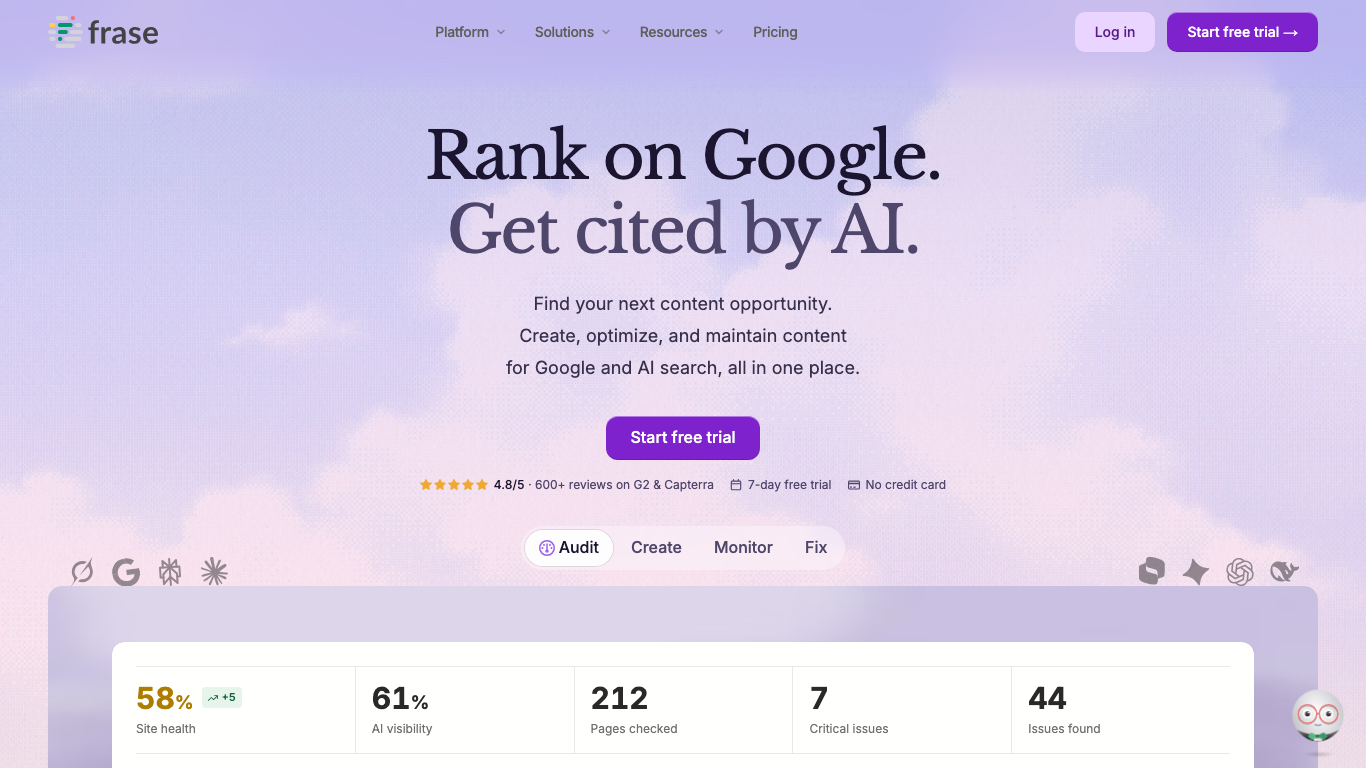
Best for: small content teams that want one tool to research, write and track.
Frase is the tool closest to what made Writesonic popular, writing and tracking in one bill, at a lower entry price. An agent researches, writes and can publish articles to WordPress, Webflow and other CMSs. Content Guard watches published pages for decay and drafts the fixes, which is the part that saves time once a site has a back catalogue, and AI Visibility monitors engines daily with alerts. Engine coverage grows with the plan: ChatGPT and Google AI on Starter, Perplexity on Professional, Claude and Gemini on Scale.
Tracking and content
- Research, writing and publishing agent
- Site audits and Content Guard decay monitoring
- AI Visibility tracking with alerts on every plan
- API, MCP and CLI access on every plan
Pricing
- Starter: $49/mo ($39 billed yearly): 10 articles, 20 AI prompts, ChatGPT and Google AI
- Professional: $129/mo: 40 articles, 50 prompts, adds Perplexity
- Scale: $299/mo: 100 articles, 75 prompts, adds Claude and Gemini
- Seven-day free trial with no card
Strengths and drawbacks
- Strengths: writing, audits and tracking at a $49 entry; overage is off by default, so the bill holds.
- Drawbacks: two engines and 20 prompts on Starter; Claude starts at $299; articles are capped by plan, as on Writesonic.
Verdict: the closest like-for-like swap for Writesonic's writer, at half the entry price.
7. AirOps
Content workflows with tracking in the same workspace.
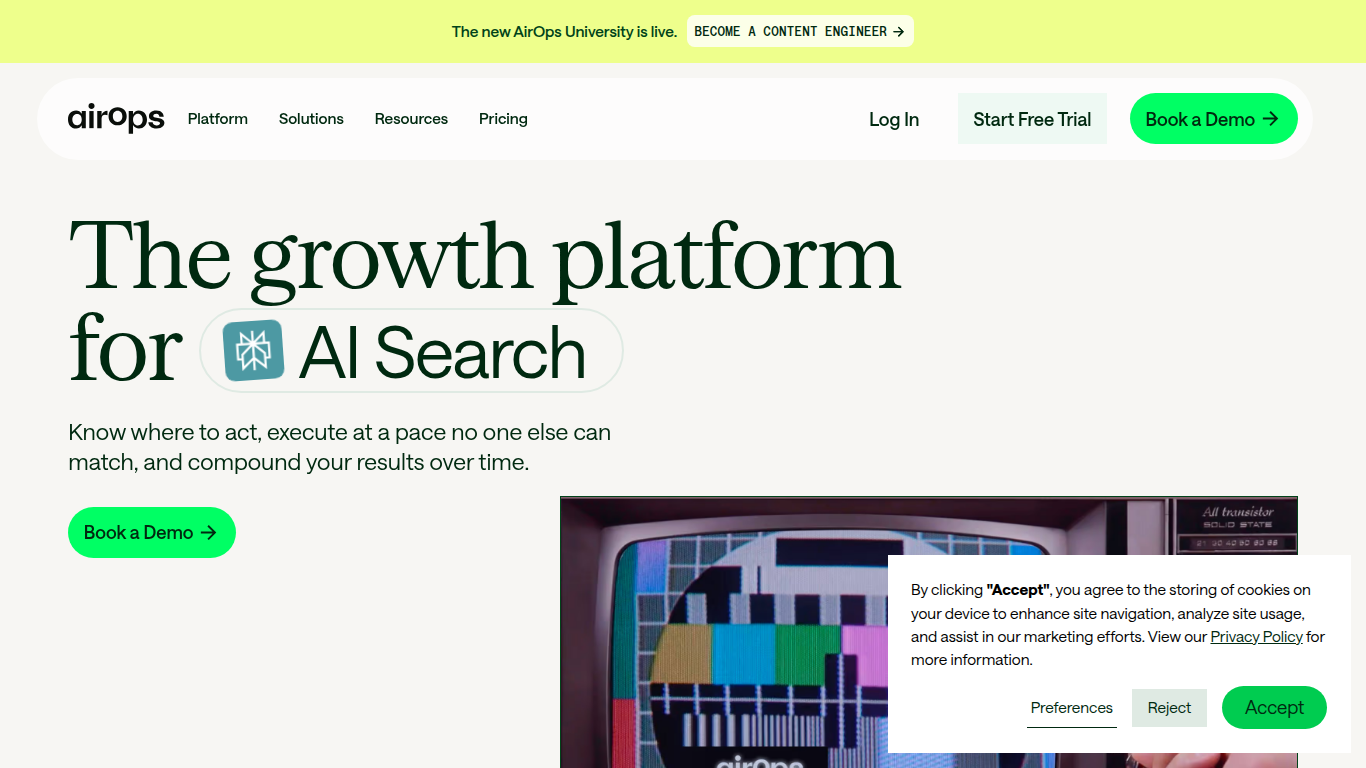
Best for: content teams that want to build their own workflows on top of AI visibility data.
If Writesonic's fixed article writer feels too rigid, AirOps lets a team build the process instead. Its Quill agent and workflows run content creation, refreshes, localization and offsite plays, and Insights tracks mention rate, citation rate, share of voice and sentiment. It rewards teams with someone to own those workflows; a team that only wants articles out of a box will find more setup than it needs. Solo tracks ChatGPT only, and Pro adds 10+ answer engines, Claude included. On AirOps' newer billing model, content and tracking draw on one monthly task balance, and each Claude answer costs four tasks.
Tracking and content
- Insights by platform, persona and region
- Quill agent, workflows and Grids for content at scale
- Page360 view joining AI citations with Search Console and GA4
- CMS integrations including WordPress, Webflow and Contentful
Pricing
- Solo: price not published, 35,000 tasks a month, ChatGPT tracking
- Pro: price not published, 100,000 tasks a month, 10+ engines
- Enterprise: custom
- 14-day free trial
Strengths and drawbacks
- Strengths: flexible workflows; tracking and content in one workspace.
- Drawbacks: no published price for Solo or Pro; on the newer billing model, content and tracking share one task balance.
Verdict: a fit for teams that want to engineer their content process, less so for teams that want a fixed price.
8. Otterly AI
The lowest paid entry on this list.
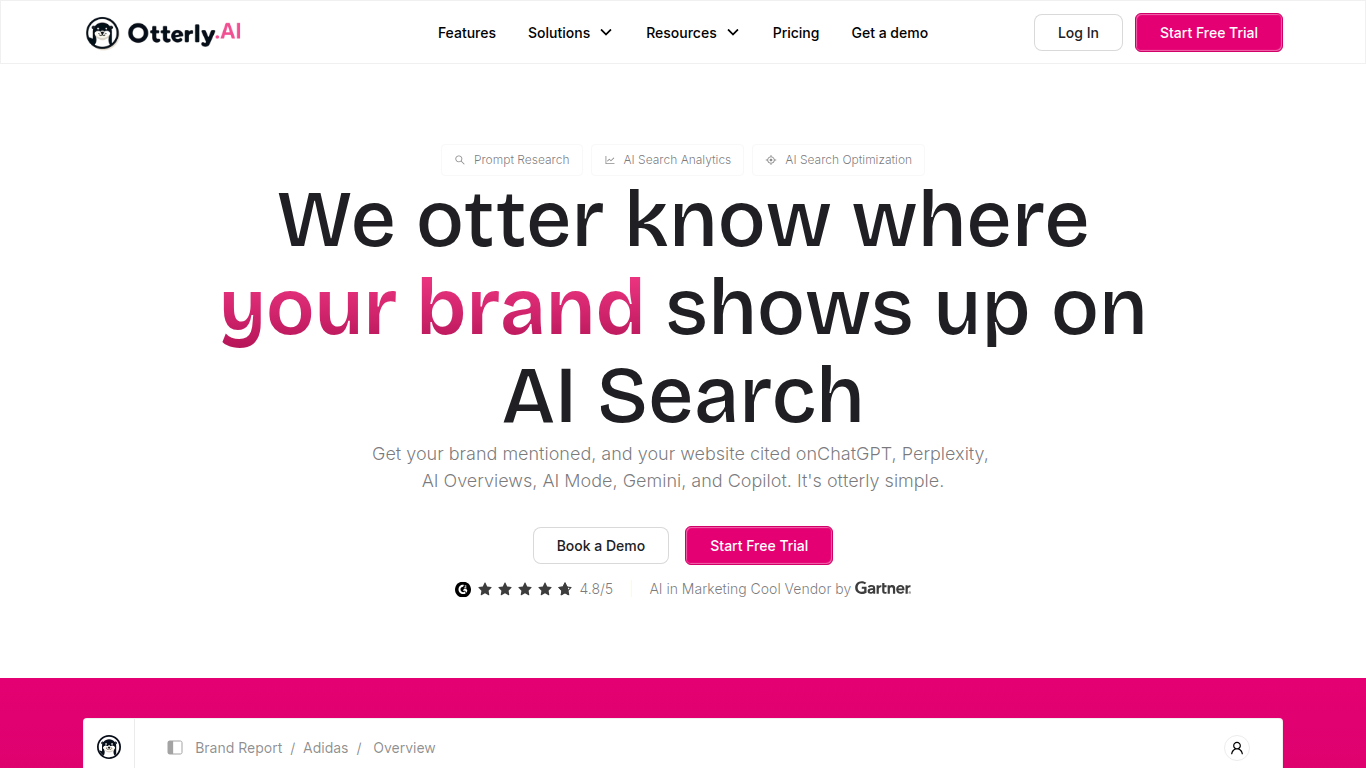
Best for: small teams that want simple, cheap AI visibility tracking.
If you only need the tracking half of Writesonic on a small budget, Otterly AI starts at $29 a month and keeps the product simple: prompts in, mentions and cited URLs out, with prioritized fixes and GEO audits on top. Every plan includes ChatGPT, Google AI Overviews, Perplexity and Microsoft Copilot; Gemini, Google AI Mode and Claude are paid add-ons, and that is where the bill grows. The plans give content briefs rather than drafts, though Otterly runs a free GEO Content Creator outside its plans that writes articles, listicles and comparisons. The Otterly alternatives guide covers the field.
Tracking and content
- Brand mentions and every cited URL, per prompt and engine
- GEO audits and prioritized recommendations
- Agent Analytics for AI crawlers on Standard and Premium
- Unlimited team members
Pricing
- Lite: $29/mo: 15 prompts
- Standard: $189/mo: 100 prompts
- Premium: $489/mo: 400 prompts
- Add-ons: Gemini and AI Mode from $9, Claude from $29 on Lite
- Free trial
Strengths and drawbacks
- Strengths: the lowest paid entry; Perplexity included on every plan.
- Drawbacks: no article writing inside the paid plans; Lite has no API, no MCP and three recommendations a week; add-ons raise the bill quickly.
Verdict: the budget tracker; pair it with a writer if you used Writesonic for both.
9. Semrush AI Visibility Toolkit
AI tracking inside the SEO suite you already use.
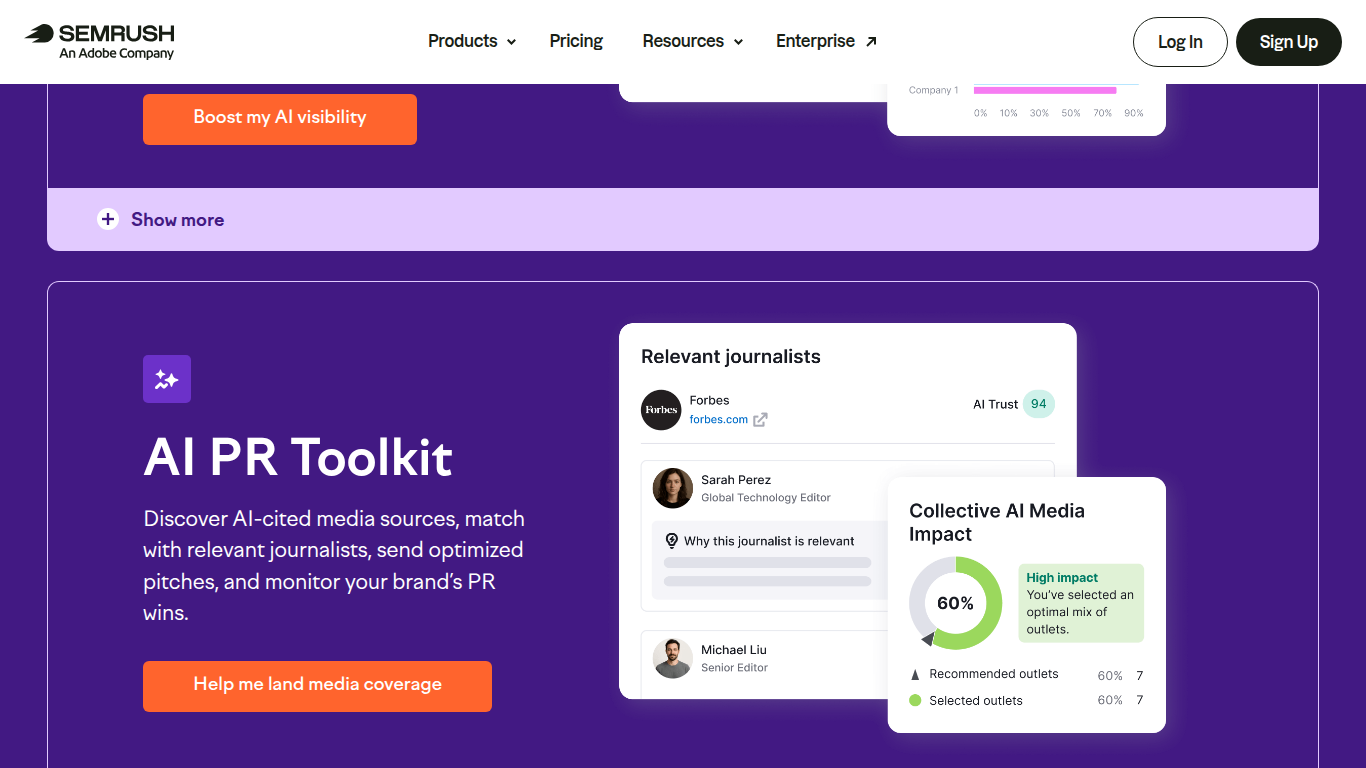
Best for: SEO teams that already report in Semrush.
For teams that live in Semrush, the AI Visibility Toolkit's main appeal is not adding another login: AI mentions sit next to the rankings and audits the team already reports on. It covers ChatGPT, Google AI, Gemini and Perplexity, with prompt tracking, competitor benchmarks and AI checks in Site Audit. The limits show up quickly at 25 prompts per domain, and writing is a separate purchase: the Content Toolkit, at $60 a month, includes an AI article generator. Claude is tracked only on the custom-priced Enterprise AIO product. The Semrush AI Visibility Toolkit alternatives guide covers the trade-offs.
Tracking and content
- Daily prompt tracking with sentiment and narrative reports
- Brand Performance reports against competitors
- AI-ready checks in Site Audit
- Content Toolkit (separate) for AI-written articles
Pricing
- AI Visibility Toolkit: $99/mo per domain, 25 prompts, one project
- Extra prompts: 50 more for $60/mo
- Content Toolkit: $60/mo
- Semrush One: from $199/mo with SEO and AI visibility together
Strengths and drawbacks
- Strengths: AI data beside the SEO data a team already trusts; one login for both.
- Drawbacks: 25 prompts for $99; pricing is per domain; no Claude outside Enterprise AIO; content costs extra.
Verdict: the simple choice for Semrush teams; a dedicated tool gives more prompts and engines for the money.
10. Jasper
For teams that only ever used the writer.
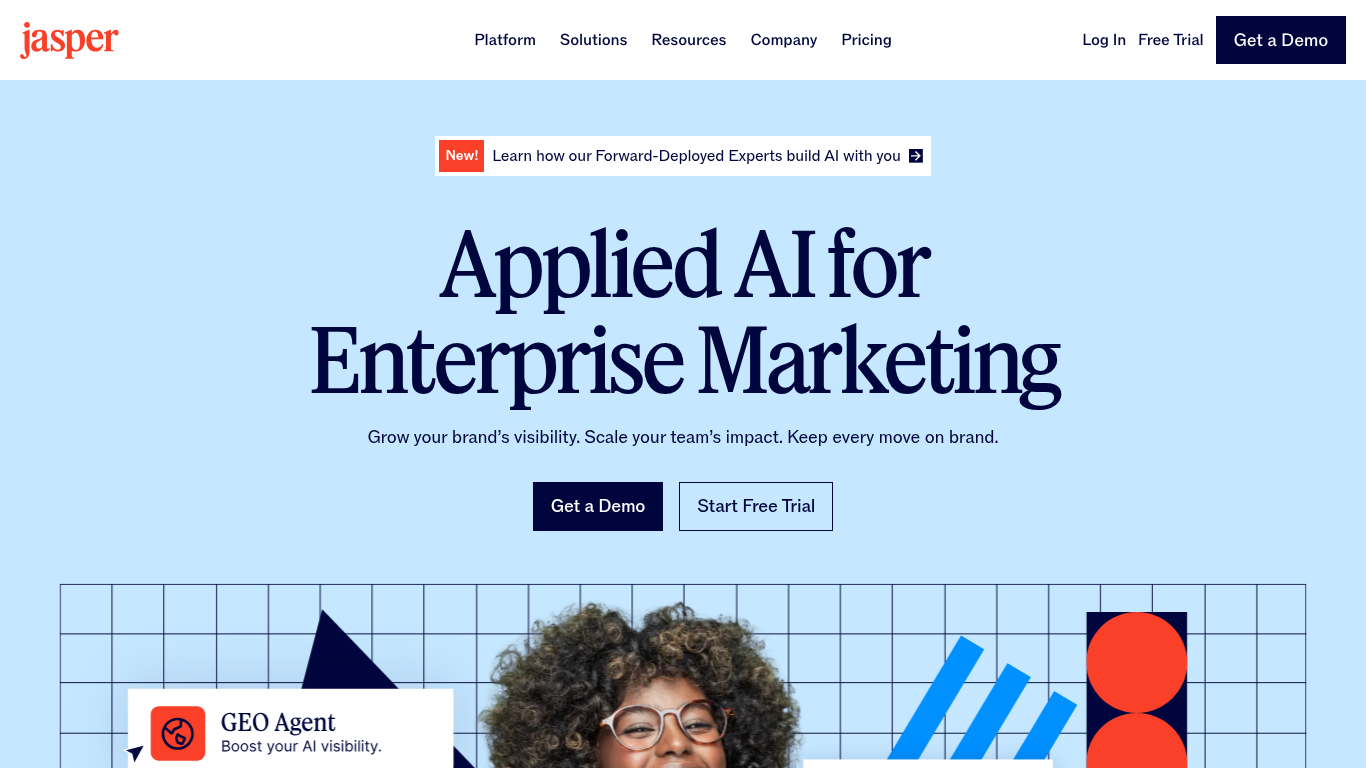
Best for: marketing teams that bought Writesonic to write and never needed the tracking.
If you came to Writesonic for copy and blog posts, Jasper keeps the focus on writing, with more control over how the brand sounds. Pro includes 100+ marketing agents, the Canvas editor, brand voices and an image suite in 30+ languages, which suits a marketing team producing campaigns and posts every week. AI visibility monitoring and GEO agents sit on the custom Business plan only, so on Pro it is purely a writing tool.
Pricing
- Pro: $69/mo per seat ($59 billed yearly), seven-day free trial
- Business: custom, with GEO agents, Jasper Studio, API and SSO
Strengths and drawbacks
- Strengths: brand-governed writing at volume, with brand voice, knowledge and audience controls built in.
- Drawbacks: priced per seat; no AI visibility tracking below Business.
Verdict: the writer-only replacement; pair it with a tracker if AI visibility matters later.
How content limits compare
Writesonic caps content by plan, and so does Frase: 15 to 50 AI articles a month on Writesonic, 10 to 100 on Frase. Peec AI, Profound and AthenaHQ let agents draft content, but every run spends credits: Peec and Profound publish their allowances, AthenaHQ does not. On its newer billing model, AirOps draws content and tracking from one task balance. Surfer counts documents per plan, from 120 on Discovery to unlimited under fair use on its top tier. Semrush sells content as a separate toolkit, and Otterly keeps article writing outside its paid plans. Geoptie puts no quota or credit meter on articles, optimizations or audits on any plan, so the bill stays the same however much content a team produces. To check how well an existing page is set up to be cited, the free GEO content checker scores it.
How to choose the right Writesonic alternative
Do you need Claude or Perplexity tracked?
If yes, Geoptie and AthenaHQ include both on a published plan, Peec AI includes Perplexity, and Frase reaches both on Scale. Writesonic, Peec AI, Profound and Semrush keep Claude for Enterprise contracts.
How much content will you produce each month?
A few pieces a month fit inside Frase's or Writesonic's caps. Weekly or daily output favours a tool without a quota, or a credit allowance sized for it.
Do you already pay for an SEO suite or a writer?
Semrush users can add AI tracking where they already work. Teams with a writing tool they like can pick a tracker such as Otterly AI or Peec AI and leave content where it is.
FAQ
What is the best Writesonic alternative for AI visibility?
It depends on what you use Writesonic for. Geoptie is the closest swap for the full bundle, with tracking on seven engines and unlimited content generation from $49 a month. Peec AI suits brands that want a tracker with public prices and an agent on top, Profound suits enterprises that want citation data and content agents on one contract, and AthenaHQ fits teams that want Claude and many engines on one plan.
Which Writesonic alternatives track Claude and Perplexity?
Geoptie includes both on every plan from $49 a month, and AthenaHQ includes both on its $295 Starter plan. Peec AI tracks Perplexity on its self-serve plans but keeps Claude for Enterprise, Frase adds Perplexity on Professional and Claude on Scale, and Otterly AI includes Perplexity with Claude as a paid add-on. Writesonic itself keeps both for its custom-priced Enterprise plan.
How much does Writesonic cost per month?
On monthly billing, Starter is $99, Basic is $249 and Growth is $499, with Enterprise priced by quote. Annual billing saves 20%, which is where the $79, $199 and $399 figures come from. Every self-serve plan tracks ChatGPT, Gemini and Google AI Overviews and includes 15, 25 or 50 AI articles a month.
Which Writesonic alternatives also write content?
Most of them. Geoptie writes unlimited articles on every plan, Peec AI and Profound draft content through agents paid for in credits, AthenaHQ writes articles on content credits, Frase and Surfer are content platforms with AI tracking added, and AirOps runs content workflows on a task balance. Otterly AI gives briefs and recommendations in its plans and offers a separate free content creator, and Semrush sells content as its own Content Toolkit.
Is Writesonic still an AI writing tool?
Partly. Writesonic now sells itself as an AI search visibility platform, but its AI Article Writer is still included in every plan, alongside site audits and content optimization. The writer is capped at 15, 25 or 50 articles a month depending on the plan.
What is a cheaper alternative to Writesonic?
Otterly AI starts at $29 a month for 15 prompts on four engines. Geoptie starts at $49 with seven engines, Claude and Perplexity included, and unlimited content generation, and Frase starts at $49 with 10 articles and AI tracking on two engines. All three cost less than Writesonic's $99 Starter on monthly billing.
Does Writesonic have a free trial?
Yes. Writesonic offers a seven-day free trial with full access and no credit card. Frase, Surfer, Profound and Jasper also offer seven-day trials, Peec AI offers seven days with a card, Otterly AI offers a free trial and AirOps offers 14 days. Geoptie has no trial, but its free GEO audit and AI rank trackers run without a subscription.
When Writesonic is still the right choice
Writesonic still makes sense for a team that wants articles, site audits and AI tracking on one bill and gets what it needs from ChatGPT, Gemini and Google AI Overviews. If the article caps fit your publishing pace and Claude or Perplexity data can wait, there is little reason to switch. Teams that want to see where they stand first can run the free GEO audit, and the guide to the best AI visibility tools covers the wider category.