Ask ChatGPT, Perplexity or Google's AI Overview which product to buy in a category and the answer usually comes with sources: a handful of web pages the engine drew on. Those pages shape which brands a buyer reads about next, and they are often not the pages that rank first on Google.
AI citation tracking is the work of recording which URLs and domains AI answers cite for the prompts in a brand's category, how often, and whether the brand's own pages make the list. This guide covers AI citation tracker tools for brands and marketing teams that want to see which sources ChatGPT cites, along with Perplexity, Google AI Overviews and similar engines. It does not cover academic tools for referencing AI output in APA or MLA. The nine tools below were shortlisted from recent comparisons of citation trackers, and each was checked against its own product and pricing pages in October 2026 for how deep its citation data goes and which plan unlocks it.
TL;DR
- Geoptie: best for content and SEO teams that want every cited URL in the order the engine cited it, plus the briefs and drafts to earn those citations, from $49/mo.
- Otterly AI: best for small teams that want URL-level citation reports and link positions on a $29 plan.
- Profound: best for enterprise brands that want source categories, Watched Pages and citation share on a custom contract.
Quick comparison
| Tool | Best for | AI engines covered | Pricing model | Starting price |
|---|---|---|---|---|
| Geoptie | Content and SEO teams that want cited URLs in order plus the content to earn citations | ChatGPT, Claude, Perplexity, Gemini, Google AI Overviews, Google AI Mode, Microsoft Copilot | Monthly plan, no usage meter | $49/mo |
| Profound | Enterprise brands with a dedicated AI search budget | ChatGPT, Perplexity, Google AI Overviews, Google AI Mode, Gemini, Microsoft Copilot, Claude, DeepSeek, Exa Search | Custom contract | Custom |
| Otterly AI | Solo marketers and small teams on a tight budget | ChatGPT, Google AI Overviews, Perplexity, Microsoft Copilot (Google AI Mode, Gemini, Claude as add-ons) | Monthly plan, engine add-ons | $29/mo |
| Peec AI | In-house teams planning PR and outreach from source data | Any 3 of ChatGPT, Google AI Overviews, Google AI Mode, Gemini, Microsoft Copilot, Perplexity, Naver AI (Claude on Enterprise) | Monthly plan, model add-ons | $95/mo |
| Ahrefs Brand Radar | Brand and SEO teams researching citations across a whole market | Google AI Overviews, Google AI Mode, ChatGPT, Perplexity, Gemini, Microsoft Copilot, Claude (Custom Prompts) | Ahrefs plan plus check packages | $129/mo |
| Scrunch | Mid-market brand teams separating owned, competitor and third-party citations | ChatGPT, Perplexity, Google AI Overviews, Microsoft Copilot (more on Enterprise) | Monthly plan | $250/mo |
| Semrush | SEO teams already working in Semrush | ChatGPT, Gemini, Perplexity, SearchGPT, Google AI Overviews, Google AI Mode | Per domain, or bundled into SEO plans | $99/mo |
| SE Ranking | SEO teams reporting rankings and AI sources side by side | ChatGPT, Gemini, Google AI Overviews, Google AI Mode | SEO plan, optional AI Search add-on | $129/mo |
| HubSpot AEO | HubSpot users and small teams that want a low-cost three-engine tracker | ChatGPT, Gemini, Perplexity | Monthly plan, extra prompts on demand | $50/mo |
1. Geoptie
AI visibility platform that shows every URL an engine cited, in order, and turns citation gaps into content.
Geoptie records the sources behind every tracked answer and pairs that citation data with the content work needed to earn more of it, from $49 a month.
What the citation data shows. Each tracked answer lists the URLs the engine cited, in the order it cited them, so citation position is visible prompt by prompt. Across all of a brand's prompts, top cited pages and top cited domains show which sources an engine leans on for the category, and a separate view follows the brand's own domain's citations over time. Prompts refresh daily in any of 123 countries, one market per prompt.
- Brand mentions alongside citations, with sentiment on every answer and competitor share of voice
- Recommendations that point at the pages engines cite, plus unlimited audits, Content Studio briefs and drafts, and content optimization on every plan
- REST API and MCP server on Professional and Enterprise, exposing cited URLs, cited domains and a citation trend per domain or page
- White-label PDF reports, a citations report among them, with free read-only client seats and brand-scoped API keys on Professional and Enterprise
For Google specifically, the free AI Overviews tracker checks whether Google's AI Overview cites your site for any search, in any of 123 countries, and shows every source it used, free and with no signup.
Limitations. Each brand tracks four of the seven engines at a time, chosen per brand. Brand recognition is lower than Semrush or Ahrefs.
Pricing
- Starter: $49/month. 15 prompts, 2 brands.
- Professional: $99/month. 100 prompts, 10 brands, API, MCP and white-label reports.
- Enterprise: $399/month. 400 prompts, unlimited brands.
- Annual billing gives two months free.
2. Profound
Enterprise AI search platform with URL-level citation analytics and source categories.
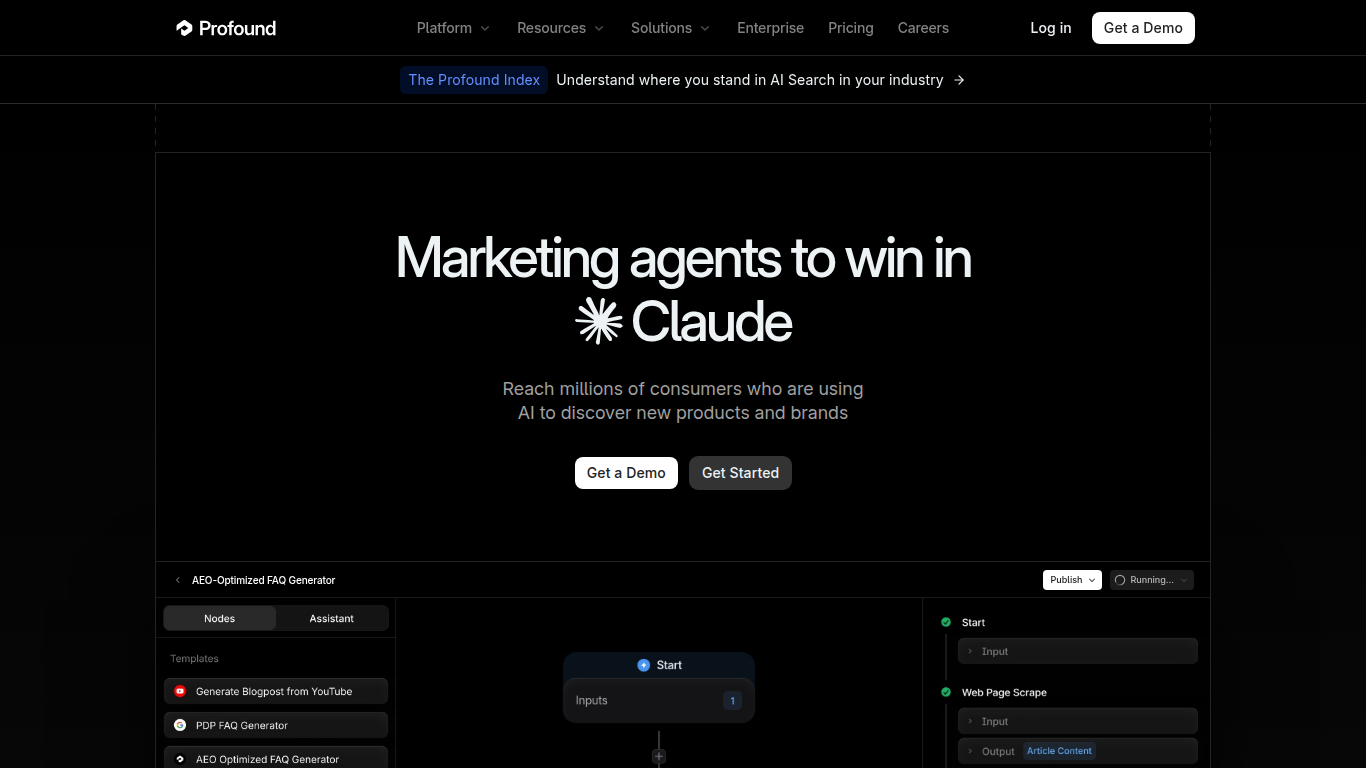
Profound shows every cited URL for each prompt it monitors, competitor domains included, and sorts each source into a category: Owned, Competitor, Earned Media, PR Wire, Social or Institution. Citation share can be compared by platform, topic and prompt, and Watched Pages follow citation volume for a single URL after it is published or updated. Teams without an enterprise budget can weigh Profound alternatives.
- Daily citation collection across up to nine answer engines on Enterprise
- Earned Media filters that surface the publishers and authors cited most often in a category
- CSV and JSON exports, plus Profound Agents that turn citation findings into briefs or outreach lists on credits
- Agent Analytics for AI crawler and referral traffic, with SSO/SAML and unlimited seats
Limitations. Brands have no self-serve paid plan, so ongoing citation tracking means a sales-led contract. The free trial runs a recommended prompt set for seven days with no history or exports. G2 reviewers mention a steep learning curve and occasional bugs.
Pricing
- Trial: free for 7 days. 50 prompts daily on ChatGPT, Gemini and Google AI Overviews.
- Enterprise: custom pricing through a demo.
- Agency Growth: $99/month plus $399/month per client workspace.
3. Otterly AI
Self-serve AI search monitor with URL-level citation reports on every plan, Lite included.
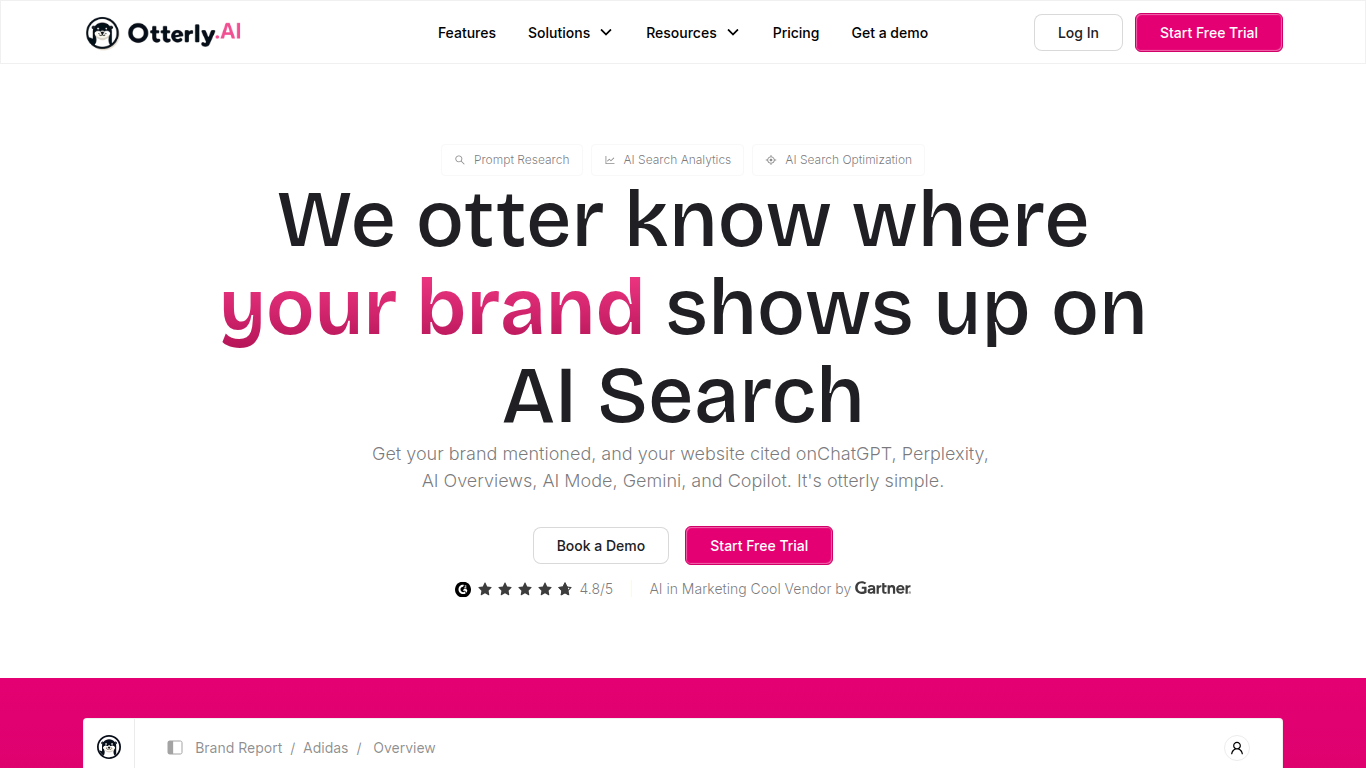
Otterly is the cheapest way on this list into URL-level citation data. It stores every cited URL per prompt and per engine, ranks the cited domains by weight, and tracks link positions as they move from week to week. A mention check flags whether each cited page names the brand or a competitor, so third-party pages that cite the category but ignore the brand become an outreach list. A wider comparison sits in Otterly alternatives.
- Citation Changes, which sorts cited URLs into top, new, increased, stable, decreased and lost against the previous period
- Link citation analysis, domain ranking and the Brand Visibility Index on every plan
- Daily tracking in more than 50 countries, with unlimited team members
- API, MCP and a Looker Studio connector from Standard
Limitations. The base engines are ChatGPT, Google AI Overviews, Perplexity and Microsoft Copilot; Google AI Mode, Gemini and Claude are paid add-ons on every plan. Lite covers 15 prompts in one workspace, with no API or MCP. G2 reviewers praise ease of use but mention dashboard clutter at high prompt volumes.
Pricing
- Lite: $29/month ($25/month billed annually). 15 prompts.
- Standard: $189/month ($160/month billed annually). 100 prompts.
- Premium: $489/month ($422/month billed annually). 400 prompts.
- Claude add-on: $29, $109 or $439 a month by plan. Custom Enterprise from 1,000 prompts. Free trial available.
4. Peec AI
Prompt-based AI search analytics that separates pages a model retrieved from pages it cited.
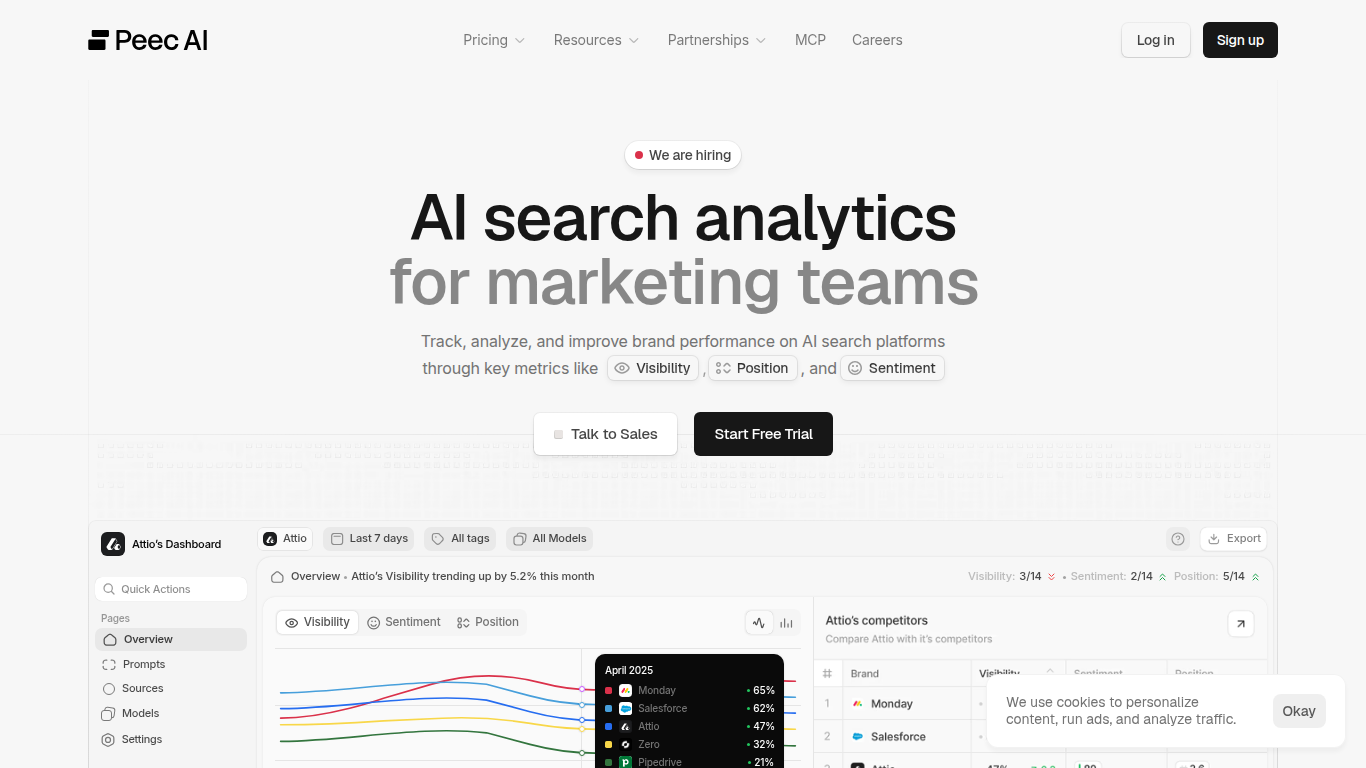
Peec puts sources at the center of its product. It reports the pages a model retrieved while building an answer separately from the ones it actually cited, and classifies each source as editorial, corporate, UGC, reference, competitor or your own site. Every domain and URL has a detail view showing which prompts keep pulling it in over time, and the full source analytics set is included on Starter. Readers comparing it with similar dashboards can start with Peec AI alternatives.
- Domain, subdomain and URL tracking with citation share
- Gap analysis that ranks sources naming competitors but not you, down to the URL
- Page-type labels for cited URLs, such as listicles, how-to guides and comparisons
- Unlimited users, daily tracking and an MCP server on every plan
Limitations. Each self-serve plan tracks three models, and a fourth costs $30 to $140 a month depending on plan. Claude is Enterprise-only, and Starter covers one project in one country.
Pricing
- Starter: $95/month ($80/month billed annually). 50 prompts, 3 models.
- Pro: $245/month ($205/month billed annually). 150 prompts.
- Advanced: $495/month ($420/month billed annually). 350 prompts.
- Enterprise: custom, up to 13 models. 7-day free trial.
5. Ahrefs Brand Radar
AI visibility index with Cited Pages and Cited Domains reports across more than 500 million prompts.
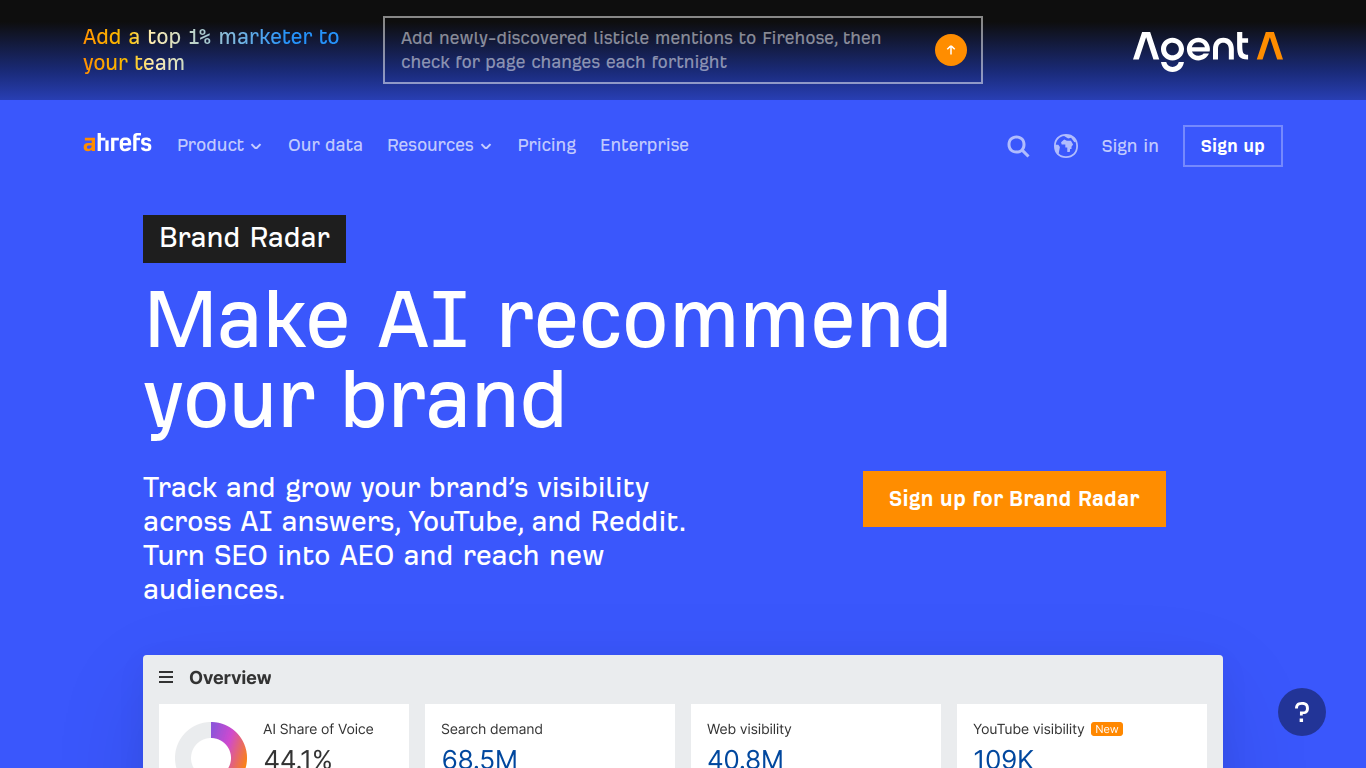
Brand Radar answers the citation question at market scale. Its Cited Domains and Cited Pages reports show which sites and URLs AI answers cite for any brand or topic, drawn from an index of more than 500 million prompts modeled on Ahrefs' search data, so competitor citation gaps can be found with no prompt setup. It also keeps pages an AI found but did not cite apart from the pages it cited. Custom Prompts track a team's own questions and record the cited pages for those too.
- Cited Pages filters for third-party pages, Reddit threads included, that cite competitors but not you
- Mentions, citations, impressions and AI share of voice per brand, also available through the API
- Custom Prompts on a daily, weekly or monthly cadence, with fanout queries for each prompt
- API and MCP access from the Lite plan
Limitations. The quota bundled with Lite covers 5 prompts a day on one platform, and Claude uses 8 checks per update. The Index is a separate add-on, has limited coverage for brands with little search demand, and each plan includes one user.
Pricing
- Lite: $129/month, with 5 Custom Prompts (150 checks a month) included.
- Custom Prompts packages: $50/month (2,500 checks), $100/month (7,000), $250/month (25,000).
- AI Visibility Index: from $199/month.
- Annual billing saves up to 17%.
6. Scrunch
AI visibility platform with a citations dashboard on its $250 Core plan.
Scrunch records every source cited in answers to tracked prompts and splits citation share by owner: the brand, its competitors and third parties. Each domain or URL carries a unique prompt count, total citations, a citation consistency rate and an Influence Score, which multiplies the share of responses citing a source by the number of prompts it appears in. Filters cover timeframe, topic, platform, persona, funnel stage and country. Cheaper routes to similar data are in Scrunch alternatives.
- Citations and sources on Core as well as Enterprise
- Mention and sentiment tracking with competitor share of voice
- Five site audits and one page optimization a month on Core, plus basic content generation
- Five user licenses on Core
Limitations. Core tracks ChatGPT, Perplexity, Google AI Overviews and Microsoft Copilot; Google AI Mode, Gemini and Claude are Enterprise-only. Core includes one brand workspace, and API access and SSO start on Enterprise.
Pricing
- Core: $250/month. 125 prompts, 4 engines.
- Enterprise: custom, with expanded engine coverage, AXP, API and SSO.
- 7-day free trial.
7. Semrush
SEO platform whose Prompt Tracking lists every cited domain and URL, ranked by citation order.
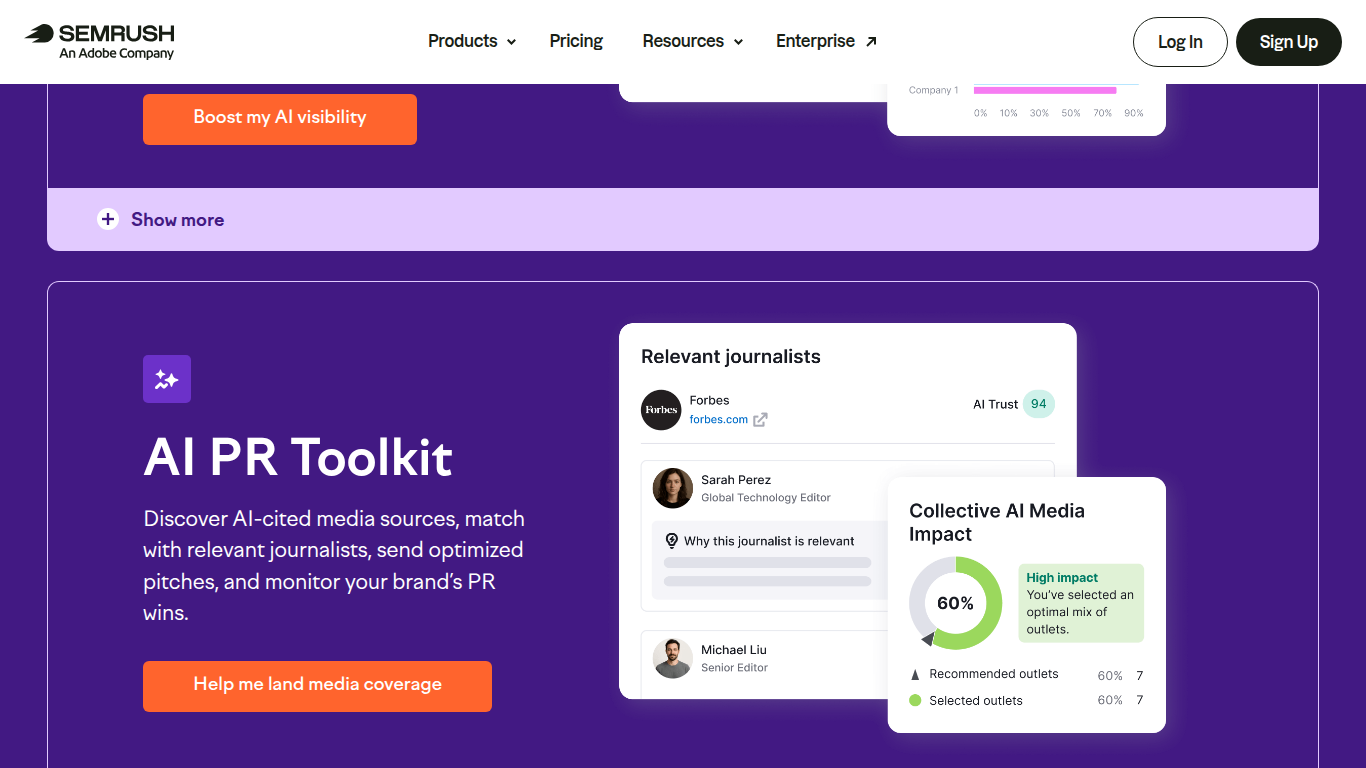
Semrush treats AI answers the way its classic Position Tracking treats search results. In ChatGPT Search, Google AI Mode and Gemini, Prompt Tracking ranks each cited domain by where it appears in the answer's citations, and a Sources report lists every domain and URL cited for the tracked prompts, your own pages included. The Visibility Overview adds Mentions, Citations and Cited Pages, while Source Opportunities lists sites that cite competitors but not you.
- Daily prompt tracking on the AI Visibility Toolkit or a Semrush One plan
- AI-Cited Media in the separate AI PR Toolkit, which ranks the outlets AI platforms cite for a topic and the journalists who write for them
- Sentiment and narratives across 68,000+ location-language combinations, refreshed weekly
- White-label reports through the $20/mo Pro Report add-on
Limitations. Claude is not tracked on any plan. The $99 toolkit covers one domain and 25 prompts, and more prompts mean moving to Semrush One plans that bundle a full SEO suite. Extra users cost from $45/mo each.
Pricing
- AI Visibility Toolkit: $99/month per domain. 25 prompts tracked daily.
- Semrush One Starter: $199/month (50 prompts daily). Pro+: $299/month (100 prompts daily). Advanced: custom.
- Annual billing saves up to 17%. Suite plans include a free trial.
8. SE Ranking
SEO suite with AI source analysis and link positions built into its standard plans.
SE Ranking follows both linked and unlinked brand references in AI answers and shows where each link sits within the answer. Its source analysis maps the domains and URLs that appear in AI answers, groups them by type such as media, blogs and forums, and highlights the sources that carry the most weight. Core includes 100 prompts tracked daily across ChatGPT, Gemini, Google AI Overviews and Google AI Mode, collected through the same interface a real user sees.
- AI competitor research on any domain, including how often it is cited and its average position
- Cached copies of AI answers with historical data
- Tracking across 7 markets, filterable in 5 languages
- API and MCP access from Core, with mentions, citation links and competitor metrics in the API
Limitations. Claude and Perplexity are not tracked. Teams that only want citation data still pay for a full SEO suite, and white-label reporting needs the Agency Pack on annual billing.
Pricing
- Core: $129/month ($103.20/month billed annually). 100 prompts tracked daily.
- Growth: $279/month ($223.20/month billed annually). 250 prompts daily.
- AI Search add-on: $89/month for 200 more prompts and the SE Visible dashboard.
- 14-day free trial, no card required.
9. HubSpot AEO
Low-cost AEO tracker with domain, page and content-type citation analysis, no HubSpot subscription required.
HubSpot AEO, still labeled beta, tracks prompts in ChatGPT, Gemini and Perplexity and updates its visibility score daily. Its citation analysis shows which domains, pages and content types AI answers reference for a brand and its competitors, sorts sources into owned, competitor, third-party, social, affiliate and other types, and charts citation rate against competitors over time. It runs on its own, and it is also included in Marketing Hub Professional and Enterprise.
- Prompt-level view with the exact response each engine returned, filterable by buyer's-journey stage
- Visibility score and competitor share of voice over time
- Prioritized recommendations for what to fix
- The free AEO Grader for a one-time snapshot across the same three engines
Limitations. Coverage stops at three engines, so Google AI Overviews, Google AI Mode, Microsoft Copilot and Claude are not tracked. The base plan covers 25 prompts for one brand, and each additional brand is another $50 subscription.
Pricing
- HubSpot AEO: $50/month ($45/month billed annually). 25 prompts, with more available to buy at any time.
- Included in Marketing Hub Professional and Enterprise.
- Free trial with 25 prompts, no card required.
How to choose an AI citation tracker
Decide first what the citation data has to answer. Teams improving their own pages need URL-level data for each prompt, while teams planning PR and outreach need the third-party domains that cite competitors and leave them out.
- To turn citation gaps into content: Geoptie, with recommendations, briefs and drafts unlimited on every plan.
- Where a link sits in the answer: Geoptie, Otterly, Semrush and SE Ranking all record citation position.
- The smallest monthly spend: Otterly from $29, Geoptie from $49 or HubSpot AEO from $50.
- Source classification for PR and outreach: Peec AI, Scrunch or Profound.
- Citation research across a whole market, without setup: Ahrefs Brand Radar.
- Citation data inside an SEO suite already in use: Semrush or SE Ranking.
- Enterprise procurement: Profound.
For coverage beyond the source layer, see this comparison of AI search visibility tools, and for Google's summaries in particular, the AI Overviews tracking tools roundup. Teams feeding citation data into their own dashboards can shortlist from AI visibility tools with API and MCP access, and ChatGPT-focused teams from the ChatGPT rank tracker tools list.
FAQ
What is AI citation tracking?
AI citation tracking records which web pages an AI answer engine cites as sources when it answers a set of prompts, and whether a brand's own pages are among them. A tracker runs the same prompts on a schedule in engines such as ChatGPT, Perplexity and Google AI Overviews, stores the cited URLs and domains, and shows how they change over time. It is a marketing measurement and has nothing to do with formatting AI output as an academic reference.
What is the difference between an AI mention and an AI citation?
A mention is the brand name appearing in the answer text. A citation is a web page listed as a source for that answer. A brand can be mentioned without any link to its site, and its pages can be cited in an answer that recommends a competitor, so tracking both shows whether engines talk about a brand and whether they rely on its content.
How can you see which sources ChatGPT cites?
Manually, run the prompt in ChatGPT with search on and open the Sources panel under the answer, which lists the cited pages and, separately, pages ChatGPT looked at without citing. That works for a handful of checks, but answers vary between runs, accounts and locations, so one look says little. A citation tracker runs the same prompts every day, keeps each cited URL and shows the trend across ChatGPT and the other engines.
What is the difference between URL-level and domain-level citation data?
Domain-level data counts how often a site such as reddit.com or g2.com is cited, while URL-level data names the exact page. Domains show which publishers an engine trusts for a category; URLs show which article, thread or product page to update, pitch or outperform. Every tool in this list reports both, and Geoptie, Otterly, Semrush and SE Ranking also record where a cited link sits within the answer.
How do you get cited more often in AI answers?
Start from the pages engines already cite for your prompts. If they are competitor comparison pages or third-party roundups, the options are to publish a stronger page on the same question or to earn a place on the page that is already cited. Direct answers near the top of a page, current facts and content that crawlers can read without JavaScript all help, and citation history shows which changes worked.
How often do AI citations change?
Often. The sources behind an answer can shift between runs of the same prompt, between days and between countries, and a page cited this week can drop out the next. Daily tracking read as a trend over several weeks gives a reliable picture where a single check does not.
Can you track Google AI Overviews citations?
Yes. Every tool here except HubSpot AEO tracks the sources Google's AI Overview cites, though Peec AI counts it as one of three chosen models and Profound offers it on its trial and Enterprise plan. For a one-off check, Geoptie's free AI Overviews tracker shows whether the AI Overview cites your site for any search, in any of 123 countries, and lists every source it used. The AI Overviews tracking tools roundup compares the options in more depth.
Turning citation data into citations
A list of the pages AI engines cite for a category is a starting point; the work is getting your own pages onto it. Geoptie shows every cited URL in the order each engine cited it, then turns each gap into recommendations, briefs and drafts, with plans from $49 a month.