Most AI visibility tools tell a brand where it ranks in AI answers; far fewer tell a technical team how the AI crawlers actually treat the site behind those answers. Scrunch AI leans into that second job, and it is where the platform is genuinely strong: its named crawler and agent-traffic analytics, paired with a GA4 view of AI referral traffic, are some of the best in the category for teams that think in logs and crawl budgets. What a buyer has to weigh is narrower: whether the $250 Core plan earns its price when its four tracked engines match much cheaper tools, and whether the parts Scrunch is increasingly known for, including Claude coverage and the Agent Experience Platform, justify moving to a custom Enterprise contract.
This review covers what Scrunch does across its plans, what it costs, where it leads, and where the tier gates change the math.
Scrunch AI at a glance
- Crawler and traffic analytics: the standout. Named tracking of ClaudeBot, GPTBot, and PerplexityBot, plus a GA4-connected view of AI referral traffic, is consistently the most-praised part of the platform.
- Engine coverage: four on the entry tier (ChatGPT, Perplexity, Google AI Overviews, Copilot), nine on Enterprise. Claude is gated to the top tier.
- Action and optimization layer: monitoring comes first. The recommendation and site-audit features work, but reviewers note they reward a team with in-house technical expertise to act on them.
- Setup and onboarding: hands-on, with a real curation cost. Auto-generated prompts skew toward branded queries, so accurate tracking needs manual prompt work up front.
- Pricing accessibility: the weak spot. Core starts at $250/mo for the same four engines that flat-priced trackers cover for far less.
What is Scrunch AI?
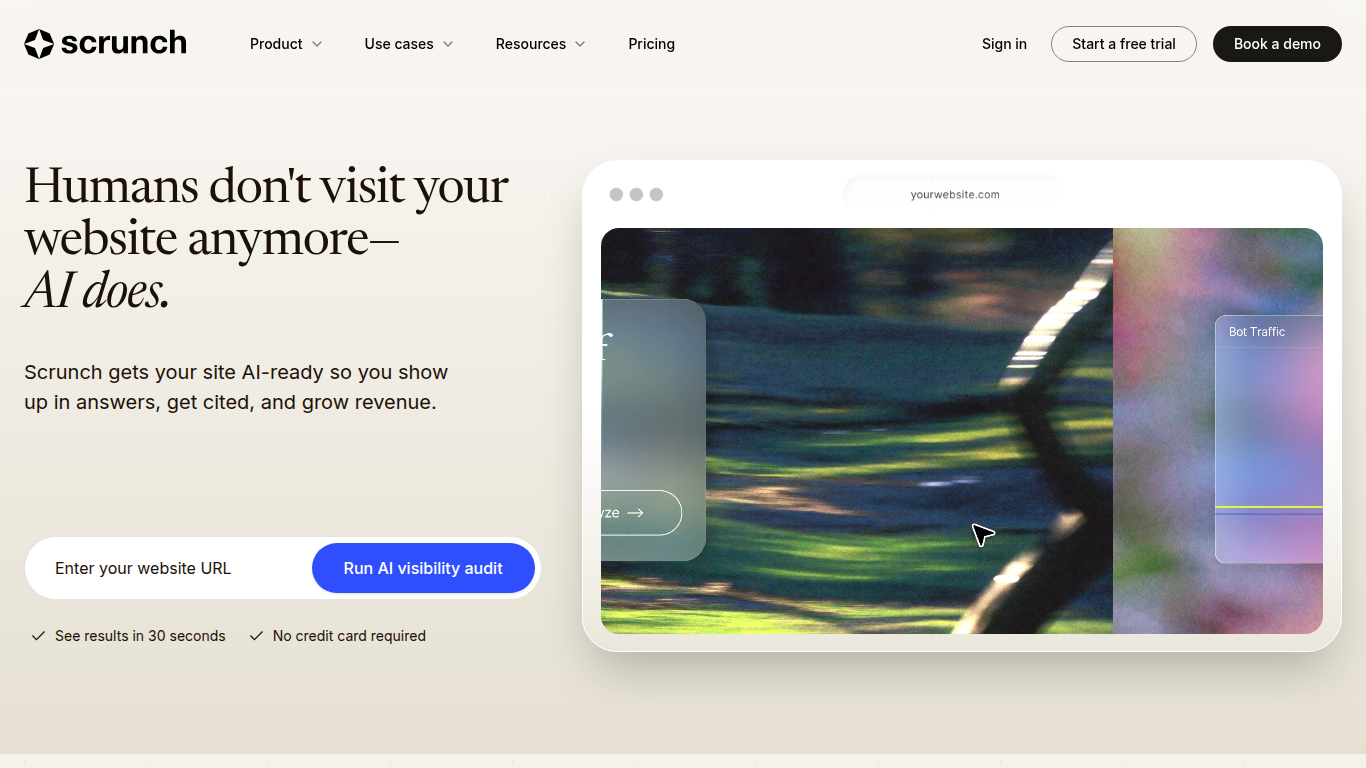
Scrunch AI is a technical-SEO-focused AI visibility platform. It tracks how a brand shows up across AI assistants, measures citations, mentions, sentiment, and share of voice against competitors, and adds a layer most trackers skip: detailed analytics on how AI crawlers and agents access a site. It is built for technical SEO leads, agencies reporting to multiple clients, and enterprise growth teams that treat AI search as a channel worth instrumenting properly.
What sets Scrunch apart from a pure answer-tracker is that it looks at both sides of the citation. It records where a brand appears in AI responses, and it records which bots visited the site, which pages they read, and how often, then connects that crawl activity to the referral traffic AI sources actually send. For a team trying to work out why a page is or is not being cited, that combination is more diagnostic than a visibility score on its own.
Scrunch AI pricing and plans
Scrunch splits its self-serve pricing into two flows, one for brands and one for agencies, with a shared custom Enterprise tier above both. The headline figure is $250 a month, and it describes the entry brand plan.
| Plan | Monthly price | Prompts tracked | Engines | Seats and workspaces | Free entry |
|---|---|---|---|---|---|
| Core | $250/mo | 125 unique | 4 (ChatGPT, Perplexity, Google AI Overviews, Copilot) | 5 seats, 1 brand workspace | 7-day free trial |
| Agency Core | $500/mo | 250 unique | 4 (same four) | Unlimited seats, 3 brand + 3 pitch workspaces | 7-day free trial |
| Enterprise | Custom | Custom | 9 (adds Claude, Gemini, Meta AI, Google AI Mode, Grok) | Custom | Demo |

Scrunch does not publish an annual-billing discount, so the monthly figures above are the rates to plan around. Both Core and Agency Core include a 7-day free trial, which is worth using, because the most important thing to understand about Scrunch sits inside the tier structure rather than the price.
Core and Agency Core differ mainly in scale, not capability. Core gives one brand workspace, five seats, and 125 prompts; Agency Core opens up unlimited seats, three brand workspaces, three pitch workspaces for prospecting, and 250 prompts, which is the shape an agency managing several clients needs. Neither changes the engine list. The capabilities Scrunch is most distinctive for, including Claude tracking, expanded engine coverage, and the AXP layer, are reserved for Enterprise. A team comparing Scrunch against other tools should be clear about which of those two products it is actually buying: the four-engine Core, or the nine-engine Enterprise platform that requires a sales conversation.
Before committing at any tier, it helps to see where a brand stands across the major assistants today. Geoptie tracks ChatGPT, Claude, Perplexity, and Gemini on a flat plan, and its free AI rank tracker returns a first read with no credit card, which makes any paid tool easier to judge against a baseline.
Which engines Scrunch AI covers
Engine coverage is tiered, and for many buyers it is the deciding factor.
- Core and Agency Core ($250 / $500): ChatGPT, Perplexity, Google AI Overviews, and Microsoft Copilot.
- Enterprise (custom): all nine engines, adding Anthropic Claude, Google Gemini, Meta AI, Google AI Mode, and Grok.
The practical consequence is that Claude sits behind the Enterprise tier. A team that came to Scrunch specifically to track Claude visibility, one of the four most-used assistants, cannot do it on either self-serve plan; it requires a custom contract. Gemini, Meta AI, AI Mode, and Grok are in the same position. For brands whose AI audience is concentrated in ChatGPT and Perplexity, the four Core engines are a reasonable spread. For anyone tracking a broader set, the engine list is the first thing to price out, because the answer usually moves the real cost to Enterprise. A free Claude rank tracker is a low-stakes way to watch the Claude slice on its own before deciding whether it is worth an Enterprise upgrade.
Scrunch AI’s key features
Scrunch is organized around three jobs: monitoring where a brand stands in AI answers, instrumenting how AI crawlers interact with the site, and acting on the gap between the two.
AI crawler and bot-traffic analytics
This is the differentiator and the reason technical teams shortlist Scrunch. Rather than treating AI search as a black box, it tracks named crawlers, so a team can see that ClaudeBot hit a pricing page eleven times last week, that GPTBot is indexing the blog but skipping the docs, or that PerplexityBot has never reached a key landing page at all. That crawl-level view turns a vague “we want to show up in AI” into specific, fixable observations about which content the engines can actually read.

GA4 AI-referral reporting
Paired with the crawler view is a connection to Google Analytics 4 that surfaces the traffic AI sources actually send, formatted for reporting rather than left raw in a GA4 export. Independent reviewers single this out as the most useful part of the platform: an agency can connect a client’s GA4 property and produce a clean, presentation-ready picture of AI referral traffic over months without rebuilding the report by hand each time. It closes the loop between being cited and seeing visits arrive, which is the connection most AI trackers struggle to make.
Prompt, citation, and competitor monitoring
The monitoring core works the way buyers expect. A team adds prompts, organized into topics, and Scrunch runs them across the engines on the plan, recording where the brand was cited, where competitors were named instead, and the share of voice across a topic. Citations break down by source, so a team can see which third-party pages, including review sites like G2 and Capterra, the engines lean on. One caveat reviewers raise repeatedly: the auto-generated prompts tend to be branded (“best [category] like [your brand]”), which inflates visibility, so the genuinely useful, non-branded prompts have to be added and maintained by hand.

Site audits and page optimization
Scrunch audits pages for AI-friendliness, flagging technical issues that can stop crawlers from reading content cleanly, such as a JavaScript-rendered page whose non-JavaScript version is missing the substance. Core includes five site audits a month and one page optimization, with sentiment analysis and recommendations alongside. The findings are accurate, but they tend to be developer-level fixes rather than content tweaks, so acting on them usually needs engineering time.
AXP, the Agent Experience Platform
AXP is Scrunch’s most forward-looking feature and its clearest Enterprise pitch. It generates an agent-facing version of a site, delivered to AI crawlers in a clean, structured format that strips away the code that confuses bots, so the version an engine reads is optimized for how it parses rather than how a browser renders. It is an Enterprise-only capability, not part of Core, and it is the layer that most distinguishes a full Scrunch contract from the entry plan.
Together, the crawler analytics and AXP are what let Scrunch argue it is a technical AI-optimization platform rather than a dashboard. The pattern from the pricing section repeats: the most distinctive of those capabilities lives on Enterprise.
Interface and experience
Scrunch’s interface is clean and, by most accounts, pleasant to navigate once it is configured. The friction is in getting there. New accounts start with default prompts that skew branded and, for local or niche businesses, can produce misleading visibility numbers until they are replaced with the queries that actually matter. Reviewers describe an onboarding that benefits from the hands-on setup Scrunch provides but still asks the user to understand prompt curation, personas, and topics before the dashboards mean much. It rewards a technical owner who will tune it, more than a generalist who wants a number at a glance. Setup is quick; reaching trustworthy data takes a few sessions of curation.
What users say about Scrunch AI
Scrunch is a newer entrant than the most established names in the category, so its public review base is thinner, and sentiment leans on hands-on write-ups and practitioner threads as much as aggregate scores. The praise is consistent on one point: the crawler and GA4 AI-traffic layer is the feature people remember, described by independent reviewers as the standout and the part that genuinely saves reporting time. On G2 and in Reddit AEO discussions, Scrunch is also credited for clean dashboards and broad engine coverage at the top tier, and one Scrunch case study reports a large lift in brand presence for non-branded prompts after adoption.
The recurring criticism is just as steady. Reviewers describe Scrunch as monitoring-first, with the actionable insights and site-audit recommendations feeling thinner than the tracking, so teams without in-house AEO expertise can struggle to turn the data into a plan. The manual prompt setup comes up often, as does the view that, for a single small brand tracking a handful of prompts, much of what Scrunch consolidates could be gathered by hand. The entry price draws comment too, since the four Core engines match tools that cost much less.
Scrunch AI pros and cons
Strengths
- Named AI-crawler analytics (ClaudeBot, GPTBot, PerplexityBot) are a genuine differentiator, with crawl-level detail few competitors match.
- The GA4 AI-referral reporting is the most-praised feature, and a real time-saver for agency and client reporting.
- Nine-engine coverage on Enterprise, with enterprise security including SOC 2 and SAML SSO.
- Granular segmentation by persona, topic, funnel stage, country, and competitor.
- Agency Core adds unlimited seats and pitch workspaces, which fits a multi-client workflow.
Limitations
- Core’s four engines (ChatGPT, Perplexity, Google AI Overviews, Copilot) are the same four cheaper trackers cover, at a $250/mo entry price.
- Claude, Gemini, Meta AI, AI Mode, and Grok are Enterprise-only, so broad engine coverage means a custom contract.
- AXP, the most distinctive optimization layer, is Enterprise-only and not part of Core.
- Monitoring leads; the recommendation and audit layers reward teams with technical and content resources to act on them.
- Setup is manual: auto-generated prompts skew branded and need curation before the data is reliable.
How Scrunch AI compares to Geoptie
Scrunch AI and Geoptie aim at different buyers. Scrunch is built for technical and enterprise teams that want crawl-level instrumentation, the AXP layer, and nine-engine breadth, and can justify a $250-and-up commitment with Enterprise for the full product. Geoptie is built for teams that want multi-engine visibility, including the engines that get gated elsewhere, on a flat, low entry price.
The engine math is worth stating precisely, because it is easy to get wrong. Scrunch Core and Geoptie both track four engines. The difference is the list. Scrunch Core covers ChatGPT, Perplexity, Google AI Overviews, and Copilot, and puts Claude on Enterprise. Geoptie covers ChatGPT, Claude, Perplexity, and Gemini on every paid tier, starting at $49/mo, so Claude is included rather than gated.
| Scrunch AI | Geoptie | |
|---|---|---|
| Starting price | $250/mo (Core) | $49/mo |
| Engines on entry tier | 4 (ChatGPT, Perplexity, Google AI Overviews, Copilot) | 4 (ChatGPT, Claude, Perplexity, Gemini) |
| Claude tracking | Enterprise-only | Included on every paid tier |
| Pricing model | Tiered, Claude and AXP gated to Enterprise | Flat per-plan |
| Free option | 7-day trial on Core | Free tracker, no card, no time limit |
| Best at | Named crawler analytics, GA4 AI traffic, AXP | Multi-engine coverage including Claude on a low flat price |
Scrunch wins on technical depth: if a team needs named crawler analytics, the AXP layer, and the full nine-engine spread, and has the budget for Enterprise, it is hard to match. Geoptie wins on entry cost and engine access: a team whose main need is seeing how it ranks across ChatGPT, Claude, Perplexity, and Gemini, without paying $250 for four engines that exclude Claude or moving to a custom contract to get it, is the one Geoptie fits. For the full field, see the best Scrunch AI alternatives.
Verdict
Scrunch AI is one of the strongest options in the category for technical AI-search work, and its named-crawler analytics are the reason.
Good fit if: you are a technical SEO team, agency, or enterprise that wants crawl-level visibility into how AI bots read your site, you value the GA4 AI-referral reporting, and you either need only the four Core engines or have the budget for the Enterprise tier that adds Claude, the rest of the engine list, and AXP.
Look elsewhere if: you want Claude tracking without a sales call, you need multi-engine coverage on a low flat price, or your four most important engines do not line up with Scrunch Core’s list and an Enterprise contract is hard to justify before you have proven the channel.
FAQ
Core is $250/mo for brands and Agency Core is $500/mo for agencies, both covering four engines, with a 7-day free trial. Enterprise, which adds Claude and four more engines plus AXP, is custom-priced through sales. Scrunch does not publish an annual-billing discount.
Only on Enterprise. Claude, along with Gemini, Meta AI, Google AI Mode, and Grok, sits on the custom-priced Enterprise tier, so tracking Claude requires a sales conversation. The Core and Agency Core plans do not include it.
Up to nine across the tiers: ChatGPT, Perplexity, Google AI Overviews, Copilot, Claude, Gemini, Meta AI, Google AI Mode, and Grok. Core and Agency Core cover the first four; the full nine are Enterprise-only.
AXP generates an agent-facing version of a site, served to AI crawlers in a clean, structured format that strips away code that confuses bots, so the engines read an optimized version of the content. It is an Enterprise-only feature, not part of Core.
Yes. Both Core and Agency Core include a 7-day free trial. The full nine-engine Enterprise product is sales-led through a demo rather than a self-serve trial.
Technical SEO teams, agencies, and enterprise growth teams that want crawl-level analytics and broad engine coverage, and have the resources to act on technical recommendations. Smaller teams that mainly need affordable multi-engine tracking tend to find better value elsewhere.
The closest flat-priced, multi-engine option that includes Claude on entry is Geoptie; the wider field is covered in the best Scrunch AI alternatives roundup and the broader best AEO tools breakdown.
What to do next
The fastest way to know whether Scrunch is worth its tier is to see your own starting point: where you stand across the major engines, which competitors are winning the citations, and whether the engines you care about are the four Scrunch covers on Core or the ones it puts on Enterprise. Geoptie’s flat-priced plans track ChatGPT, Claude, Perplexity, and Gemini together, and the free AI rank tracker gives you that baseline with no credit card and no time limit, so the comparison starts from data rather than a demo.