AI visibility trackers like to compete on how many engines they cover, but the number on the homepage and the number a given plan actually monitors are rarely the same. Peec AI is one of the most polished trackers in the category, built in Berlin, and its brand-mention sentiment scoring is the capability competitors most often try to match. The decision a buyer faces with Peec is less about whether the product is good, because it is, and more about which three engines you are willing to give up, whether that cap loosens as you spend more, and what happens when the engine you came to track turns out to be Enterprise-only.
This review walks through what Peec does, what each plan costs, where it genuinely leads, and where the engine math stops you short.
Peec AI at a glance
- Sentiment and mention analytics: the standout. Peec scores how a brand is talked about, not just whether it is named, and reviewers regularly single this out as the best in its class.
- Multilingual and geographic reach: genuinely strong. Tracking spans 14+ languages with country-level breakdowns, and you can monitor any supported region or language at no extra prompt cost.
- Engine coverage: the constraint. Every self-serve plan lets you pick three engines from a list of seven, and that limit holds from the $95 Starter all the way to the $495 Advanced.
- Ease of use: low friction. Setup takes minutes, the dashboard is clean, and unlimited seats come on every paid plan.
- Optimization depth: thin by design. Peec measures and benchmarks; it does not audit your site, hand you a fix list, or attribute AI mentions to traffic and leads.
What is Peec AI?
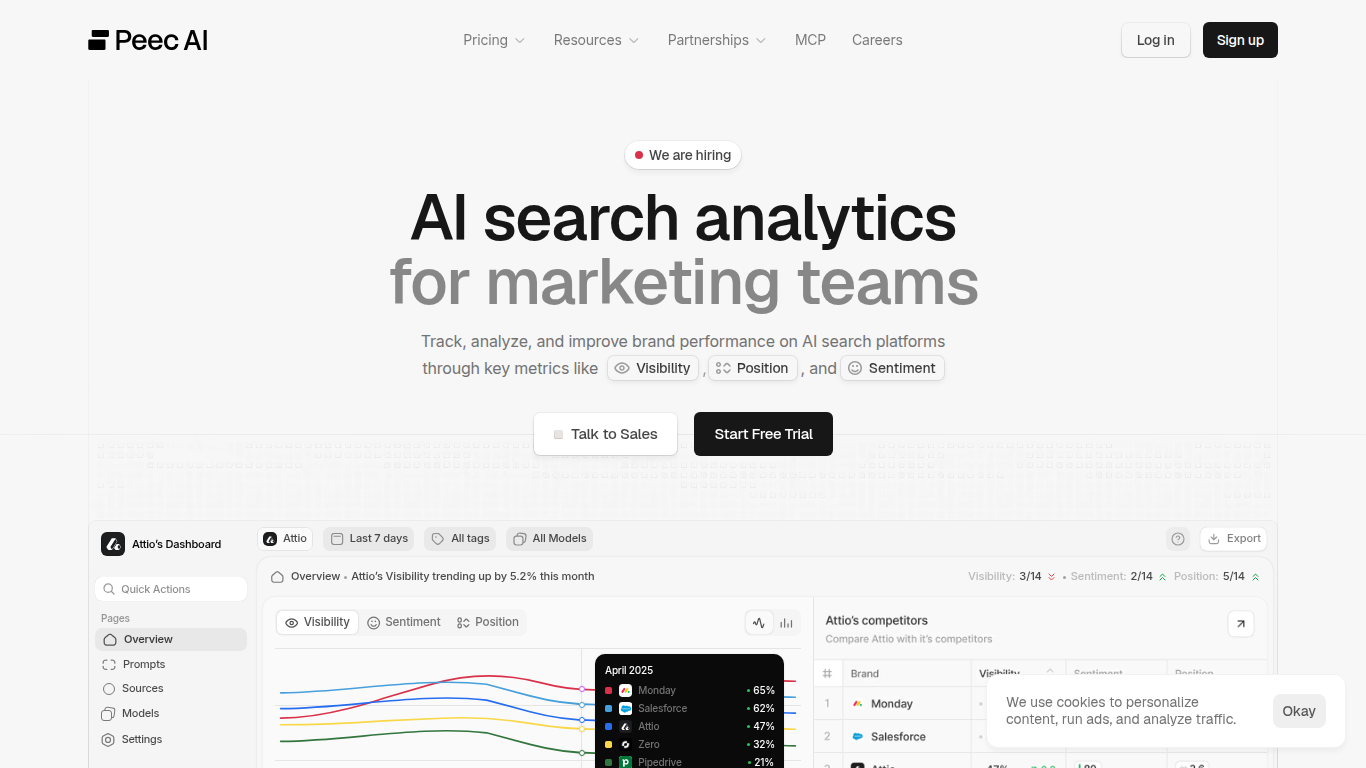
Peec AI is an AI search analytics platform that tracks how a brand shows up when assistants like ChatGPT, Perplexity, and Google’s AI surfaces answer buyer questions. It measures visibility, average position, citation share, and sentiment across a set of prompts, then benchmarks all of it against named competitors. Rather than calling model APIs, Peec scrapes the assistants’ own web interfaces, so the responses it logs are close to what a real user would see. It is aimed at marketing teams and agencies that want clean, trustworthy monitoring across several engines and languages without a heavy learning curve.
What sets it apart from a basic rank checker is the depth on the qualitative side: Peec does not just record that a brand was mentioned, it estimates the tone of that mention and traces the exact sources feeding the answer.
Peec AI pricing and plans
Peec publishes three self-serve plans and a custom Enterprise tier. Prices render in US dollars or euros depending on your region; the dollar figures below are the headline monthly rates, with the euro equivalent noted.
| Plan | Monthly price | Prompts | Engines included | Projects | Notable adds |
|---|---|---|---|---|---|
| Starter | $95/mo (€89) | 50 | 3 of 7 | 1 | Unlimited seats, daily tracking |
| Pro | $245/mo (€205) | 150 | 3 of 7 | 2 | Everything in Starter, more competitors |
| Advanced | $495/mo (€425) | 350 | 3 of 7 | 5 | Multi-country, Looker Studio connector |
| Enterprise | Custom | Custom | All 7 plus Claude and GPT-5 Search | Unlimited | API access, SSO, weekly or daily tracking |

Annual billing takes 15% off any plan, and there is a 7-day free trial with no credit card required. Unlimited user seats apply to every paid tier, which is unusually generous and a real plus for agencies and larger teams.
The thing to understand before buying is what climbing the ladder actually buys. Moving from Starter to Pro to Advanced raises the prompt allowance from 50 to 150 to 350 and the project count from one to five, plus the multi-country view and Looker connector at the top. What it does not raise is the number of engines you can monitor: that stays fixed at three on all three self-serve plans. Adding a fourth engine is a separate paid add-on, priced at $35 a month on Starter, $85 on Pro, and $165 on Advanced, per extra model. So a team that wants broad coverage should price out the add-ons alongside the base plan, because the headline figure assumes three engines, not the full set.
Before signing up at any tier, it helps to know where a brand actually stands across the major engines right now. A free AI visibility check returns that picture for one brand in about a minute, which makes it far easier to judge how many engines you genuinely need to pay Peec to watch.
Engine coverage
Engine coverage is where most Peec evaluations live or die, so it is worth being precise about it.
The self-serve plans share one pool of seven engines, and you choose three of them at onboarding: ChatGPT, Google AI Mode, Google AI Overviews, Microsoft Copilot, Perplexity, Gemini, and Grok. That choice is the same on every tier. A team on the $495 Advanced plan picks three engines from the same seven as a team on the $95 Starter; the extra money buys prompts, projects, and reporting reach, not a wider engine list. Tracking a fourth engine means paying the per-model add-on on top.
Claude is the bigger catch. Claude Sonnet 4 is not in the seven-engine self-serve pool at all; along with GPT-5 Search, it sits on the Enterprise tier and runs through an API integration. A brand that came to Peec specifically to monitor Claude, one of the four assistants most people actually use, cannot do it on Starter, Pro, or Advanced, and cannot unlock it with an add-on either. It requires an Enterprise sales conversation and a custom contract. Peec is not unusual here: several capable trackers in the category reserve Claude for a top, sales-led tier as well. For teams whose audience clusters in ChatGPT, Perplexity, and Google’s surfaces, three engines is a workable spread. For anyone who needs Claude or wants to watch more than three engines at once, the engine list is the first number to price out, because it often quietly moves the real cost upward. A free Claude rank tracker is a no-cost way to keep an eye on the Claude slice while deciding whether Peec’s Enterprise tier is worth the call.
Peec AI’s key features
Peec is organized around measuring presence, reading the tone of that presence, and showing where it comes from.
Brand-mention sentiment scoring
This is the feature Peec is best known for. Beyond logging that a brand appeared in an answer, Peec scores how it was characterized and tracks that sentiment over time and against competitors. Ask a tool whether a brand shows up for “best project management software for agencies” and most will tell you yes or no; Peec also tells you whether the assistant framed it as the value pick, the enterprise option, or an also-ran, and whether that framing is trending warmer or cooler week to week. Reviewers who have tested several trackers consistently rate this as the most credible sentiment implementation in the category.
Sources and citation breakdown
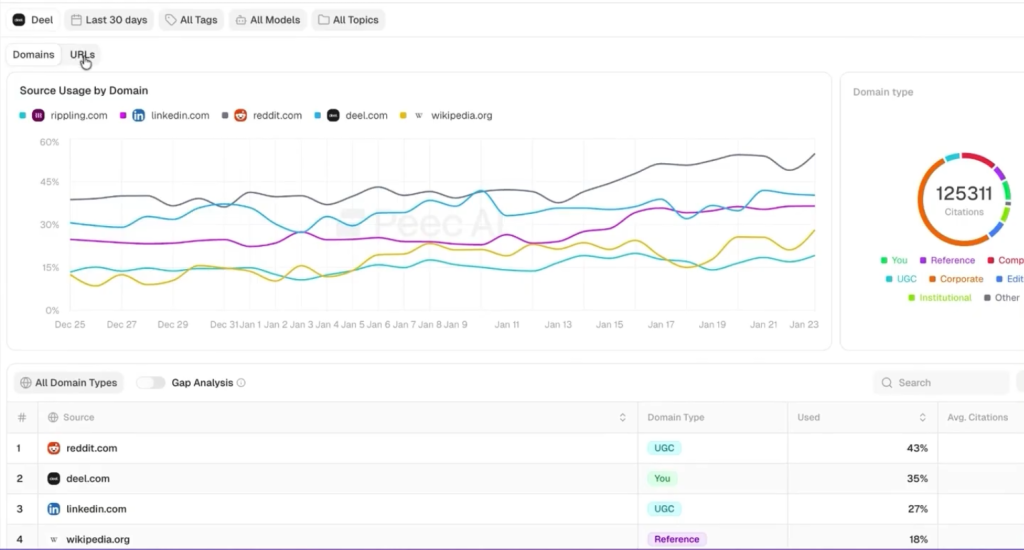
Peec’s Sources view shows the exact domains and individual URLs that AI answers cite when they discuss a topic, then categorizes each one as a competitor, an owned property, editorial, user-generated content like Reddit, or a reference site. The URL-level tab is the genuinely useful part: instead of learning that a competitor is cited “a lot,” a team sees the specific blog post or comparison page driving those citations, plus a gap view of sources that name rivals but not them. That turns into a concrete outreach and content list rather than a vague instruction to “improve coverage.”
Competitor share of voice
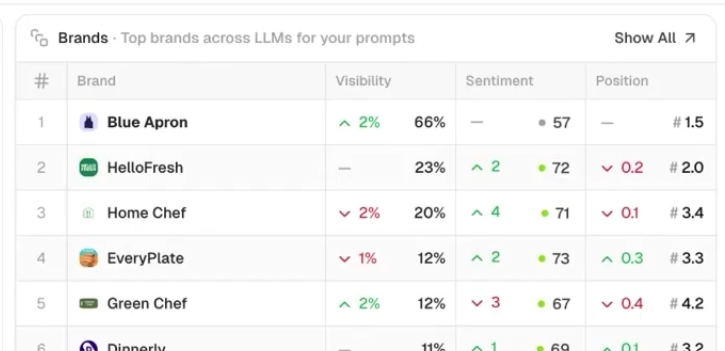
Every prompt result rolls up into a share-of-voice standing against the competitors a team adds. The Industry Ranking view lists each tracked brand with its average position, sentiment, and the percentage of answers it appears in over a chosen window, so a team can see at a glance whether it is gaining or losing ground on a topic. Clicking a competitor surfaces the exact prompts and answers where that rival is winning citations, which is where benchmarking stops being a scoreboard and starts being a to-do list.
Suggested prompts and onboarding
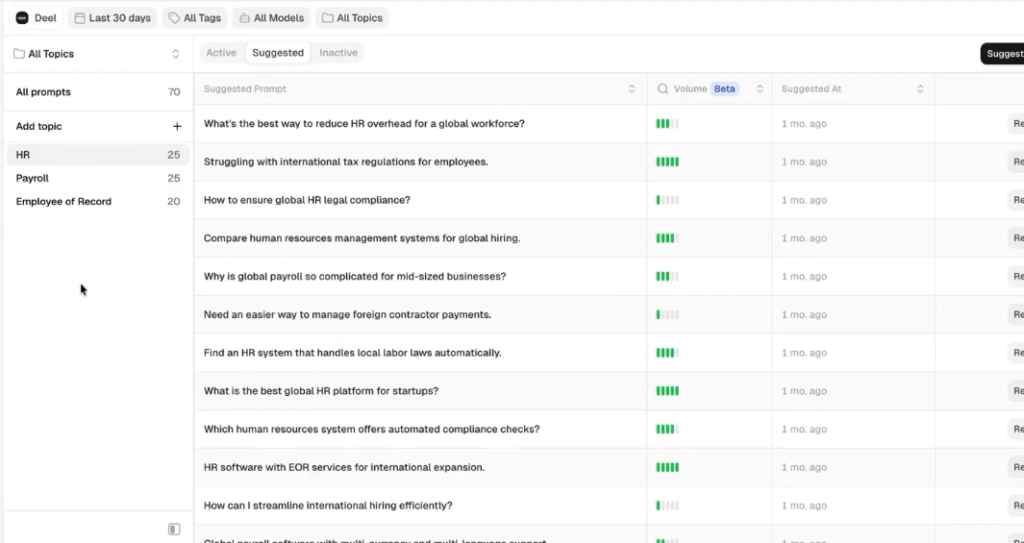
Most trackers assume a team already knows which prompts to monitor. Peec analyzes a site and proposes a starter set of prompts based on its topics, which can be accepted or rejected in a click, so a brand with no prompt list can be tracking sensible queries within minutes. Onboarding includes a guided kickstart session, and the whole setup, adding a domain, competitors, and prompts, typically takes a few minutes rather than the multi-week ramp heavier platforms ask for.
Multilingual and country-level analytics
Peec tracks across 14+ languages and breaks citation share down by country, with no surcharge for extra regions or languages, since pricing is tied to prompt volume rather than geography. For a brand selling into several European markets, that means seeing from one dashboard that it leads the German-language answers for a topic but trails in French, a level of localization most competitors either skip or gate behind a higher tier.
Interface and experience
Peec is one of the easier tools in this space to get comfortable with. The dashboard puts visibility, sentiment, sources, and competitor ranking on the landing screen, and reviewers routinely describe understanding the whole product within about half an hour. Setup is quick, and the unlimited-seat policy lets a team bring in everyone who needs the data without per-user math. One limit worth flagging: Peec only shows data from the day tracking begins, with no historical backfill, so a brand that signs up today has to let the dataset accumulate rather than looking back at last quarter.
What users say about Peec AI
Peec carries a small but positive review base on G2 and comes up regularly in practitioner discussions, including a widely read Reddit write-up from a team that ran it for three months. The praise is consistent: the interface is clean, the suggested-prompts feature saves real setup time, the source-level citation data is useful for outreach, and unlimited seats plus a no-card trial make it easy to get a team started. The sentiment tracking is the most-cited strength, and one detail backs up that it is more than marketing: it is bundled into the mid-tier plan, where several competing tools either charge a large premium for sentiment or do not offer it at all.
The recurring criticism is just as steady, and it is not about accuracy. Reviewers describe Peec as a monitoring tool rather than an optimization one: it shows what is happening and where, but it does not run a site audit, hand back a prioritized fix list, or tell a team how to earn the citations it is missing. Several also note that it does not estimate AI-referred traffic or connect mentions to leads, even on paid plans, so attribution has to come from separate analytics. The no-backfill limit and the lack of an advertised SOC 2 certification come up for larger or regulated buyers. The fair summary across reviews is that Peec answers “where do we stand?” very well and leaves “what do we do about it?” to the team.
Peec AI pros and cons
Strengths
- Best-in-class brand-mention sentiment scoring, bundled rather than sold as a premium add-on.
- Strong multilingual and country-level analytics, with no surcharge for extra regions or languages.
- URL-level source and gap analysis that translates directly into outreach targets.
- Clean, fast-to-learn interface with unlimited seats on every paid plan.
- A genuine 7-day free trial with no credit card, which is rarer in this category than it should be.
Limitations
- Every self-serve plan caps included engines at three of seven, and the cap does not lift on the $495 Advanced tier.
- Claude and GPT-5 Search are Enterprise-only, so the two most-requested missing engines require a sales call.
- Monitoring only: no site audit, no fix playbook, and no AI-traffic or lead attribution.
- No historical backfill; data starts the day tracking begins.
- Per-model add-ons mean broad engine coverage costs more than the headline price suggests.
How Peec AI compares to Geoptie
Peec and Geoptie overlap on the core job of tracking brand visibility across AI answers, but they make opposite choices on engines and price. Peec leads on the qualitative side, its sentiment depth and multilingual reach are real advantages, and gives you three engines on a plan that starts at $95. Geoptie takes a flatter approach: all four of its engines are included on every paid tier, starting at $49 a month, with Claude in the set from the entry plan rather than behind an Enterprise contract.
| Peec AI | Geoptie | |
|---|---|---|
| Starting price | $95/mo (€89) | $49/mo |
| Engines on entry tier | 3 of 7 (choose at onboarding) | 4 (ChatGPT, Claude, Perplexity, Gemini) |
| Claude tracking | Enterprise-only, via API | Included on every paid tier |
| Pricing model | Tiered; engine count capped at 3, extras as add-ons | Flat per-plan, all engines included |
| Free option | 7-day trial, no card | Free tracker, no card, no time limit |
| Best at | Sentiment depth and multilingual analytics | All-engine coverage on a low flat price |
The straight read is that Peec wins on sentiment nuance and language reach, while Geoptie wins on engine access and entry cost. A team whose priority is reading how its reputation is described across languages and markets, and that is happy choosing three engines, will get a lot from Peec. A team that wants to watch ChatGPT, Claude, Perplexity, and Gemini together without a per-engine surcharge or a sales call is the one Geoptie is built for. For the wider field, see best Peec AI alternatives.
Verdict
Peec is a genuinely well-made tracker that is strong where it counts: sentiment scoring, multilingual coverage, and a clean day-to-day workflow.
Good fit if: you care most about how your brand is described rather than just whether it appears, you sell across multiple languages or countries, you want a clean tool a whole team can use without per-seat fees, and three engines (chosen from the seven on offer) cover the assistants your audience actually uses.
Look elsewhere if: you need to track Claude without an Enterprise contract, you want more than three engines without stacking add-ons, you are looking for a tool that tells you how to improve rather than only how you are doing, or a $95-and-up monthly spend is hard to justify before you have proven AI search as a channel.
Frequently Asked Questions
Peec has three self-serve plans: Starter at $95/mo (€89) for 50 prompts, Pro at $245/mo (€205) for 150 prompts, and Advanced at $495/mo (€425) for 350 prompts, plus a custom Enterprise tier. Annual billing takes 15% off, and every paid plan includes unlimited seats.
Seven are available on the self-serve plans, but you choose only three of them: ChatGPT, Google AI Mode, Google AI Overviews, Microsoft Copilot, Perplexity, Gemini, and Grok. That three-engine cap is the same on Starter, Pro, and Advanced; a fourth engine is a paid add-on ($35 to $165 a month depending on plan).
Only on Enterprise. Claude Sonnet 4, along with GPT-5 Search, is not in the seven-engine self-serve pool and runs through an API integration on the custom-priced Enterprise tier. No add-on unlocks it on Starter, Pro, or Advanced.
Yes. Peec offers a 7-day free trial with no credit card required, which is enough to set up prompts and see the visibility, sentiment, and source data before paying.
For teams that treat AI visibility as a real channel and have someone to act on the data, yes, especially if sentiment and multilingual coverage matter. It is a measurement tool, not an optimization one, so a brand expecting it to fix its citation gaps or prove traffic and leads will need other tools alongside it.
Marketing teams and agencies that want clean, multi-engine monitoring with strong sentiment and language coverage and are comfortable choosing three engines. It fits brands that already have some AI search presence to measure rather than brand-new sites with nothing yet to track.
The closest flat-priced, all-engine option is Geoptie, which includes Claude on its entry plan. The broader set of trackers and monitors is covered in our best Peec AI alternatives roundup and the wider best LLM tracking tools breakdown.
What to do next
The engine cap is the part of a Peec decision worth resolving first, and the cleanest way to do that is to look at where your brand actually stands today. Run a free AI visibility check to see your position across the major engines, then compare that against Geoptie’s flat-priced plans, where ChatGPT, Claude, Perplexity, and Gemini are all included from $49 a month with no per-engine add-ons. With that baseline in hand, whether Peec’s three engines and sentiment depth are the right trade for your team becomes a much easier call.