
In a category where most tools hide their price behind a sales call, a published $29 plan stands out before anything else does. Otterly AI is the cheapest real paid entry in AI visibility tracking, a self-serve tool that won a Gartner Cool Vendor nod in 2025 and lets unlimited teammates into every plan, including the cheapest one. The decision a buyer actually has to make is narrower than “is Otterly any good.” It’s whether the $29 Lite plan does enough on its own, when the jump to the $189 Standard or $489 Premium plan is worth it, and which of the engines you came to track are bundled in versus billed as paid extras.
This review walks through what Otterly does, what each tier costs, where it genuinely leads, and where the headline price stops telling the whole story.
Otterly AI at a glance
- Entry price: the lowest real paid entry in the category. Lite is $29/mo with a public sign-up, not a sales call.
- Engine coverage: four base engines on every tier. Gemini, Google AI Mode, and Claude are paid add-ons billed on top.
- GEO audit: a genuine strength. The crawlability and AI-readiness audit is among the most detailed at this price.
- Team access: unlimited seats on every plan, Lite included, which is rare in a category that usually meters users.
- Dashboard depth: capable but busy. Setup is fast, while the reports get dense once prompt volumes climb.
What is Otterly AI?
Otterly AI is a self-serve AI search visibility platform. It runs a set of prompts across AI assistants on a daily schedule, captures the full answer each one returns, records whether a brand was mentioned and where it ranked, and tracks which domains the engines cited. On top of the monitoring it adds a generative engine optimization audit that scores a site for AI-readiness, plus reporting and exports for sharing the numbers with a team or a client.
It is built for lean marketing teams, in-house SEOs, and agencies that want to start tracking AI search without a procurement process or a per-seat tax. The Austria-based product leans into accessibility: quick AI-assisted onboarding, public pricing, a free trial, and unlimited team members on every plan. Affordable and easy to start is what most of its customers cite first.
Otterly AI pricing and plans
Otterly publishes three self-serve plans plus a custom Enterprise tier. The $29 headline is real, and it buys a working plan rather than a teaser.
| Plan | Monthly price | Prompts | Base engines | Workspaces | Free trial |
|---|---|---|---|---|---|
| Lite | $29/mo | 15 | 4 (ChatGPT, AI Overviews, Perplexity, Copilot) | 1 | 14 days |
| Standard | $189/mo | 100 | 4 | Unlimited | 14 days |
| Premium | $489/mo | 400 | 4 | Unlimited | 14 days |
| Enterprise | Custom | Custom | 4 | Unlimited | Demo |
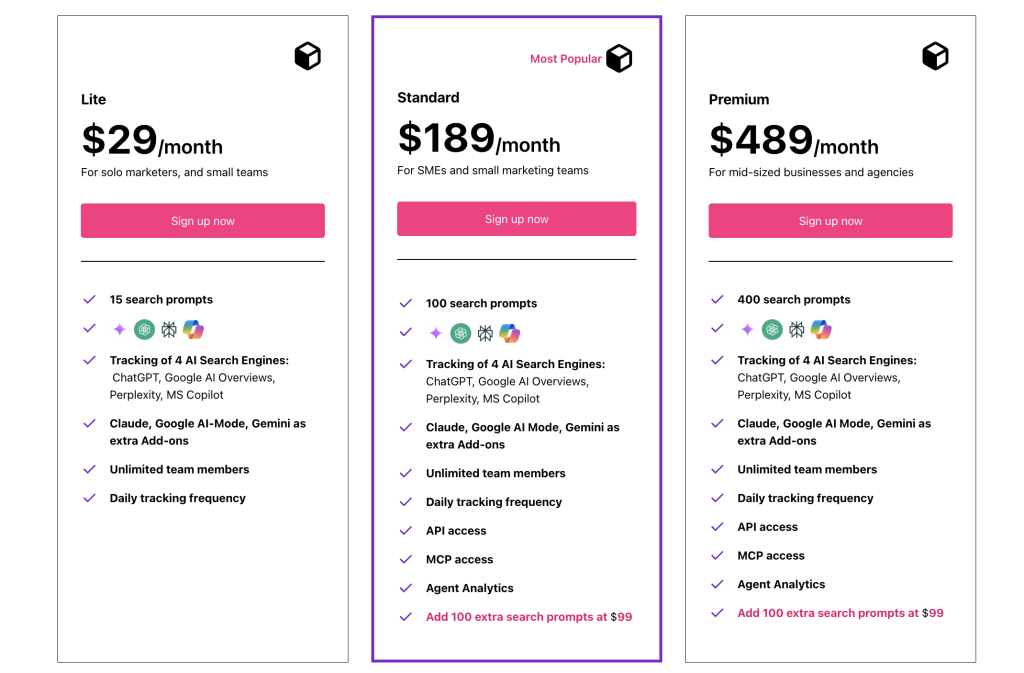
Annual billing knocks roughly 15% off, bringing the effective rates to $25, $160, and $422 a month. Every tier includes the same feature set, unlimited team members, daily tracking, and the GEO audit. The only things that scale with price are prompt volume, the number of workspaces, the audit allowance, and API access, which arrives on Standard.
The gap between Lite and Standard is the first thing to weigh. At $29, Lite tracks 15 prompts in a single workspace, enough for a solo marketer or a small brand validating whether AI search demand is real for them, but not enough to cover a full product line, several markets, or a competitor set, and unused prompts do not roll over. Standard at $189 is the first plan that feels practical for a working brand: 100 prompts, unlimited workspaces, API and Looker Studio access. Premium at $489 raises the ceiling to 400 prompts for agencies and larger prompt sets, with an Agency Partner program that lifts those allowances further. Extra prompts add to Standard and Premium in packs of 100 at $99/mo.
Before committing to any tier, it helps to see where a brand actually stands across the major assistants today. A free AI rank tracker returns that picture across ChatGPT, Claude, Perplexity, and Gemini with no credit card, which makes a paid plan easier to size.
Which engines Otterly tracks
Engine coverage is where the $29 framing needs the most care, because the base price covers four engines and the rest are billed on top.
- All tiers (4 base engines): ChatGPT, Google AI Overviews, Perplexity, and Microsoft Copilot.
- Paid add-ons: Google AI Mode and Gemini at $9 (Lite), $59 (Standard), or $149 (Premium) per month each; Claude at $29 (Lite), $109 (Standard), or $439 (Premium) per month.
The practical consequence is that engine breadth is the real variable in the bill. The four base engines cover a lot of ground, but a team that wants Gemini, Google AI Mode, or Claude pays extra for each, and the add-on prices climb steeply with the tier. Claude is the one worth flagging, because it is one of the four assistants most people use day to day, and Otterly is often reported as simply “supporting Claude.” The accurate position is that Claude is a paid add-on, not part of any base plan, so tracking it means stacking $29 to $439 a month on top of the plan price depending on tier. DeepSeek, Grok, and Meta AI are not offered at all. For a brand whose audience lives mostly in ChatGPT and Google’s surfaces, the base four are a reasonable spread. For anyone who needs Claude or Gemini, the engine add-ons are the first line to price out, because they can quietly move the real cost well above the headline. A free Claude rank tracker is a no-cost way to watch the Claude slice while deciding whether Otterly’s add-on is worth it.
Otterly AI’s key features
Otterly is organized around three jobs: tracking where a brand shows up in AI answers, showing which sources the engines trust, and auditing a site so it can earn more of those citations.
Search prompt monitoring
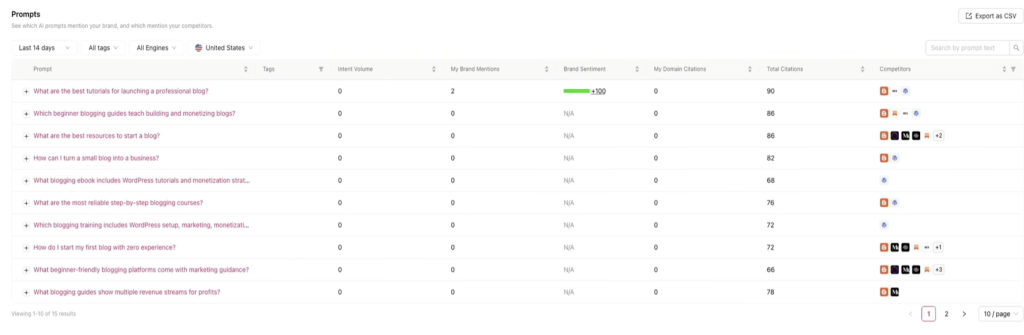
This is the core. A team defines the prompts that matter, and Otterly runs them daily across the four base engines, storing the full answer text rather than a snippet. Track a prompt like “best project management software for agencies” and the record shows whether the brand was named, where it landed in the answer, and which competitors appeared alongside it, with the history building day over day so a content push can be checked against actual movement. The AI-assisted setup suggests prompts, niches, and competitors during onboarding, so the first dataset arrives in minutes rather than after a manual prompt-building session.
Link citations and domain ranking
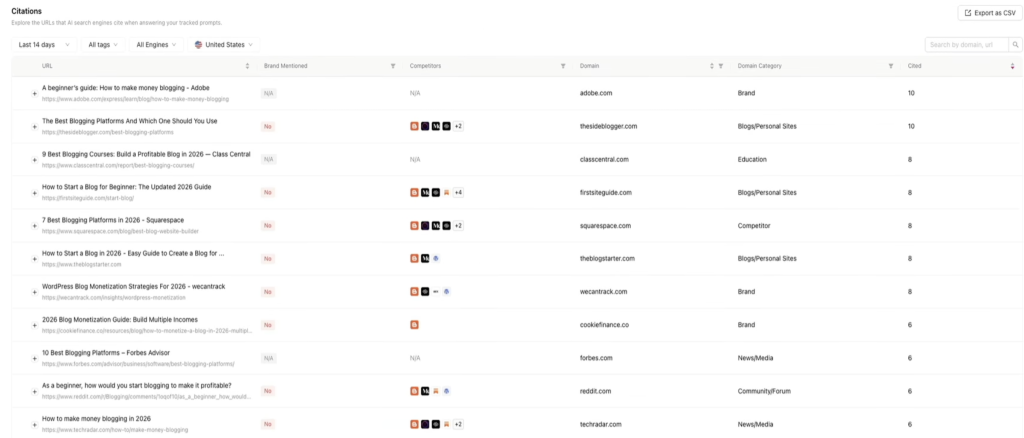
For every captured answer, Otterly parses which URLs the engine cited and ranks domains by how often they appear in a category. This turns opaque AI responses into a competitive map: a team can see which sources ChatGPT and Perplexity lean on when answering questions in their space, which competitors keep earning citations, and which of their own pages get referenced. It often surfaces the uncomfortable fact that a third-party listicle outranks the brand’s own site in AI citations, which is a useful pointer for where to invest in coverage next.
Brand Visibility Index
The Brand Visibility Index rolls mention frequency and average position into a single score per brand, so a team can track its standing over time and against named competitors without reading a dozen separate charts. It is a feature reviewers single out as genuinely distinct; the equivalent metric is not packaged this cleanly in most competing trackers. For a marketing lead who needs one number to put in a monthly report, it is the headline the dashboard is built around.
GEO audit
This is the feature that earns Otterly its strongest praise. The generative engine optimization audit evaluates a site against a long list of factors tied to AI citation, including content depth, structure, freshness, structured data, and crawlability, then flags what is holding pages back. When a prompt keeps skipping the brand, the audit helps separate a topical-coverage gap from a technical one, and the output is concrete enough to hand to a content team as a brief. The audit allowance scales by tier, from 1,000 URL audits a month on Lite up to 10,000 on Premium.
Prompt research and reporting
Otterly’s AI Prompt Research tool turns a keyword, brand, or URL into the conversational prompts an audience would actually type into an assistant, which takes some guesswork out of building a prompt set. Around the monitoring sit the reporting pieces: multi-country support across 50+ markets, CSV exports, and a Google Looker Studio connector on Standard and up that lets agencies fold AI visibility into the client dashboards they already send. None of this is unique alone, but together it closes the loop from tracking to a shareable report.
Interface and experience
Otterly is genuinely easy to start. The four-step, AI-assisted setup picks niches, prompts, and competitors for a new account, and most users see real data within about 15 minutes, which is reflected in the near-perfect ease-of-use scores it carries on review sites. The trade-off shows up later: as prompt volume grows, the dashboard fills with separate table-style reports, and related information ends up split across brand reports, citation reports, and domain rankings without a strong narrative tying them together. Heavy users describe the interface as clean to look at but busy to navigate, with a learning curve steeper than the quick setup suggests. It rewards someone comfortable reading tables more than someone looking for a single guided “here’s what to do next” view.
What users say about Otterly
Otterly carries strong marks where it is reviewed: a 5.0 on Product Hunt, near-perfect ease-of-use scores on OMR Reviews, and steady G2 praise for how quickly teams reach useful data. Hands-on reviewers consistently name two things as better than the field at the price: the GEO audit and the Brand Visibility Index. The credibility markers back that up, including the Gartner Cool Vendor 2025 recognition, a 10,000-plus user milestone, and a customer list spanning Opera, Avis Budget Group, Sportradar, and A1 Telekom. One frequently cited result is Bacula Enterprise reaching the top spot in ChatGPT’s answer for “best HPC backup software” after using Otterly to tune its prompt coverage.
The criticisms are just as consistent. The dashboard clutter noted above is the most common usability complaint. Sentiment tracking is described in Otterly’s own materials but reviewers report struggling to find it usefully surfaced in the dashboard, so it is safer to treat it as immature than as a headline feature. And like nearly every tool in this category, Otterly tells a brand it appeared in an answer but not whether anyone clicked through, so it is a visibility tracker rather than a traffic or revenue attribution platform. Pairing it with analytics is still on the buyer.
Otterly AI pros and cons
Strengths
- The lowest real paid entry in the category at $29/mo, with a public sign-up rather than a demo gate.
- Unlimited team members on every plan, Lite included, which most competitors meter or reserve for higher tiers.
- A best-in-class GEO audit and a distinctive Brand Visibility Index that reviewers rate above peers at the price.
- Fast, AI-assisted onboarding that gets a team to real data in minutes.
- Transparent, flat feature set: every tier gets the same tools, with only prompt volume and workspaces scaling.
Limitations
- Only four engines are included; Gemini, Google AI Mode, and Claude are paid add-ons that can push the bill well above the plan price.
- Claude in particular costs $29 to $439/mo on top depending on tier, so it is never bundled.
- Lite’s 15 prompts are quickly outgrown, and the next step up is a sizeable jump to $189.
- The dashboard gets cluttered at higher prompt volumes, and sentiment tracking is underdeveloped.
- No AI-referral traffic or revenue attribution; it tracks visibility, not outcomes.
How Otterly AI compares to Geoptie
Otterly and Geoptie are aimed at a similar buyer from different angles. Otterly competes on the lowest possible entry price and a strong audit, with engine breadth sold separately on top. Geoptie competes on giving a team all four major engines, including Claude and Gemini, on a flat plan with nothing gated behind add-ons.
| Otterly AI | Geoptie | |
|---|---|---|
| Entry price | $29/mo (Lite, 15 prompts) | Free tier, then $49/mo (Starter, 15 prompts) |
| Base engines on entry | 4 (ChatGPT, AI Overviews, Perplexity, Copilot) | 4 (ChatGPT, Claude, Perplexity, Gemini) |
| Claude tracking | Paid add-on ($29 to $439/mo by tier) | Included on every paid tier |
| Gemini tracking | Paid add-on ($9 to $149/mo by tier) | Included on every paid tier |
| Pricing model | Per-plan, plus engine and prompt add-ons | Flat per-plan |
| Free option | 14-day trial | Free tracker, no card, no time limit |
| Best at | Lowest paid entry, GEO audit, unlimited seats | Four engines including Claude, flat on every tier |
The fair read is that Otterly wins on headline entry price and on a couple of features, the GEO audit and the unlimited seats, that are genuinely strong. A solo marketer or small brand that mainly tracks ChatGPT and Google’s surfaces, values a detailed site audit, and wants to add seats freely will find Otterly hard to beat at $29. The picture changes the moment Claude or Gemini matters, because those are extras at Otterly and included at Geoptie, so a team needing the full four engines often ends up paying more at Otterly than the headline implies. Geoptie also keeps a permanently free tier rather than a 14-day trial. For the wider field, see the best Otterly AI alternatives.
Verdict
Otterly is the most accessible on-ramp into AI search tracking, and for the right team that is exactly enough.
Good fit if: you’re a solo marketer, small brand, or agency that wants a low, predictable entry price, you value a detailed GEO audit and unlimited team seats, and your tracking centers on ChatGPT, Perplexity, AI Overviews, and Copilot rather than Claude or Gemini.
Look elsewhere if: you need Claude or Gemini tracking without paying a per-engine premium, you expect to outgrow 15 prompts quickly and want the next tier to stay affordable, or you want AI visibility and traffic attribution in one place rather than a visibility tracker alone.
FAQ
How much does Otterly AI cost?
Three self-serve plans: Lite at $29/mo (15 prompts), Standard at $189/mo (100 prompts), and Premium at $489/mo (400 prompts), plus a custom Enterprise tier. Annual billing brings those to about $25, $160, and $422 a month. Every tier covers the same four base engines and the same feature set.
Is the $29 Lite plan enough?
For a solo marketer or a small brand validating AI search, yes: it is a real working plan with daily tracking, the GEO audit, and unlimited seats. It is not enough to monitor a full product line, several markets, or a large competitor set, since 15 prompts go quickly and do not roll over. Most growing teams move to Standard for the 100-prompt allowance.
Does Otterly AI track Claude?
Only as a paid add-on. Claude is not included on any base plan; adding it costs $29 (Lite), $109 (Standard), or $439 (Premium) per month on top of the plan price. So Otterly can track Claude, but never as part of the headline price.
What AI engines does Otterly AI cover?
Four engines are included on every tier: ChatGPT, Google AI Overviews, Perplexity, and Microsoft Copilot. Google AI Mode, Gemini, and Claude are available as paid add-ons. DeepSeek, Grok, and Meta AI are not offered.
Does Otterly AI have a free trial?
Yes, a 14-day free trial is available on the self-serve plans, with no long-term commitment. There is no permanently free tier.
Who is Otterly AI best for?
Lean marketing teams, in-house SEOs, and agencies that want an affordable, self-serve tracker with a strong site audit and room to add teammates at no extra cost. Teams that need Claude or Gemini in the base price, or that want traffic attribution alongside visibility, tend to find better fits elsewhere.
What are the best Otterly AI alternatives?
The closest flat-priced option that includes Claude and Gemini on every tier is Geoptie. The broader field is covered in the best Otterly AI alternatives roundup and the wider best AEO tools breakdown.
What to do next
If Otterly is on the shortlist, the cost question is easier to settle once the engine list is clear, so start by writing down which assistants actually matter for the brand and pricing the add-ons against them. It also helps to have a baseline to compare any tool against. Geoptie’s free AI rank tracker shows where a brand stands across ChatGPT, Claude, Perplexity, and Gemini with no credit card and no time limit, and the platform keeps all four engines on a flat plan if the add-on math on a four-engine tracker starts to add up.