
Most AEO tools save their real surprise for the pricing page, where the plan that carries the product’s reputation turns out to sit two tiers above the one with the headline price. Profound is the most established name in the category, and for good reason: its Prompt Volumes data is genuinely unmatched, its enterprise customer base is real, and the depth of its top tier is hard to rival. The question a buyer actually faces is narrower than “is Profound any good.” It’s whether the $99 Starter plan is worth paying for at all, whether the jump to the $399 Growth plan is justified, and whether the engine you came to track is even available without a sales call.
This review covers what Profound does across its three tiers, what it costs, where the platform genuinely leads, and where it stops.
Profound at a glance
- Engine coverage: deep at the top, gated below. Ten engines on Enterprise, but only ChatGPT on Starter and three on Growth.
- Data depth: the strongest in the category. Prompt Volumes shows real AI search demand by topic, which no direct competitor matches.
- Content layer: capable. The Agents feature turns citation data into briefs and drafts, on a credit model.
- Onboarding and ease of use: moderate. Powerful, but it rewards a team with a dedicated AEO owner rather than a casual user.
- Pricing accessibility: the weak spot. Meaningful functionality starts at $399/mo, and the engine many buyers want is Enterprise-only.
What is Profound?
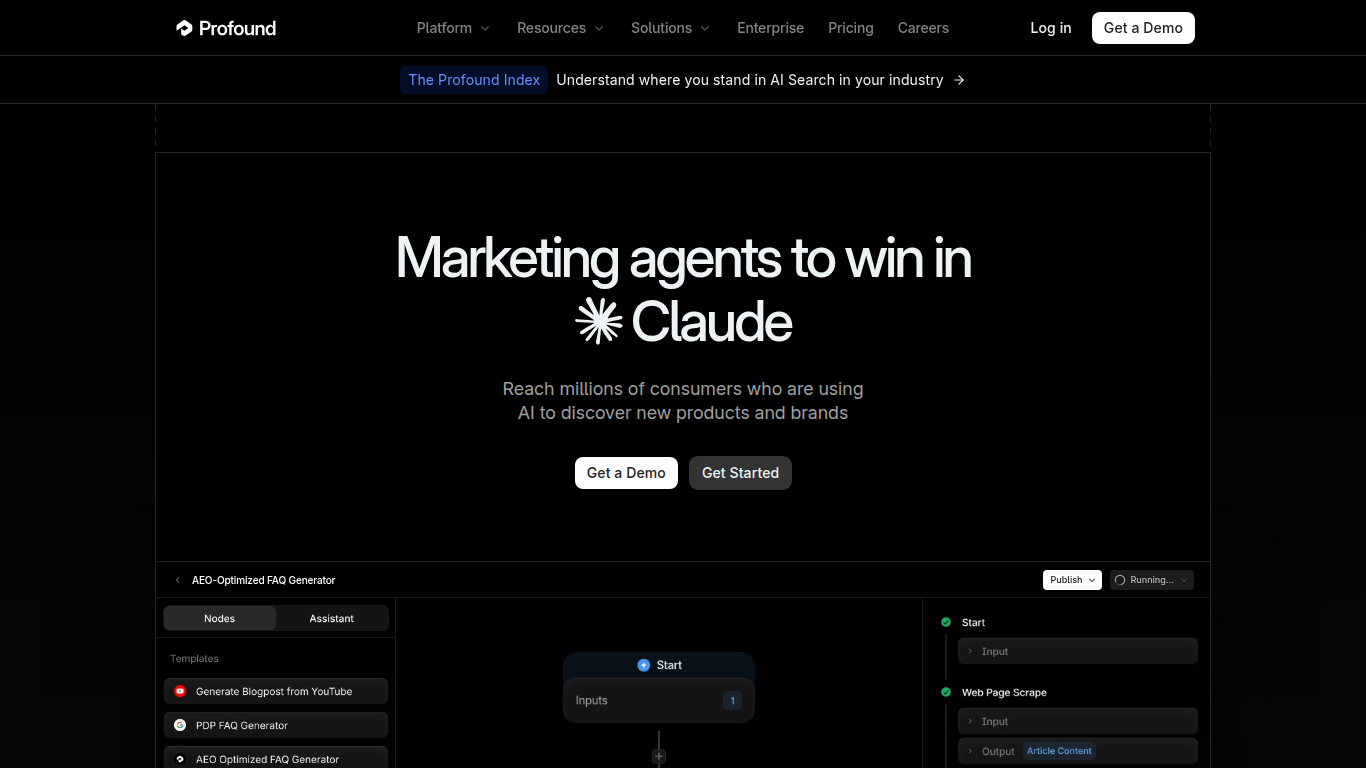
Profound is an enterprise AI visibility and answer-engine-optimization platform. It tracks how a brand appears across AI assistants, measures citations, sentiment, and share of voice against competitors, and layers on content tools that act on what it finds rather than just reporting it. It is built for marketing, growth, and PR teams that treat AI search as a real channel, and its customer list leans toward larger brands with the budget and headcount to run a program around it.
The platform’s reputation rests on data most competitors can’t produce. Where a typical tracker tells a brand where it ranks for a set of prompts, Profound also estimates how often people are asking those questions in the first place, which turns AI visibility from a vanity score into a content-strategy input.
Profound pricing and plans
Profound publishes three plans. The headline number is $99 a month, but it describes the smallest of the three by a wide margin.
| Plan | Monthly price | Prompts tracked | Engines | Seats | Free entry |
|---|---|---|---|---|---|
| Starter | $99/mo | 50 (1,500 responses/mo) | ChatGPT only | 1 | — |
| Growth | $399/mo | 100 (9,000 responses/mo) | 3 (ChatGPT, Perplexity, Google AI Overviews) | 3 | Self-serve “try for free” |
| Enterprise | Custom | Custom | Up to 10 (adds Claude, Gemini, Copilot, Meta AI, Grok, DeepSeek, AI Mode) | Custom | Demo only |

Annual billing takes two months off both Starter and Growth, so the effective yearly rate is roughly 17% lower than the monthly figures above.
The gap between Starter and Growth is the most important thing to understand before buying. At $99/mo, Starter tracks a single engine (ChatGPT), 50 prompts, and a small monthly response allowance, with no exports and no Opportunities. It’s enough to see what Profound looks like, not enough to run an AEO program. The capabilities Profound is known for, including multi-engine tracking, the Opportunities panel, the Agents content engine, and exports, begin at the $399 Growth plan. A team comparing Profound against other tools should treat $399 as the real entry price, not $99.
Before committing to any plan at this price, it’s worth knowing where your brand actually stands across the major engines today. A free AI visibility audit returns that picture for one brand in about a minute, which makes any vendor’s demo easier to judge.
Which engines Profound tracks
Engine coverage is tiered, and it’s where most Profound evaluations turn.
- Starter ($99): ChatGPT only.
- Growth ($399): ChatGPT, Perplexity, and Google AI Overviews.
- Enterprise (custom): up to ten engines, adding Google AI Mode, Gemini, Microsoft Copilot, Meta AI, Grok, DeepSeek, and Anthropic Claude.
The practical consequence is that Claude sits behind the Enterprise tier. A team that came to Profound specifically to track Claude visibility, one of the four most-used assistants, can’t do it on any self-serve plan; it requires a sales conversation and a custom contract. The same is true of Gemini and Copilot. For brands whose AI audience is concentrated in ChatGPT, Growth’s three engines are a reasonable spread. For everyone tracking a broader set, the engine list is the first thing to price out, because the answer often pushes the real cost to Enterprise. A free ChatGPT rank tracker is a low-stakes way to see the ChatGPT slice on its own before deciding how much engine breadth you actually need to pay for.
Profound’s key features
Profound is organized around three jobs: measuring where a brand stands in AI answers, showing what people are actually asking, and acting on the gap.
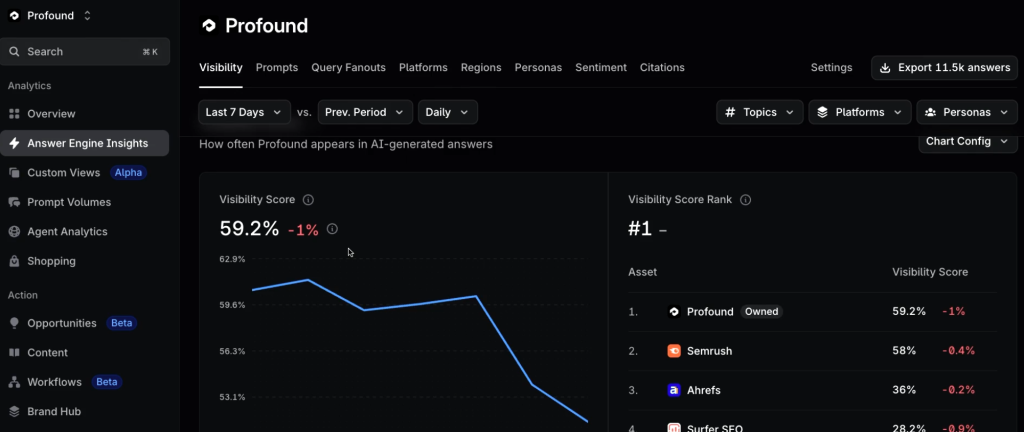
Answer Engine Insights
This is the monitoring core. Track a prompt like “best AI rank trackers” and the execution log shows where the brand landed on each engine on the plan: cited third on ChatGPT, mentioned once on Perplexity, absent from Google AI Overviews, with the competing brands named in each answer listed alongside. Visibility score, average position, and citation share are tracked over time, so a team can tell whether a content push actually moved placement rather than guessing. The share-of-voice view rolls those individual prompts up into a single standing against named competitors across a topic.
Prompt Volumes
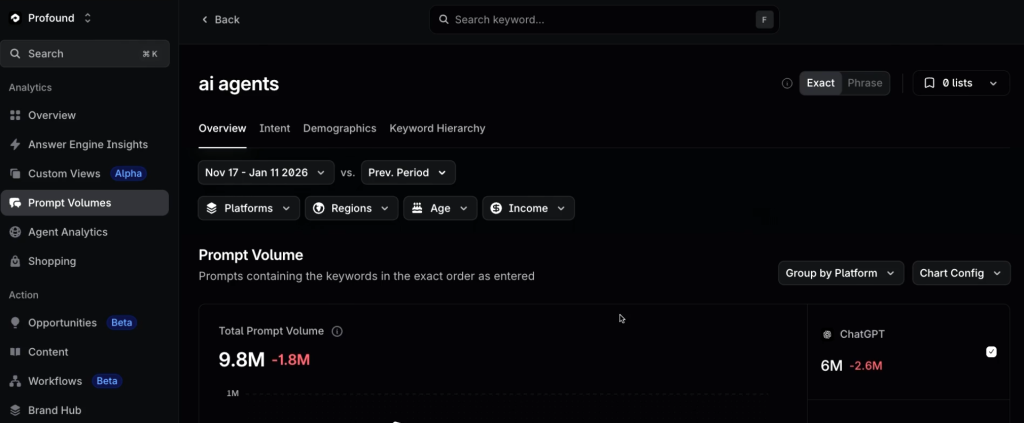
The standout, and the feature most often cited as genuinely unique. Where most trackers tell a brand where it ranks for a prompt, Prompt Volumes estimates how often people are asking that kind of question in the first place, clustered into topics and broken down by engine, region, and demographics. For a category like “content operations,” it surfaces the total monthly prompt demand and which platform carries most of it, which turns AI visibility from a vanity score into an input for what to write next. On Growth it covers relevant keywords; the full search dataset is Enterprise-only.
Opportunities
Available from Growth up, this is the layer that tells a team what to do rather than leaving them to read a chart. Instead of a generic “improve your coverage,” it surfaces specific, prioritized actions: a particular content gap to fill, a named publication and writer to pitch with the rationale attached, or a specific discussion thread to engage. Each item carries the current performance data behind it, so the list can be worked in impact order.
Agents
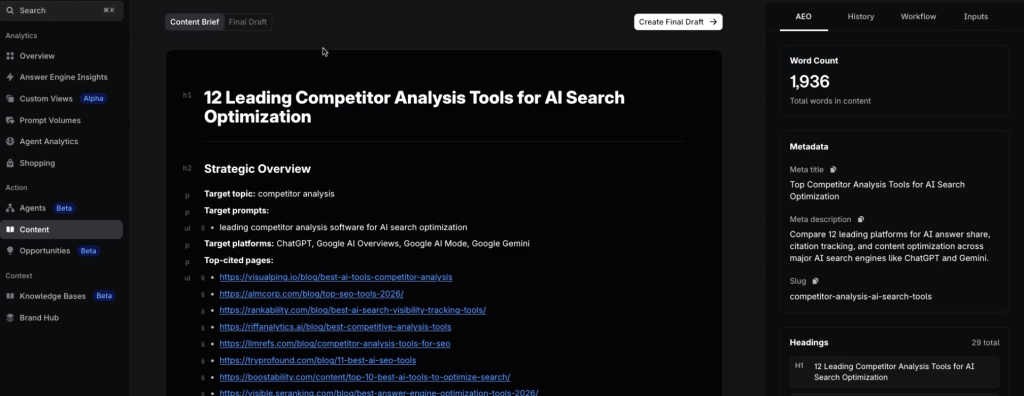
Profound’s content engine. Agents generate AEO-optimized briefs and full drafts built from what’s actually being cited in a brand’s category, so a brief arrives with the target topic, the prompts and platforms it should win, and the pages currently being cited to reference. It runs on a credit model rather than a flat article count: 100 credits a month on Starter, 400 on Growth, custom on Enterprise, with each run costing credits in proportion to its complexity.
Agent Analytics
The attribution layer. It connects to web analytics to show how AI crawlers like GPTBot, ClaudeBot, and PerplexityBot access a site, which pages they read, and how visitors arriving from AI search go on to behave, closing the loop between being cited and seeing traffic from it.
Together, the demand data and the content engine are what let Profound argue it’s more than a dashboard. The catch repeats from the pricing section: almost all of this lives on Growth and above.
Interface and learning curve
Profound is powerful and, by most accounts, not the fastest tool to get comfortable with. The dashboards are dense, the data is deep, and teams report that the platform pays off once prompt sets are tuned and someone owns the workflow. Reviewers consistently note that it works best with a dedicated AEO or SEO lead driving it, rather than as a tool a marketing generalist checks occasionally. Setup itself is quick; reaching the point where the insights change what a team does takes longer, typically a few weeks of tuning.
What users say about Profound
Profound holds a leader position on G2 with the deepest review base in the AEO category, and it comes up frequently in practitioner discussions on Reddit, which is unusual for a B2B tool and suggests genuine adoption rather than marketing noise. The customer base backs that up: brands like MongoDB, Indeed, and US Bank are the kind that clear procurement and security review, and Ramp’s reported jump in AI visibility after adopting the platform is the most-cited result in the category.
The praise centers on two things: the depth of the data and the specificity of the recommendations. Teams that have tried several AEO tools single out Prompt Volumes as a capability they couldn’t find elsewhere, and the Opportunities panel for telling them what to do rather than leaving them to interpret a chart. The recurring criticism is just as consistent. Pricing structure is the most common complaint, with the $99 Starter widely read as a funnel toward the $399 Growth plan. The second is the learning curve, and the related observation that smaller teams without a clear owner struggle to turn the volume of data into action.
Profound pros and cons
Strengths
- Prompt Volumes is a genuine differentiator; no direct competitor shows AI search demand at the same depth.
- The deepest engine coverage in the category at the top tier (ten engines), with enterprise-grade compliance and support.
- The Opportunities panel produces specific, prioritized actions rather than raw metrics.
- The Agents content layer turns citation data into production-ready drafts without a separate tool.
- Credible enterprise customer base and the most-cited case studies in the category.
Limitations
- Real functionality starts at $399/mo; the $99 Starter is a single-engine orientation tier, not a working plan.
- Claude, Gemini, and Copilot are Enterprise-only, so broad engine coverage means a custom contract.
- Steeper learning curve than lighter trackers; it rewards a dedicated owner.
- No flat self-serve path to multi-engine coverage below $399.
How Profound compares to Geoptie
Profound and Geoptie solve overlapping problems for different buyers. Profound is built for enterprise teams that want the deepest possible data and a content engine to match, and that can justify the $399-and-up commitment. Geoptie is built for teams that want multi-engine visibility on a flat, low entry price without gating the engines that matter behind an upgrade.
| Profound | Geoptie | |
|---|---|---|
| Starting price | $99/mo (ChatGPT only); $399/mo for multi-engine | $49/mo |
| Engines on entry tier | 1 (ChatGPT) | 4 (ChatGPT, Claude, Perplexity, Gemini) |
| Claude tracking | Enterprise-only | Included on every paid tier |
| Pricing model | Tiered, multi-engine gated to Growth+ | Flat per-plan |
| Free option | Self-serve trial on Growth | Free tracker, no card, no time limit |
| Best at | Enterprise depth, Prompt Volumes, content Agents | Multi-engine coverage on a low flat price |
Profound wins on depth; Geoptie wins on entry cost and engine access. A team that needs Prompt Volumes, ten-engine coverage, and an in-platform content engine, and has the budget for Enterprise, will find Profound hard to beat. A team whose main need is seeing how it ranks across ChatGPT, Claude, Perplexity, and Gemini without paying $399 or talking to sales is the one Geoptie is built for. For the full set of options, see best Profound alternatives.
Verdict
Profound is the category’s most complete enterprise AEO platform, and it earns that standing on data depth and engine breadth few rivals can match.
Good fit if: you’re an enterprise or growth-stage team treating AI search as a core channel, you have a dedicated owner to run it, you want Prompt Volumes and a content engine in one place, and your budget reaches the $399 Growth plan or an Enterprise contract.
Look elsewhere if: you want multi-engine coverage on a low flat price, you specifically need Claude or Gemini tracking without a sales call, or you’re early enough in your AEO motion that $399/mo is hard to justify before you’ve proven the channel.
FAQ
Three plans: Starter at $99/mo (ChatGPT only, 50 prompts), Growth at $399/mo (three engines, 100 prompts), and Enterprise at custom pricing (up to ten engines). Annual billing takes roughly two months off the Starter and Growth rates.
Only as an orientation. Starter tracks one engine with no exports and no Opportunities, which is enough to see how Profound works but not to run a real program. The features that justify the platform begin at the $399 Growth plan.
Only on Enterprise. Claude, along with Gemini, Copilot, Meta AI, Grok, and DeepSeek, sits on the custom-priced Enterprise tier, so tracking Claude requires a sales conversation. The Starter and Growth plans don’t include it.
Up to ten across all tiers: ChatGPT, Perplexity, Google AI Overviews, Google AI Mode, Gemini, Microsoft Copilot, Meta AI, Grok, DeepSeek, and Claude. The split is one engine on Starter, three on Growth, and the full list on Enterprise.
The Growth plan offers a self-serve “try for free” entry, while Enterprise is sales-led through a demo. There’s no free trial of the full ten-engine product.
Enterprise and growth-stage teams with a dedicated AEO owner and the budget for the $399 Growth plan or an Enterprise contract. Smaller teams and those who mainly need affordable multi-engine tracking tend to find better value elsewhere.
The closest flat-priced, multi-engine option is Geoptie; the broader field is covered in our best Profound alternatives roundup and the wider best AEO tools breakdown.
What to do next
Profound is a strong platform for a team that’s ready for it. The clearest way to know whether you are is to see your own AI visibility first: where you stand across the major engines, which competitors are winning citations, and whether you need ten-engine depth or just a clear view of the handful that matter. Geoptie’s free AI visibility audit gives you that baseline at no cost, and the free AI rank tracker covers ChatGPT, Claude, Perplexity, and Gemini with no credit card and no time limit.