A credit-pool plan only looks cheap until you work out what a single tracked prompt actually costs you each month. Rankscale is an AI visibility tracker built around that model, and it leads the category on one count in particular: the broadest advertised engine list, 17 and counting, with unused credits rolling over instead of expiring. The question a buyer needs answered is not whether Rankscale can watch the engine they care about, because it almost certainly can. It is what that engine costs to run, because the per-engine rates are not equal, and the gap between them decides the bill. That is the catch buried in the engine count.
This review covers what Rankscale does, what each plan costs, how the credit system behaves once real engines are switched on, and who it suits.
Rankscale at a glance
- Engine breadth: the widest in the category. ChatGPT, Gemini, Perplexity, Google AI Mode and AI Overviews, Claude, DeepSeek, Mistral, Grok, and Copilot, with GUI and API variants of several.
- Cost model: pay-per-run credits from a monthly pool, billed per prompt, per engine, per run, with rollover.
- Cost predictability: the weak spot, and the reason the engine count misleads. Per-engine rates run from 0.25 credits to several, so the same prompt set can cost wildly different amounts depending on which engines are enabled.
- Control and flexibility: strong. Each prompt can run against its own engine mix on its own schedule, which is genuinely rare at this price.
- Polish and reporting: functional rather than refined. The data is deep and granular, the dashboards are plain, and there is no native report builder.
What is Rankscale?
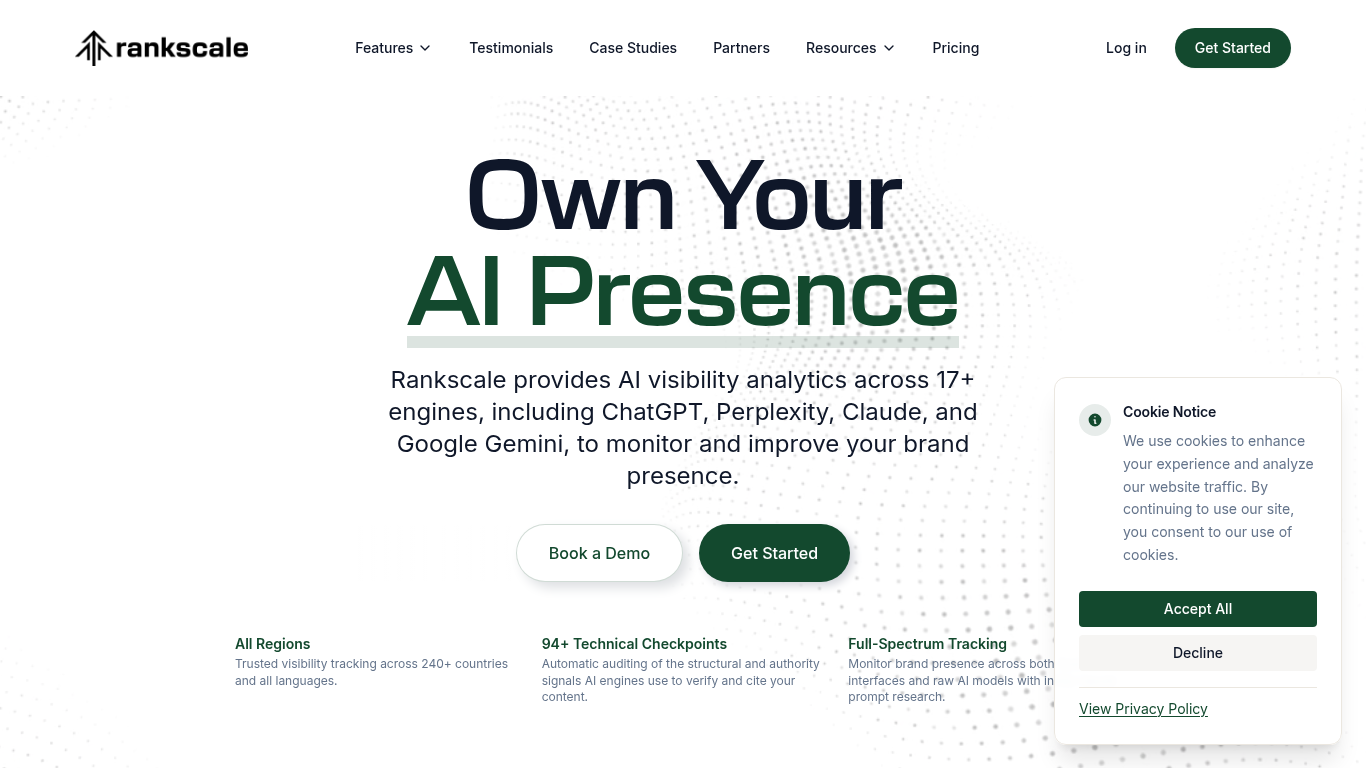
Rankscale is a monitoring-first AI visibility platform, built by the German firm Rankscale GmbH, that tracks how a brand shows up inside AI-generated answers. It recreates the prompts real users would type, captures the full response from each engine, and records where the brand was mentioned, which sources were cited, and how that compares with competitors over time. Rather than selling a fixed number of tracked prompts, it meters usage through credits, so a team pays in proportion to how many prompts, engines, and refresh cycles it runs.
That billing choice is the platform’s defining trait. It rewards teams that want granular control and a low floor to start from, which is why Rankscale tends to attract solo marketers, DIY-minded SEO leads, and agencies juggling many client brands rather than enterprises that prefer a flat, predictable line item.
Rankscale pricing and plans
Rankscale promotes three standard plans plus a sales-led custom tier. The entry point is Pro at $99 a month, and every plan carries the same engine list. What separates them is the size of the credit pool.
| Plan | Monthly price | Credits/mo | Brand dashboards | Page audits/mo | Engines | Free entry |
|---|---|---|---|---|---|---|
| Pro | $99/mo | 1,200 | 10 | 50 | 17+ | 7-day free trial |
| Growth | $385/mo | 5,500 | 50 | 200 | 17+ | — |
| Enterprise | $780/mo | 12,000 | 100 | 200 | 17+ | — |
| Custom | Sales-led | Tailored | Custom | Custom | 17+ | — |

Annual billing takes 15% off any plan. Credits left unused roll into the next cycle, up to twice the monthly allocation on Pro and three times on Growth and Enterprise, and top-ups can be bought at any time. Every tier includes unlimited team seats with no per-seat charge, which is unusual and a real point in Rankscale’s favor for agencies. Pro can be tried free for seven days with no charge until day seven. The Growth plan, marked as the agency choice, adds white-label dashboards and REST API access along with an agency program of affiliate commissions, client discounts, a partner-directory listing and ten free prompt-research queries a month. The only genuinely custom tier is the sales-led one, reserved for buyers who need SSO, an SLA, or a dedicated success manager.
What each credit buys matters more than the plan price, because that is where a $99 plan quietly becomes something else. Before committing to any of these tiers, it helps to know where a brand actually stands across the major engines right now. A free AI visibility audit returns that snapshot for one brand in about a minute, which gives any credit estimate a baseline to sit against.
How Rankscale credits actually work
This is the section that decides whether Rankscale is cheap or expensive for a given team, and it is where the “17+ engines on every plan” promise needs unpacking. The engines are all available on every paid tier. They simply do not cost the same to run.
Each time Rankscale queries an engine for one prompt, it spends credits at a per-engine rate:
- 0.25 credits per run: ChatGPT, Gemini, Perplexity, and Google AI Mode.
- 1 credit per run: DeepSeek, Google AI Overviews, and several API model variants.
- 2 credits per run: Claude, along with Perplexity’s Pro models and Mistral Large.
- 4 credits per run: the heaviest API models, such as Gemini 3 Pro.
The practical effect is that Claude costs eight times what ChatGPT costs to track. Take Pro’s 1,200 monthly credits and a realistic setup of 50 prompts checked weekly across the four base engines, which run at 0.25 each. That comes to roughly 217 credits a month, comfortably inside the pool. Add Claude to those same 50 prompts at the same weekly cadence and the bill climbs by about 433 credits, pushing the total to around 650, more than half the entire Pro allocation consumed by a single engine. Switch on DeepSeek or one of the Pro API models as well and the pool empties before the month does, at which point the choice is a top-up or the $385 Growth plan.
None of this is hidden, and the rollover softens it. But it does mean the engine list is the first thing to price out, not the last. A team that came to Rankscale specifically to watch Claude should treat Claude as the line item that sets its real monthly cost. Watching the Claude slice on its own first, through a free Claude rank tracker, is a low-stakes way to gauge how much of that engine you actually need before paying eight times the base rate for it inside a credit pool.
Rankscale’s key features
Rankscale is organized around four jobs: see where a brand lands in AI answers, trace which sources fed those answers, benchmark the result against rivals, and audit individual pages for AI readiness.
Prompt-level visibility tracking
The core of the tool. Enter a prompt like “best AI rank trackers,” choose the engines and a cadence, and Rankscale runs it on schedule, storing the full answer each time. The result view shows the brand’s visibility score, its average position, how many times it was mentioned versus cited, and a detection rate, with a complete execution history so a team can open any single run and read the exact answer the engine returned. Because each prompt carries its own engine selection and frequency, a high-priority term can be tracked daily across several engines while a long tail of prompts runs weekly on ChatGPT alone.
Citation and source analysis
Visibility on its own does not explain why a brand wins or loses an answer, so Rankscale records the sources behind each response. The citations view ranks the domains AI engines lean on most for a tracked topic, and the sources view surfaces which URLs on a brand’s own site are being pulled into answers. For a prompt where a competitor keeps appearing, this turns a vague “they rank and we don’t” into a concrete list of the publications and pages feeding that result, which is the input a content or digital-PR plan actually needs.
Competitor benchmarking
Every tracked prompt runs under identical conditions for a brand and its named competitors, so the share-of-voice comparison is like-for-like. The benchmarking view aggregates mention frequency, citation share, and position into one standing per competitor, then splits it by engine, which regularly exposes asymmetries: a rival might dominate Google AI Overviews yet barely register on ChatGPT, telling a team where to defend and where to push. Trend graphs over weeks separate a genuine shift from the normal week-to-week noise of model outputs.
Page audits
Alongside prompt tracking, each plan includes a monthly allowance of page audits, 50 on Pro and 200 on Growth and Enterprise, that grade any URL for AI search readiness across content quality, authority signals, technical structure, and engagement, with specific suggestions for each. The recommendations are prescriptive and useful for quick fixes. The headline AI readiness score is best treated as a rough guide rather than a metric to report, since running the same page twice can return different numbers, a quirk Rankscale shares with most AI-generated scoring.
Taken together, these features cover the monitoring and diagnosis side thoroughly. What Rankscale deliberately does not do is act on the findings: there is no built-in content generation or automated remediation, so turning insight into published change stays a manual job for the team.
Interface and experience
Rankscale is built for control rather than first impressions. Signing up takes only an email, no name required, though a card is needed once a plan is chosen, and setting up a brand and the first prompts is quick. From there the platform rewards a hands-on user: filters by engine, topic, and date range, per-prompt cadence settings, and a credit estimate shown before each prompt is saved. The trade-off is polish. The dashboards are dense and plain rather than presentation-ready, and there is no native report generator, so sharing with a client or manager means a dashboard link, a screenshot, or a PDF, with Looker Studio export available on Pro and above. Practitioners who want the data and the control tend to love it; those who want a tool that looks impressive in a stakeholder meeting often find it spartan.
What users say about Rankscale
Sentiment is positive but drawn from a small base, as expected for a young tool. Across review aggregators Rankscale sits around 4.7 out of 5, and the platform reports more than a thousand active users alongside an enterprise and agency customer list that includes Bosch, Iberdrola, UBS, Cartier, and agencies such as Dentsu, Publicis Sapient, and WPP Media.
The praise is consistent across hands-on reviews and practitioner threads: the price-to-capability ratio is hard to beat, the engine breadth is unusually wide, and the per-prompt control gives more granularity than tools costing several times as much. The criticism is just as consistent. The dashboards are not polished, the absence of a report builder is a recurring annoyance, the page-audit scores are too inconsistent to trust as metrics, and credit consumption can be hard to predict once tracking expands across engines, regions, and clients. The common thread is that Rankscale is a strong instrument that still leaves interpretation and action entirely to the user.
Rankscale pros and cons
Strengths
- The broadest advertised engine list, covering 17+ engines including Claude, DeepSeek, Mistral, and Grok on every paid tier, with no engine locked to a higher plan.
- Per-prompt control over engine mix and cadence, which is rare at any price.
- A credit calculator on the pricing page that prices a prompt set before you commit, which is more transparency than most metered tools offer.
- Unusually current feature set, including query fanout analysis, sponsored-ad tracking inside ChatGPT and AI Mode, shopping-card analysis, and MCP access for querying your own data from an AI assistant.
- Credits roll over and top-ups are available, so spend tracks usage rather than a fixed cap.
- Unlimited team seats on every plan, plus white-label and API access from the $385 Growth tier, which suits agencies.
Limitations
- Uneven per-engine rates make the monthly bill hard to forecast: Claude costs 2 credits per run, eight times the 0.25 of the base engines.
- The entry price is $99, well above the cheapest paid plans in the category, so the low-cost reputation does not survive contact with the current pricing page.
- Heavy or multi-engine tracking burns through Pro’s 1,200 credits quickly, pushing real costs toward Growth or frequent top-ups.
- No native report builder; sharing relies on dashboard links, exports, or screenshots.
- Page-audit readiness scores are inconsistent and not reliable as reported metrics.
- Monitoring only; no content generation or remediation layer.
How Rankscale compares to Geoptie
Rankscale and Geoptie answer the same question, how a brand shows up in AI answers, with opposite billing philosophies. Rankscale meters every prompt, engine, and run through a credit pool, which gives an agency fine control but a bill that moves with usage. Geoptie charges a flat monthly price, with Claude costing the same as every other engine on every paid tier, so the line item does not change when Claude is switched on.
Rankscale genuinely beats Geoptie on breadth: 17 or more engines against Geoptie’s seven, including DeepSeek, Mistral and Grok, which Geoptie does not track at all. It also offers per-prompt cadence control and page audits that Geoptie does not match. The trade is that Geoptie caps a single brand workspace at four engines from its seven, while Rankscale lets a prompt run against everything it supports, for a price.
| Rankscale | Geoptie | |
|---|---|---|
| Starting price | $99/mo (1,200 credits) | $49/mo |
| Engines on entry tier | 17+ advertised, billed per engine per run | 7 available, any 4 tracked per brand |
| Claude tracking | Included, but at 2 credits/run (8x base) | Included on every paid tier at one flat rate |
| Pricing model | Credit pool, pay-per-run, rolls over | Flat per-plan |
| Free option | 7-day free trial on Pro; no free tier | No free plan or trial; free standalone tools need no card |
| Best at | Widest engine list, granular agency control | Predictable cost with Claude included |
Put simply, Rankscale leads on breadth and granular control, while Geoptie leads on entry price and a bill that stays still. A team that wants the longest possible engine list, fine per-prompt tuning, and the flexibility to scale spend up and down will get a lot from Rankscale, especially an agency. A team that mainly needs the major assistants, with Claude costing the same as ChatGPT and no credit math to manage, and can work within four engines per brand, is the one Geoptie fits. For the wider field, see the best Rankscale AI alternatives.
Verdict
Rankscale earns its reputation as the most flexible AI visibility tracker for hands-on users, and the broad engine list is genuine rather than marketing. The catch is in the credit rates, not the coverage. Every engine is available on every plan, but they are not priced alike, so the engine count tells you what Rankscale can watch, not what it will cost you to watch it.
Good fit if: you are a DIY-minded SEO lead or an agency that wants the widest engine list, granular per-prompt control, and unlimited seats, and you are comfortable managing credit consumption to keep costs in check.
Look elsewhere if: you want a flat, predictable monthly bill, you specifically need steady Claude tracking without it consuming most of your credit pool, you are shopping below $99 a month, or you want polished, presentation-ready reporting and a content layer that acts on what the tool finds.
FAQ
Three standard plans: Pro at $99/mo (1,200 credits), Growth at $385/mo (5,500 credits), and Enterprise at $780/mo (12,000 credits), plus a sales-led custom tier. Annual billing takes 15% off, and credits roll over to the next cycle, up to twice the monthly allocation on Pro and three times on Growth and Enterprise.
Every tracked prompt spends credits each time it runs, charged per engine and per refresh. Base engines like ChatGPT cost 0.25 credits per run, while heavier engines cost more, so the same prompt set can cost very different amounts depending on which engines and how often it runs.
Yes, Claude is available on every paid tier, but it bills at 2 credits per run, eight times the 0.25 rate of the base engines. Tracking Claude across a meaningful prompt set can consume more than half of Pro’s 1,200 monthly credits on its own.
Rankscale advertises 17 and more, including ChatGPT, Gemini, Perplexity, Google AI Mode and AI Overviews, Claude, DeepSeek, Mistral, Grok, and Copilot, with GUI and API variants of several. All are available on every paid plan; the difference between plans is the size of the credit pool, not the engine list.
Yes. Pro can be tried free for seven days, with no charge until day seven and cancellation at any time. There is no permanently free tier, and a card is required to activate a plan.
DIY SEO leads and agencies that value engine breadth, per-prompt control, and unlimited seats, and that can manage credit usage. Teams wanting a flat, predictable bill, a sub-$99 entry price, or polished reporting tend to find better value elsewhere.
The closest flat-priced option with Claude included on its entry plan is Geoptie, at $49 a month with seven engines available and any four tracked per brand. The wider set of trackers and platforms is covered in the best Rankscale AI alternatives roundup and the broader best LLM tracking tools breakdown.
What to do next
Whether Rankscale’s credit model works in your favor comes down to one number: what your engine list costs per month once the engines you care about are switched on. Map that out before you commit, with Claude and any heavier engines priced at their real per-run rates rather than the headline. It also helps to see where your brand stands today, so the spend has a target. Geoptie’s free AI visibility audit gives that baseline at no cost, and the free AI rank tracker covers ChatGPT, Claude, Perplexity, and Gemini with no credit card and no subscription.