AEO buying gets harder when none of the vendor’s prices are public — the comparison can’t begin until a sales call ends. Goodie sits firmly in that camp: an enterprise AEO platform with a credible enterprise story (eleven engines at the top tier, Agentic Commerce coverage of Amazon Rufus and Walmart Sparky that no one else in this list matches, and customer case studies citing real conversion lift from Dermalogica, NoGood, and SteelSeries) but every one of its three tiers — Explorer, Pro, and Enterprise — is gated behind a “Get a Demo” form. Engine coverage at each tier sits behind that same demo, and Claude tracking is fully unlocked only on the custom-priced Enterprise contract.
For a marketing team comparing options against a fixed monthly budget, that’s a week of sales discovery before the real comparison work even starts. The eight alternatives below all publish their prices on the page; the free AI rank tracker covers ChatGPT, Claude, Perplexity, and Gemini at no cost if a starting point is helpful before reading further.
TL;DR — best Goodie alternatives by use case
- Geoptie — published prices and a free starting tier, the opposite of Goodie’s demo-only model. Four engines on a $49/mo Starter, no sales call to see the number.
- Otterly AI — best for solo SEOs and small teams that want to start tracking AI visibility for under $30 a month with no sales call
- Profound — best for enterprise teams that need the deepest engine breadth with SOC2 compliance
The full comparison is below.
Quick comparison table
| Tool | Best for | AI engines covered | Pricing model | Starting price |
|---|---|---|---|---|
| Geoptie | Marketing teams that want flat-priced multi-engine AI visibility on every tier | ChatGPT, Claude, Perplexity, Gemini | Flat per-plan | $49/mo |
| Otterly AI | Solo SEOs and small teams testing AI visibility for under $30/mo | ChatGPT, AI Overviews, Perplexity, Copilot (4 included); AI Mode and Gemini as paid add-ons | Flat per-plan | $29/mo Lite |
| Profound | Enterprise teams needing the deepest engine coverage with compliance | ChatGPT (Starter); + Perplexity + AI Overviews (Growth); 10 engines incl. Claude (Enterprise) | Flat per-plan; Enterprise custom | $99/mo Starter |
| Peec AI | Brand teams focused on how AI describes their brand, with sentiment scoring | ChatGPT, AI Mode, AI Overviews, Copilot, Perplexity, Gemini, Grok — choose 3 of 7 on self-serve; Claude Enterprise-only via API | Flat per-plan + engine add-ons | $95/mo Starter |
| Scrunch | Technical SEO teams that need AI-crawler analytics alongside citation tracking | ChatGPT, Perplexity, Google AIO, Copilot (Core); Claude, Gemini, Meta AI, AI Mode, Grok (Enterprise) | Flat per-plan | $300/mo Core ($250 annual) |
| SE Ranking AI Search | SEO teams that want AI visibility folded into a full SEO suite | AI Overviews, AI Mode, Perplexity, ChatGPT (AI Search add-on) | Flat plan + flat add-on | $218/mo combined |
| Ahrefs Brand Radar | Established SEO teams already in the Ahrefs ecosystem | AI Overviews, AI Mode, ChatGPT, Perplexity, Copilot, Gemini, Grok | Flat per-plan | $398/mo Select |
| Semrush AI Toolkit | SEO teams that want AI visibility inside their existing Semrush workflow | ChatGPT, Google AI, Gemini, Perplexity (Claude Enterprise-only) | Per-domain add-on, multiplied per seat | $99/mo per domain per user |
All pricing is monthly-billed. Engine coverage often changes by tier — the engine that matters most may not be unlocked on the entry plan.
1. Geoptie
Best for marketing teams that want flat-priced multi-engine AI visibility with a published number on every tier.
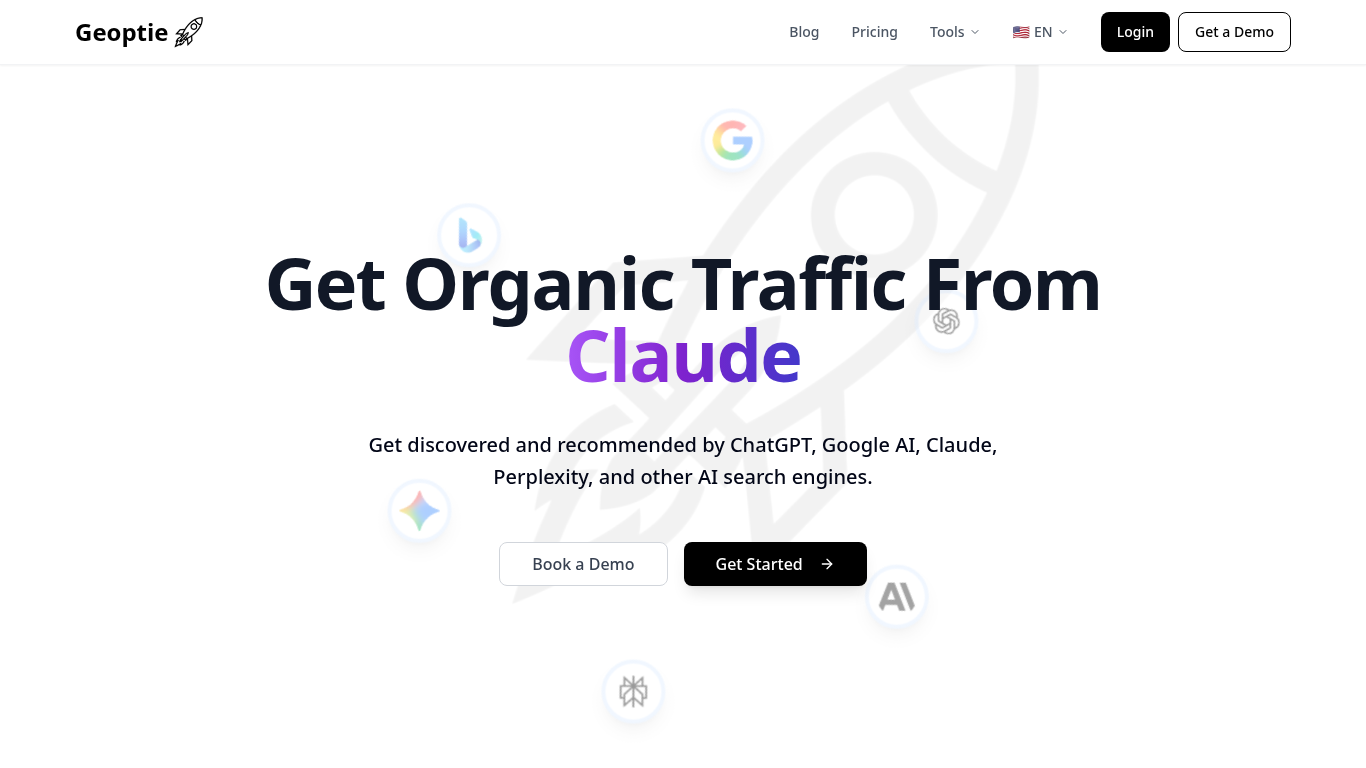
Geoptie tracks brand visibility across ChatGPT, Claude, Perplexity, and Gemini — all four engines included on every paid plan from $49/mo. Three published prices, no demo gate, no engine gating across tiers. The four engines are the platforms where most measurable AI search citations land today; Goodie’s engine list runs longer, but seven of the eleven engines (including Claude) require an Enterprise contract.
Key features
- Four engines (ChatGPT, Claude, Perplexity, Gemini) on every paid tier including the $49 Starter
- Citation and brand-mention tracking with daily refresh
- Competitor share-of-voice across the same prompt set
- Multi-brand workspaces — 10 on Professional, unlimited on Enterprise
- Free single-engine rank trackers (ChatGPT, Claude, Perplexity) plus a free GEO audit
- CSV and PDF exports on every plan
Pricing
- Starter — $49/mo ($41/mo billed annually). 15 prompts, 2 brands.
- Professional — $99/mo ($83/mo annually). 100 prompts, 10 brands.
- Enterprise — $199/mo ($166/mo annually). 400 prompts, unlimited brands.
- Add-on prompt pack: +100 prompts at $99/mo.
Pros
- Published price on every tier — no demo gate
- Claude included at $49 Starter, not gated to a higher tier
- Free single-engine trackers with no credit card and no time limit
Cons
- Four engines, not the eleven Goodie’s marketing implies
- No Agentic Commerce coverage (Amazon Rufus, Walmart Sparky) — Goodie’s genuine differentiator for retail
- No dedicated AI-crawler analytics — Scrunch covers that dimension
2. Otterly AI
Best for solo SEOs and small teams that want to start tracking AI visibility for under $30 a month with no sales call.
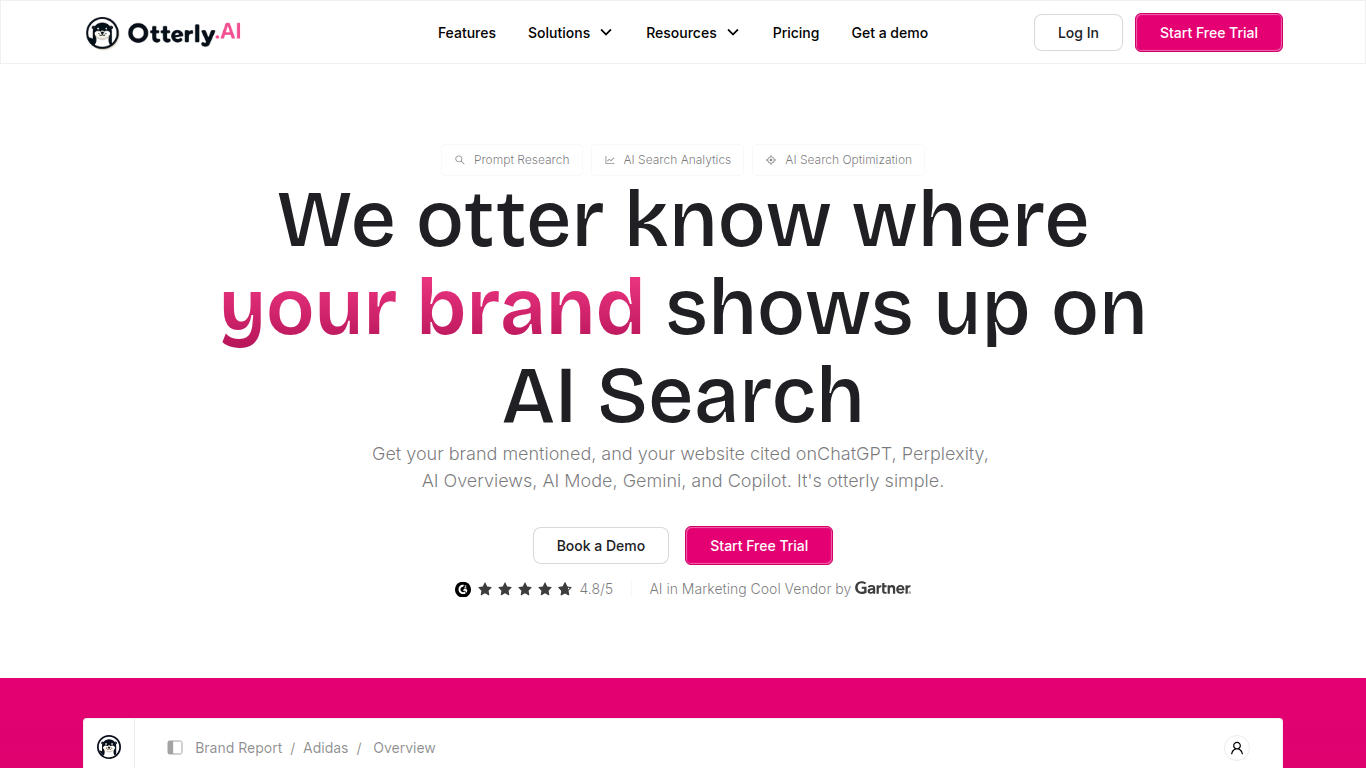
Otterly is the cheapest paid entry on this list. The $29/mo Lite tier covers four engines (ChatGPT, Google AI Overviews, Perplexity, Microsoft Copilot) with 15 prompts and daily tracking. Gartner Cool Vendor 2025. For a Goodie prospect who balked at the demo gate, Otterly is the fastest possible answer — sign up, see data the same day, decide later. See the Otterly alternatives breakdown for context.
Key features
- 4 engines on every tier (ChatGPT, AI Overviews, Perplexity, Copilot)
- AI Mode and Gemini available as add-ons ($9–$149/mo by tier)
- Real-time visibility alerts and sentiment analysis
- Public API on Standard and Premium tiers
- Google Looker Studio connector
Pricing
- Lite — $29/mo ($25/mo billed annually). 15 prompts.
- Standard — $189/mo ($160/mo annually). 100 prompts, public API.
- Premium — $489/mo ($422/mo annually). 400 prompts.
Pros
- Cheapest paid entry on this list, fully self-serve
- Gartner Cool Vendor 2025 credibility for SMBs
- Strong real-time alerting
Cons
- No Claude on any tier — a meaningful gap for AI-search programs
- Gemini and AI Mode are add-ons rather than included
- No AI-crawler analytics or content-optimization actions
3. Profound
Best for enterprise brands that need the deepest engine breadth with SOC2 compliance.
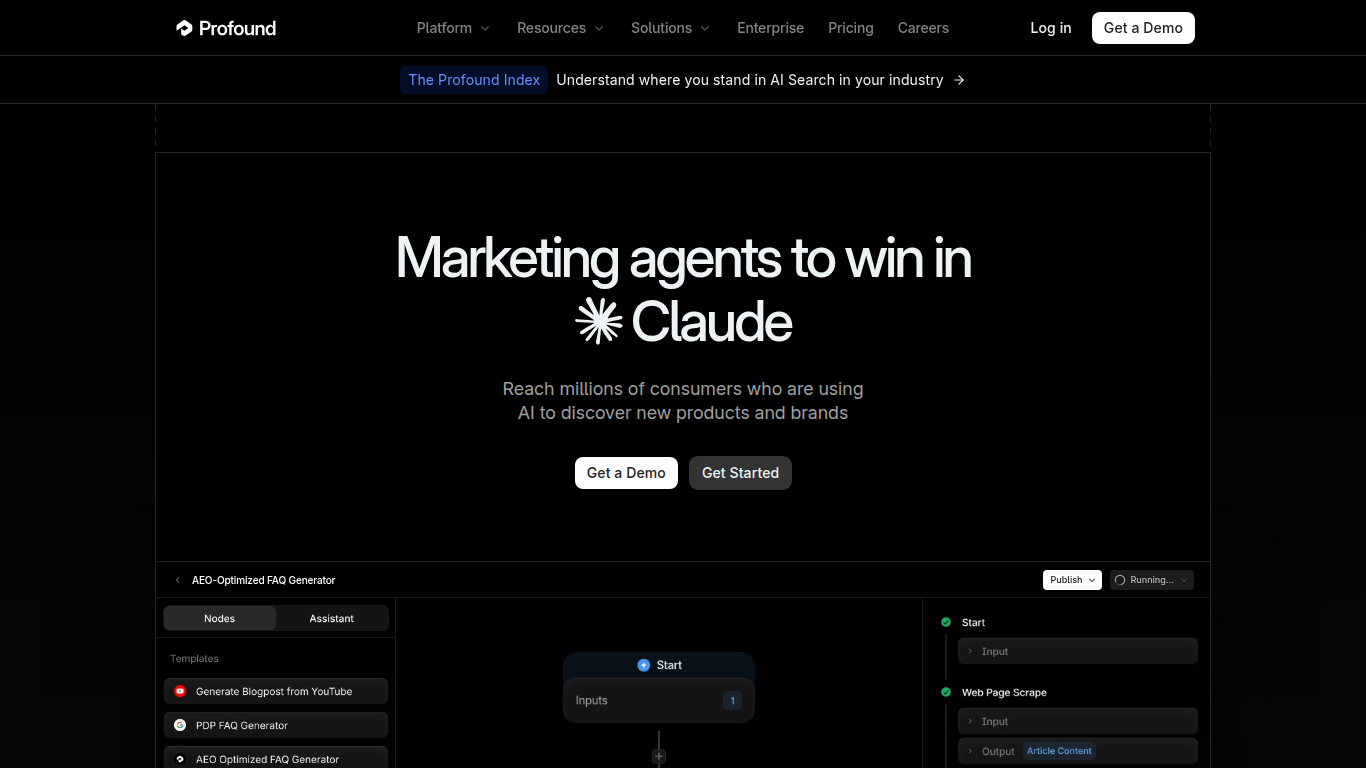
Profound is the closest direct competitor to Goodie’s enterprise positioning. Ten engines on the top tier (ChatGPT, Perplexity, Claude, Gemini, AI Overviews, AI Mode, Copilot, Meta AI, Grok, DeepSeek), SOC2 Type II compliance, and a full Agent Analytics layer for AI crawlers. The key difference for a Goodie shopper: Profound publishes Starter Lite at $99 (ChatGPT-only) and Growth at $399 with three engines + 6 AEO-optimized articles per month. Enterprise is custom, but the floor is visible before any sales call. See the Profound alternatives comparison for the wider context.
Key features
- 10 engines on Enterprise — broadest in this list
- Growth includes 6 AEO-optimized articles per month alongside monitoring
- SOC2 Type II compliance, SSO/SAML, dedicated Slack support on Enterprise
- Agent Analytics — full AI-crawler visibility (Anthropic, OpenAI, Perplexity bots) with Cloudflare integration
- Conversation Explorer with a large real-prompt dataset
Pricing
- Starter — $99/mo. 50 prompts, ChatGPT only.
- Growth — $399/mo. 100 prompts across ChatGPT, Perplexity, AI Overviews. 6 articles/mo.
- Enterprise — custom. 10 engines including Claude, multi-company, SSO/SAML + SOC2.
Pros
- Deepest engine coverage in this list for enterprise buyers
- Strongest compliance posture for regulated industries
- Strong Agent Analytics for technical teams
Cons
- Starter is ChatGPT-only — multi-engine starts at $399
- Enterprise pricing is custom — Claude tracking is sales-led
- No public Enterprise ceiling
4. Peec AI
Best for brand teams focused on how AI describes their brand, with sentiment scoring.
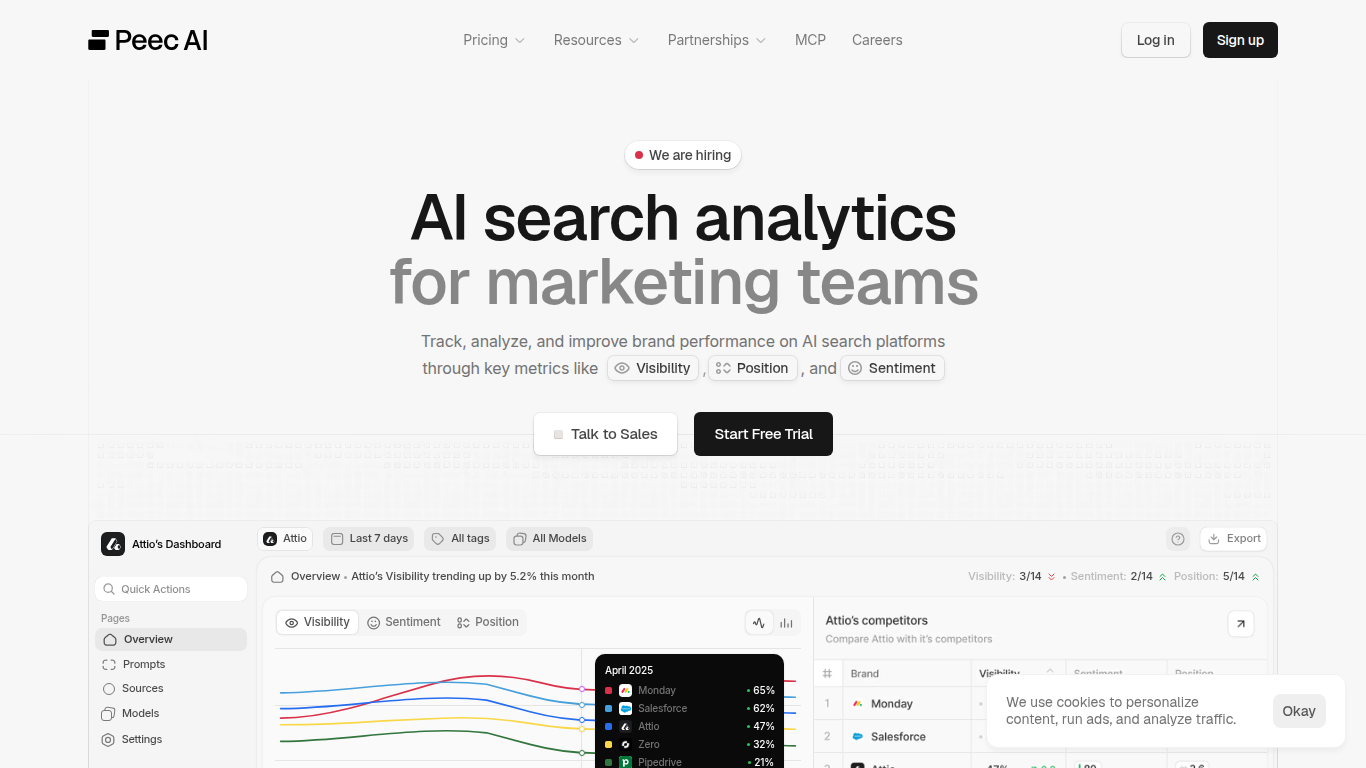
Peec is European-built (Berlin-headquartered) and specializes in brand-mention sentiment — the dimension that matters when an AI names a brand without linking it. Self-serve tiers cap engine selection at 3 of 7 (ChatGPT, AI Mode, AI Overviews, Copilot, Perplexity, Gemini, Grok), and Claude Sonnet 4 is available only on Enterprise via API. Strong multilingual and country-level analytics. See the Peec AI alternatives breakdown.
Key features
- 7 self-serve engines, choose 3 per project
- Claude Sonnet 4 and GPT-5 Search on Enterprise via API
- Best-in-class brand-mention sentiment scoring
- Multilingual brand-mention analytics across 14+ languages
- Country-level breakdown of citation share
- 7-day free trial; unlimited user seats on every plan
Pricing
- Starter — $95/mo (€89/mo). 50 prompts, choose 3 of 7 engines.
- Pro — $245/mo. 150 prompts.
- Advanced — ~$495/mo. 350 prompts.
- Enterprise — custom. Adds Claude Sonnet 4 + GPT-5 Search via API.
- 15% discount on annual billing.
Pros
- Strong multilingual and regional brand-mention analytics
- 7-day free trial — easy self-serve evaluation
- Best-in-class sentiment depth on AI brand framing
Cons
- 3-of-7 engine cap means selection trade-offs even at higher tiers
- Claude requires Enterprise — same gating shape as Goodie, just visibly priced
- Engine add-ons stack quickly past the $95 headline
5. Scrunch
Best for technical SEO teams that need AI-crawler analytics alongside citation tracking.
Scrunch is the AI-crawler analytics specialist of this list. It exposes named coverage of ClaudeBot, GPTBot, OAI-SearchBot, and PerplexityBot — which pages they crawl, how often, what they extract — alongside citation and mention tracking. Core covers four engines on the publicly-priced tier; Claude, Gemini, Meta AI, AI Mode, and Grok are Enterprise-only. See the Scrunch AI alternatives comparison.
Key features
- Named-crawler analytics for ClaudeBot, GPTBot, OAI-SearchBot, PerplexityBot
- 4 engines on Core (ChatGPT, Perplexity, Google AIO, Copilot)
- Citation, mention, and sentiment tracking
- Persona-based prompt sets and page-level audits
- Strong technical SEO orientation (llms.txt, crawler segmentation)
Pricing
- Core — $300/mo monthly ($250/mo billed annually). 4 engines, 350 custom prompts, 3 seats.
- Growth — $500/mo ($417/mo annually). 5 seats, 700 custom prompts.
- Enterprise — custom. Adds Claude, Gemini, Meta AI, AI Mode, Grok.
Pros
- Best AI-crawler analytics in the category at a published price
- Strong technical SEO orientation
- Clean published pricing on Core and Growth
Cons
- 4-engine Core ceiling — Claude and Gemini require Enterprise
- $300 entry is higher than Geoptie, Otterly, or Peec
- No free trial; demo-only at Enterprise
6. SE Ranking AI Search
Best for SEO teams that want AI visibility folded into a full SEO suite.
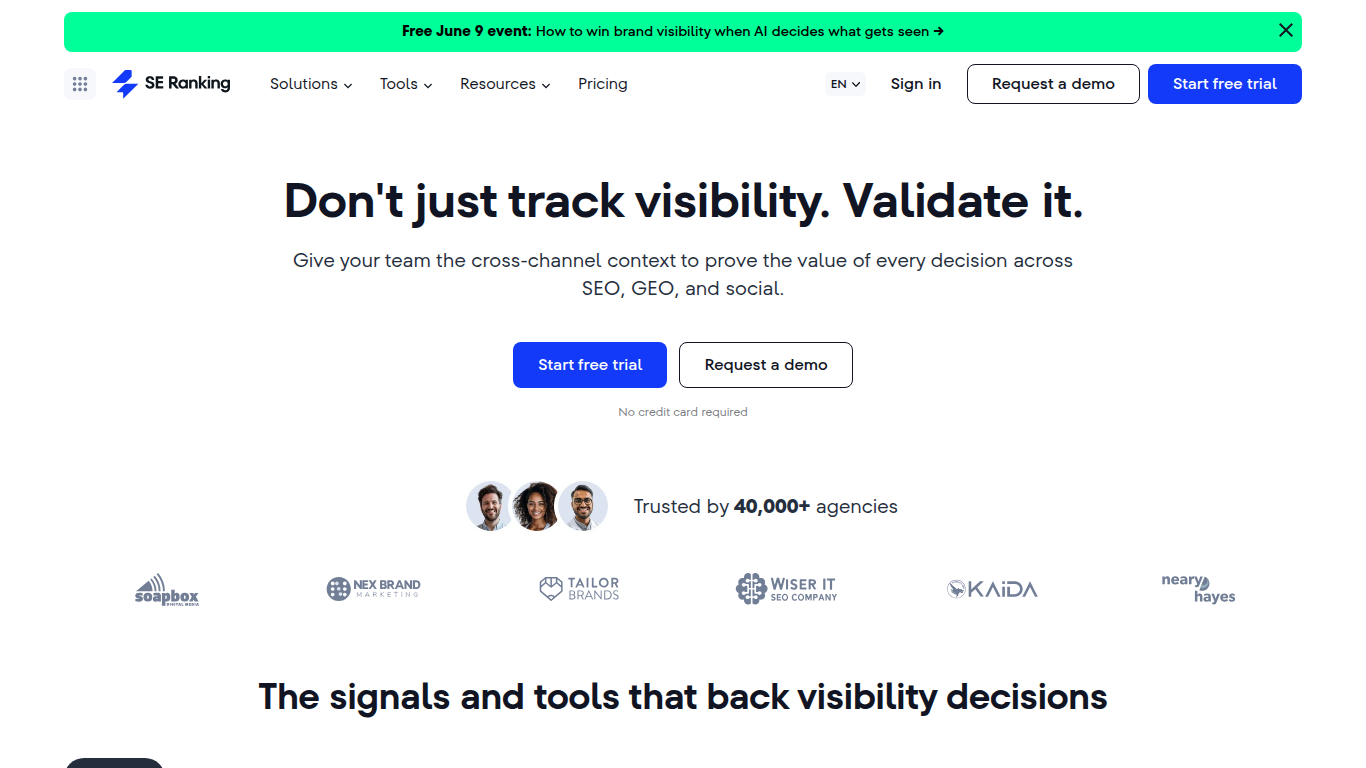
SE Ranking is a traditional SEO suite with an AI Search add-on layered on top. The combined entry is $218/mo (Core $129 + AI Search $89) — slightly above Geoptie Professional, but with a full SEO suite alongside. The AI Search add-on covers ChatGPT, AI Overviews, AI Mode, and Perplexity. 14-day free trial on Core with no credit card.
Key features
- Full SE Ranking SEO suite (rank tracking, backlinks, audits, competitive research)
- AI Search add-on with “SE Visible” dashboard for brand mentions, citations, and sentiment
- 4 AI engines tracked (AI Overviews, AI Mode, Perplexity, ChatGPT)
- 14-day free trial on Core, no credit card
Pricing
- Core (SEO) — $129/mo ($103.20/mo billed annually).
- AI Search add-on — $89/mo ($71.20/mo annually). 200 prompts.
- Combined entry — $218/mo ($174.40/mo annually).
- Growth (SEO) — $279/mo ($223.20/mo annually).
Pros
- SEO and AEO in one platform, published pricing on every plan
- 14-day free trial with no credit card
- Strong fit for teams already running SE Ranking
Cons
- No Claude in the AI Search add-on
- Four-engine ceiling — no Claude, Copilot, Grok, or Gemini
- True entry is $218/mo combined — Core alone does not include AI Search
7. Ahrefs Brand Radar
Best for established SEO teams already in the Ahrefs ecosystem.
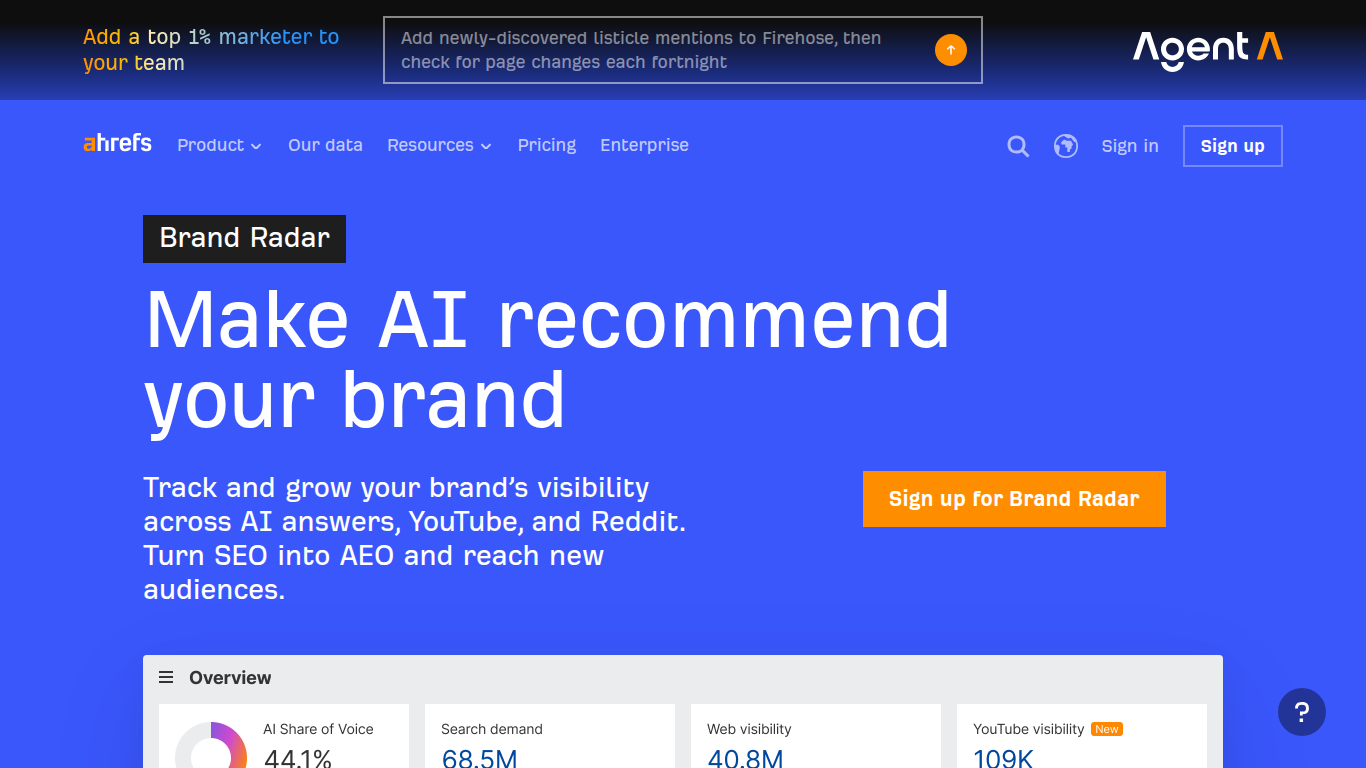
Brand Radar layers AI visibility tracking onto Ahrefs’ 395M+ monthly organic prompt dataset — the largest real-search-backed prompt source in the category. Seven engines tracked (AI Overviews, AI Mode, ChatGPT, Perplexity, Copilot, Gemini, Grok). No Claude on the Brand Radar feature page. The entry tier (Select platforms) is $398/mo and the All platforms tier is $699/mo with 2,500 custom prompt checks. Higher price floor than the dedicated AEO tools, but the prompt dataset and existing Ahrefs ecosystem come bundled.
Key features
- 395M+ monthly organic prompts — largest real-search dataset in the category
- Brand mentions, citations, and share-of-voice tracking
- Beta tracking on Reddit, YouTube, and TikTok — surfaces AI engines cite heavily
- Integration with the full Ahrefs SEO suite
- 7 AI engines tracked (no Claude)
Pricing
- Select platforms — $398/mo. Six engines.
- All platforms — $699/mo. Adds Grok and 2,500/mo custom-prompt checks.
Pros
- Largest real-search prompt dataset of any tool here
- Published flat pricing on every tier
- Tight integration with Ahrefs’ existing SEO data
Cons
- No Claude on the Brand Radar feature page
- $398/mo entry is high for AI-visibility-only use
- Bundled-suite model — effectively paying for Ahrefs too
8. Semrush AI Toolkit
Best for SEO teams that want AI visibility inside their existing Semrush workflow.
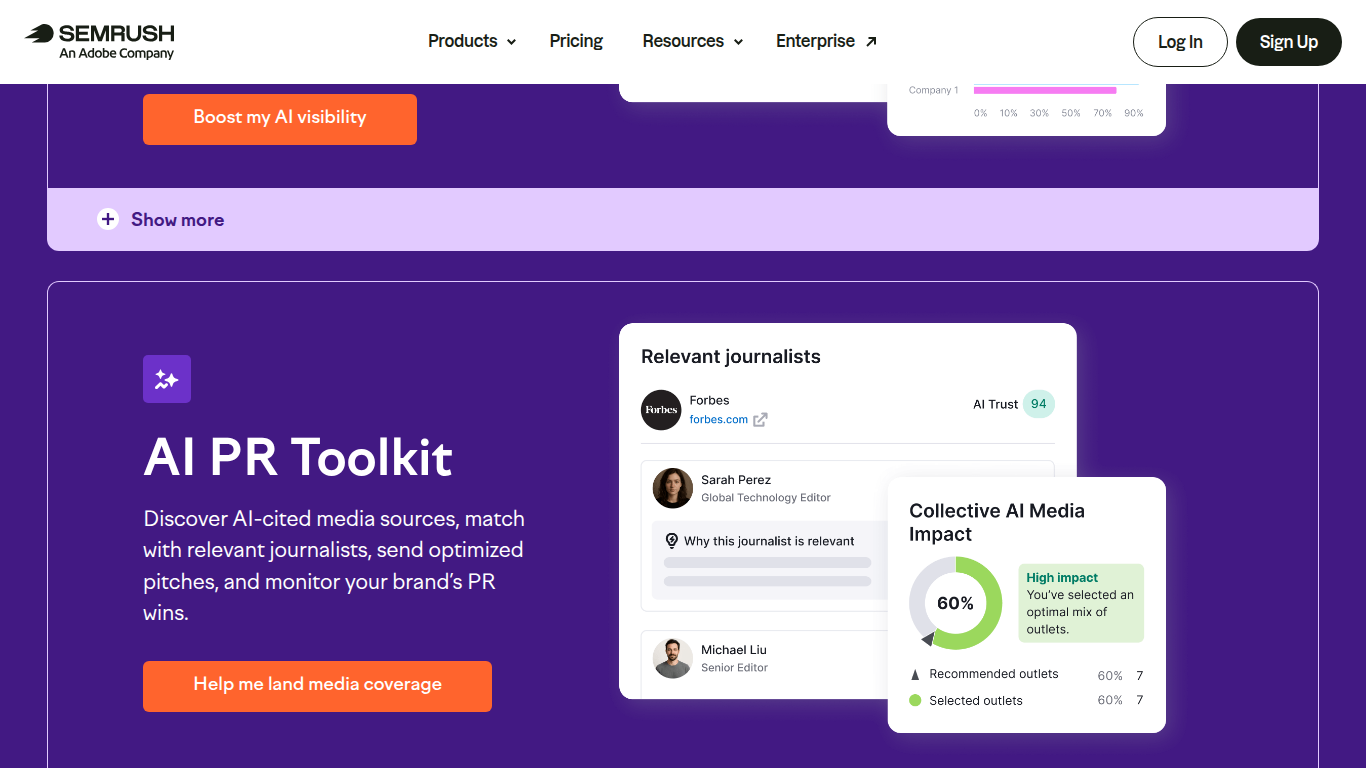
The Semrush AI Toolkit is a $99/mo per-domain add-on layered onto a Semrush plan (Semrush One bundles start at $199/mo). It tracks ChatGPT, Google AI, Gemini, and Perplexity — four engines, with Claude Enterprise-only and no public Enterprise price. For Goodie prospects already on Semrush, this is the lowest-friction option. The pricing footnote: the $99 add-on is per domain per user, so three teammates needing access on one domain runs $297/mo for the add-on alone, before the base Semrush plan.
Key features
- 4 AI engines tracked (ChatGPT, Google AI, Gemini, Perplexity)
- Brand mentions and competitive AI visibility benchmarking
- Integration with Semrush’s existing keyword, traffic, and SEO data
- Position tracking across both traditional SERPs and AI surfaces
- AI competitor analysis and AI readiness site audit
Pricing
- AI Toolkit add-on — $99/mo per domain per user.
- Semrush One — Starter — $199/mo.
- Semrush One — Pro+ — $299/mo.
- Semrush One — Advanced — $549/mo.
- Claude — Enterprise-only, custom quote.
Pros
- Bolts onto a tool many SEO teams already pay for
- All entry-tier prices published
- Strong prompt-research depth from the Semrush data layer
Cons
- Per-seat multiplication makes team rollouts expensive fast
- No Claude on any publicly-priced tier
- Bundled-suite model — paying for Semrush too
How to choose the right Goodie alternative
- Broadest answer-engine coverage at the lowest published flat entry price: Geoptie at $49/mo — ChatGPT, Claude, Perplexity, and Gemini with no demo required.
- Cheapest paid entry under $30: Otterly AI Lite at $29/mo — no Claude included.
- Enterprise programs across 10 engines with SOC2: Profound Enterprise.
- Sentiment depth on how AI describes a brand: Peec AI Starter ($95) with the 3-of-7 cap.
- AI-crawler analytics on a publicly-priced tier: Scrunch Core.
- SEO and AEO in one suite: SE Ranking combined Core + AI Search.
- Largest real-search prompt dataset: Ahrefs Brand Radar.
- Teams already on Semrush: Semrush AI Toolkit (watch per-seat multiplication).
- Free AI visibility tracking with no credit card and no time limit: the AI rank tracker.
If the AEO program is retail or commerce and the engine list specifically needs Amazon Rufus or Walmart Sparky for SKU-level visibility, Goodie’s Agentic Commerce Suite is a genuine fit and the demo gate is worth clearing. For every other use case, the eight tools above publish a price that can be acted on today.
Frequently asked questions
Goodie operates a demo-only sales motion across all three tiers (Explorer, Pro, Enterprise). The likely reasons are enterprise positioning and value-based pricing — Goodie’s customer logos (Dermalogica, Rathbones, SteelSeries, NoGood) skew brand-marketing, and the sales motion is built around custom enterprise contracts. The practical effect for buyers is that every tier requires a sales call to get a quote.
No. Goodie offers no free trial — the only path into the product is “Get a Demo.” For a no-cost evaluation today, the free AI rank tracker covers ChatGPT, Claude, Perplexity, and Gemini.
Otterly AI Lite at $29/mo monthly ($25/mo billed annually) is the cheapest paid entry, with 15 prompts across ChatGPT, AI Overviews, Perplexity, and Copilot. The cheapest full multi-engine option is Geoptie Starter at $49/mo for ChatGPT, Claude, Perplexity, and Gemini.
Per Goodie’s pricing page, Explorer covers ChatGPT, AI Overview, and Perplexity — three engines. Pro adds Gemini, Copilot, and Amazon Rufus (six engines total — no Claude). Claude, Meta AI, Grok, DeepSeek, and AI Mode are Enterprise-only. The full eleven-engine list shown on the homepage is only available on the Enterprise plan.
For enterprise teams that need broad engine coverage and regulated-industry compliance (SOC2 Type II), Profound is a closer fit than Goodie and publishes its Starter Lite price at $99/mo so the floor is visible before booking a call. For retail teams that specifically need Amazon Rufus or Walmart Sparky tracking, Goodie’s Agentic Commerce Suite is the better fit — Profound does not cover those engines.
The free AI rank tracker covers ChatGPT, Claude, Perplexity, and Gemini with no credit card and no time limit. HubSpot’s AI Search Grader provides a one-shot free audit but not ongoing tracking. Most other alternatives offer a 14-day free trial (Peec AI, SE Ranking) rather than a permanent free tier.
On Goodie, yes — Claude is Enterprise-only. Same on Peec AI (Claude Sonnet 4 is Enterprise-only via API), Scrunch (Claude is Enterprise-only on Core), Semrush AI Toolkit (Claude is Enterprise-only with no public price), and Ahrefs Brand Radar (no Claude at all). The exception is Geoptie, which includes Claude on the $49/mo Starter. For Claude tracking on a sub-Enterprise budget, that is the cleanest fit.
What to do next
If the AEO program is enterprise-scale and the engine priority list includes Amazon Rufus or Walmart Sparky, the Goodie demo is worth the calendar time. For most marketing teams shopping in 2026 — flat budget, mid-market team, four engines that drive most measurable AI search citations — a tracking workflow can be live today on a tool that publishes its price.
The free AI rank tracker tracks brand visibility across ChatGPT, Claude, Perplexity, and Gemini with no credit card, no time limit, no demo call. For broader category context, see the best LLM tracking tools and best AEO tools roundups. The sister Tier 2b alternatives posts for AthenaHQ and Rankscale AI cover adjacent shortlists.