
Most AI visibility platforms make the price the last thing you find out, after a demo call and a sales email. Promptwatch goes the other way: it publishes a $95 entry plan that, unusually, ships with daily refresh, MCP and API access, AEO content generation, and AI-crawler logs all included rather than parcelled out across higher tiers. The question worth answering is not whether Promptwatch is capable, because it clearly is, but whether the $95 Essential plan covers what a brand actually needs once the engine list comes into focus.
This review walks through what Promptwatch does, what each plan costs, where it genuinely leads, and the one constraint that decides whether Essential is enough or a brand ends up on a much larger plan.
Promptwatch at a glance
- Entry price: strong. Essential is $95/mo and arrives with the full feature set rather than a stripped-down starter.
- Engine coverage: nine engines are supported, but the Brands flow tracks only four of them at once on every tier.
- Refresh cadence: daily on every paid plan, including Essential, which is rare at this price.
- Attribution: multi-modal. A JS snippet, Google Search Console, and server-log analysis all feed AI-traffic data.
- Polish: capable but still maturing. Reviewers praise the depth and flag interface bugs on a fast-moving product.
What is Promptwatch?

Promptwatch is an AI search visibility and generative engine optimization platform. It tracks a set of prompts across AI assistants on a daily schedule, records whether a brand is mentioned and where it ranks in each answer, and maps which sources the engines cite when they respond. Around that monitoring it adds an AEO content generator, AI-crawler log analysis, and multi-modal traffic attribution, so a team can connect what AI engines read on a site to what they end up saying about the brand.
It is built for brands, in-house SEO teams, and agencies that want prompt-level tracking without a procurement cycle. The Amsterdam-based product leans into being self-serve and transparent: public pricing, a 7-day trial on the entry tier of each flow, and a feature set deep enough that experienced practitioners get raw data rather than simplified dashboards. Configurable and fast is what most of its users cite first.
Promptwatch pricing and plans
Promptwatch sells through two routes that differ in one decisive way. The Brands plans are the self-serve ladder most readers will land on; the Agencies plans cost more but lift the engine ceiling.
| Brands plan | Monthly price | Prompts | Models tracked | Refresh |
|---|---|---|---|---|
| Explore | $0 (forever) | 10 | ChatGPT only | — |
| Essential | $95/mo | 50 | 4 of 9 | Daily |
| Professional | $245/mo | 150 | 4 of 9 | Daily |
| Business | $579/mo | 350 | 4 of 9 | Daily |
| Agencies plan | Monthly price | Projects | Models tracked |
|---|---|---|---|
| Kick-off | $199/mo | 5 | All 9 |
| Growth | $399/mo | 15 | All 9 |
| Scale | $799/mo | 30 | All 9 |
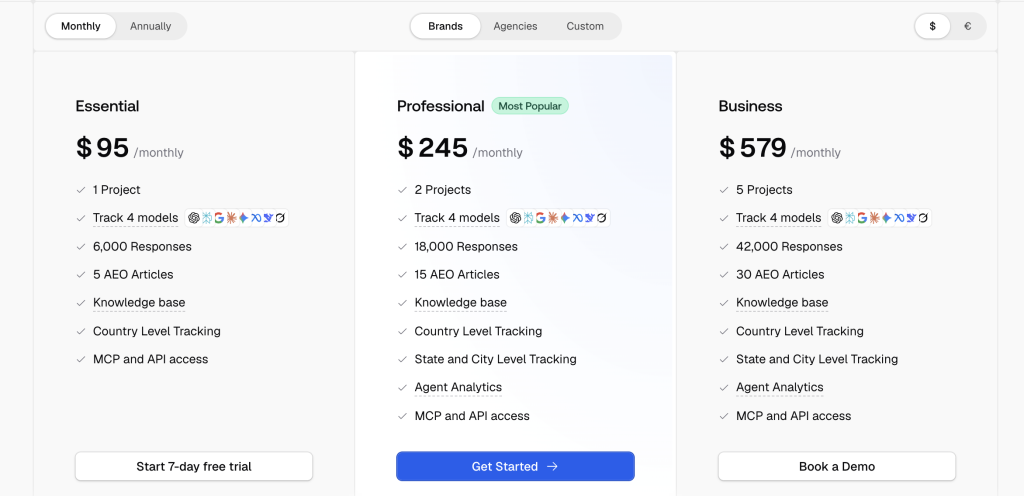
Annual billing takes roughly 17% off, which works out to about two free months at each tier. What stands out on the Brands flow is how little is held back at the bottom: Essential at $95 includes daily refresh, MCP and API access, the AEO content generator, crawler logs, country-level tracking, and a 7-day free trial. Many competitors meter API access, content generation, or refresh frequency by tier, so getting all of them at the entry price is a real point in Promptwatch’s favour. The climb from there buys volume and depth rather than unlocking core features: Professional at $245 adds state and city tracking, agent analytics, and higher prompt and crawler ceilings, and Business at $579 raises projects and prompts again for larger brands.
The decision that matters more than the price ladder is how many engines a brand needs to watch at once, because that is where the Brands and Agencies flows split. A baseline read across the assistants makes that easier to judge, and Geoptie’s flat-priced plans track four engines on every tier with nothing held back for higher plans, which is a useful reference point when sizing a Promptwatch tier.
Engine coverage
Engine coverage is the part of Promptwatch most third-party write-ups get wrong, and it is the single most important thing to understand before paying.
Promptwatch supports nine engines in total: ChatGPT, Perplexity, Google AI Overviews, Google AI Mode, Claude, Gemini, Meta’s Llama, DeepSeek, and Grok. It also tracks the OpenCode and Claude Code developer tools as a separate category. That is a wider list than almost anything else in the category.
The catch is that the Brands flow tracks only four of those nine at a time, and that cap holds on every Brands tier, including the $579 Business plan. A brand picks its four engines and monitors those; watching a fifth means swapping one out or moving to the Agencies flow, where Kick-off at $199 and every plan above it tracks all nine at once. So the headline “nine engines” is accurate at the platform level but not at the brand-tier level, and several pricing posts that claim all nine come included on every plan are simply describing the agency product.
Claude is worth singling out, because it is one of the four assistants most audiences use and because earlier write-ups misreported it. Claude is selectable on Essential and up as one of the four chosen models, not gated to a higher tier. The constraint is not which engines are available but how many run at once: a brand that wants ChatGPT, Claude, Gemini, and Perplexity together is fine on Essential, but adding AI Overviews or Grok to that set means rotating the selection or upgrading. For teams whose audience spans more than four surfaces, the four-engine cap is the line that pushes them onto an agency plan. A free AI rank tracker is a no-cost way to watch ChatGPT, Claude, Perplexity, and Gemini together while deciding whether four engines is enough or the agency tier is the real requirement.
Promptwatch’s key features
Promptwatch organizes its work around three jobs: tracking where a brand appears in AI answers, showing which sources earn those answers, and turning the gaps into action.
Monitors
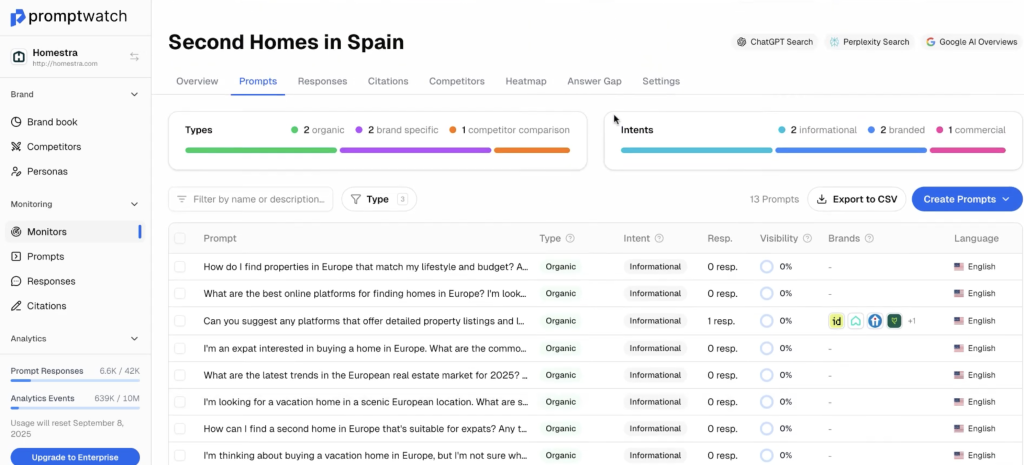
Monitors are how Promptwatch structures tracking. A team groups prompts into separate containers by geography, funnel stage, product line, or campaign, and each Monitor reports brand visibility and citations on its own. A B2B brand might run one Monitor for top-of-funnel category prompts like “best project management software for agencies” and another for branded comparison prompts, then read each independently and cap spend per Monitor. It is the feature reviewers most often call the most configurable way to measure visibility across prompt sets and markets.
Answer Gap analysis
Answer Gap is the feature experienced users rate highest. It surfaces prompts where competitors appear in AI answers and the brand does not, then points at the content or citation gap behind the miss. When a prompt keeps skipping the brand, the report separates a coverage problem from a credibility one and reads as a concrete brief for what to publish or pitch next. The flip side, noted by reviewers, is that it assumes SEO fluency: the output is concise rather than hand-holding, so a non-specialist may find it cryptic without context.
Sources and citation tracking
For every captured answer, Promptwatch parses which domains, pages, Reddit threads, and YouTube videos the engine cited, and ranks them by how often they show up in a category. This turns opaque AI responses into a map of which sources the models trust, and it routinely surfaces that a third-party listicle or a Reddit thread outranks the brand’s own pages in citations, which is a direct pointer for where digital-PR effort should go next.
Multi-modal traffic attribution
Promptwatch is one of the few trackers that tries to connect visibility to real visits. It offers three attribution methods at once: a JS snippet for tracking AI-referral sessions, a Google Search Console integration for AI Overviews and AI Mode traffic, and server-log analysis to spot AI-crawler activity. A team can run all three together, which is closer to a full picture of AI-driven traffic than the visibility-only view most tools stop at. The crawler-log angle, paired with the included crawler logs on every tier, is a remnant of where the product started and remains one of its more distinctive pieces.
AEO content generation
Each tier includes a monthly allowance of AEO articles, from 5 on Essential to 30 on Business, built to match what engines tend to cite. It is a genuine time saver for closing a content gap quickly, though it is the weakest part of the suite: reviewers find the output needs heavy editing for tone and originality and lags dedicated writing tools. It reads as a useful add-on rather than a reason to choose the platform.
Interface and experience
Promptwatch is built for people who already think in AI-visibility terms. Setup is straightforward, with prompt suggestions generated from a website or keywords, and the daily refresh means real movement shows up within days of a content or PR push rather than at the end of a monthly cycle. The trade-off is polish. Hands-on reviewers describe an interface that is less flashy than some rivals and, more pointedly, one carrying interface bugs and reporting glitches that are hard to flag or escalate, on a product that ships new features fast enough to be hard to keep up with. It rewards an SEO-fluent user who wants data over guidance, and it asks more of a newcomer than the quick setup suggests.
What users say about Promptwatch
Promptwatch carries a 4.7 on G2 and steady praise from hands-on reviewers, who single out the same strengths: the configurability of Monitors, the daily refresh, the Answer Gap report, and the breadth of attribution. The customer base backs up the credibility, with the platform citing 1,480-plus brands and agencies and a logo set that includes Duolingo, Typeform, Shutterstock, Yelp, Fireflies, and several European banks, a strong roster for a product founded in 2025. Reviewers who use it daily describe it as their most-used AI SEO tool while still recommending it with caution.
The criticisms are consistent. The interface bugs noted above are the most common complaint, and reviewers want a clearer way to report them. The built-in content generation lags specialist tools and needs editing before use. The learning curve is real for anyone new to AI search, since the most powerful reports assume the reader can interpret them. And the four-engine cap on the Brands flow is the limit teams run into once they want to watch more than four surfaces at once.
Promptwatch pros and cons
Strengths
- A genuinely full-featured $95 entry: daily refresh, MCP and API access, AEO content, and crawler logs are all on Essential, not reserved for higher tiers.
- Daily refresh on every paid plan, which surfaces the impact of content and PR within days.
- The widest engine list in the category, nine in total, with Claude selectable from Essential up.
- Multi-modal traffic attribution (snippet, Search Console, and server logs) that few competitors match.
- Highly configurable Monitors and a strong Answer Gap report that experienced SEOs rate above peers.
Limitations
- The Brands flow tracks only 4 of the 9 engines at once on every tier, including the $579 Business plan; all-9 coverage requires the Agencies flow at $199 and up.
- Reviewers report interface bugs and reporting glitches on a fast-changing product.
- Built-in content generation is underdeveloped and needs heavy editing.
- The most useful reports assume SEO fluency, so there is a learning curve for newcomers.
- The step from Essential’s 50 prompts to Professional’s 150 is a sizeable jump to $245.
How Promptwatch compares to Geoptie
Promptwatch and Geoptie solve a similar problem from different ends. Promptwatch competes on depth and breadth: nine supported engines, daily refresh, multi-modal attribution, and a content and crawler-log suite, with the trade that the Brands flow watches four engines at a time. Geoptie competes on giving a team all of its four engines, including Claude and Gemini, on a flat plan with no per-engine cap and a lower entry price.
| Promptwatch | Geoptie | |
|---|---|---|
| Entry price | $95/mo (Essential) | $49/mo (Starter) |
| Engines tracked at once | 4 of 9 (Brands flow, every tier) | All 4 on every paid tier |
| Claude tracking | Selectable on Essential and up | Included on every paid tier |
| All-engine coverage | Agencies flow only ($199+), all 9 | All 4 engines, no choose-N cap |
| Pricing model | Per-plan, split Brands and Agencies flows | Flat per-plan |
| Free option | 7-day trial (Essential and Kick-off) | Free tracker, no card, no time limit |
| Best at | Daily refresh, attribution, and breadth | Four engines including Claude, flat, no cap |
The fair read is that Promptwatch wins on breadth and on a couple of features, the attribution stack and the daily refresh at $95, that are genuinely strong. A brand or agency that wants to watch a wide range of engines, values crawler-log and traffic attribution, and has the SEO fluency to use the data will find a lot to like. The picture narrows for a team that mainly needs the four assistants most audiences use, because Geoptie tracks all four with no choose-N cap, starts at $49.
Verdict
Promptwatch is one of the more capable trackers at its price, and for a team that fits its shape the $95 plan delivers a lot.
Good fit if: you want daily refresh, MCP and API access, and content generation without paying a premium for them, you value multi-modal traffic attribution and crawler-log analysis, and the four engines you care about most fit inside the Brands flow’s cap, or you are an agency that needs all nine on the Agencies plans.
Look elsewhere if: you need to watch more than four engines at once without stepping up to an agency tier, you want a polished, low-learning-curve interface over raw data depth, or you want all of your engines included on a flat plan at a lower entry price.
FAQ
The Brands flow has three paid plans: Essential at $95/mo (50 prompts), Professional at $245/mo (150 prompts), and Business at $579/mo (350 prompts), plus a free Explore tier that tracks ChatGPT only. The Agencies flow runs $199, $399, and $799 a month. Annual billing saves roughly 17%, about two months at each tier.
For a brand tracking up to four engines and around 50 prompts, yes: Essential is a full-featured plan with daily refresh, MCP and API access, content generation, and crawler logs, not a stripped-down starter. It falls short if you need to watch more than four engines at once or need more than 50 prompts, at which point Professional or the Agencies flow becomes the answer.
Promptwatch supports nine: ChatGPT, Perplexity, Google AI Overviews, Google AI Mode, Claude, Gemini, Meta’s Llama, DeepSeek, and Grok. The Brands plans track four of those nine at a time on every tier; the Agencies plans track all nine at once.
Yes. Claude is selectable on the Essential plan and above as one of the four engines a Brands account tracks, and it is part of the all-nine coverage on the Agencies plans. It is not reserved for a higher tier.
Yes, a 7-day free trial on the Essential and Kick-off plans, plus a permanently free Explore tier that tracks ChatGPT only. The higher Brands tiers do not include the trial.
Brands, SEO teams, and agencies that want deep, daily prompt-level tracking with strong attribution and the SEO fluency to act on it. Agencies in particular benefit from the all-nine Agencies plans. Teams wanting a simple, low-learning-curve tracker or all engines on a single flat plan tend to look elsewhere.
The closest flat-priced option that includes all four of its engines on every tier, with no choose-N cap, is Geoptie. The wider field is covered in the best LLM tracking tools breakdown.
What to do next
Settling the Promptwatch question comes down to one count: how many engines the brand needs to watch at once. List them first, because four or fewer keeps Essential in play while five or more points at the Agencies flow and a very different bill. A baseline helps too. Geoptie’s free AI rank tracker shows where a brand stands across ChatGPT, Claude, Perplexity, and Gemini with no credit card and no time limit, and the platform keeps all four engines on a flat plan with no per-engine cap if the four-of-nine math on the Brands tiers starts to pinch.


