
In the GEO category, a published price is usually a fixed monthly number, but a credit-based plan turns that number into a floor rather than the whole bill. AthenaHQ is one of the most polished platforms in the space, and it does something most of its rivals do not: it puts eleven AI models, Claude among them, on a single paid plan, and reviewers consistently call its dashboard one of the easiest to navigate in the category. There is now a free tier underneath that plan, which changes the question a buyer has to settle. It is no longer whether to risk money on an unknown platform, because the free tier answers that. It is whether the jump from free to $295 a month buys enough, and whether paying by credit instead of a flat fee leaves the monthly cost predictable enough to plan around.
This review covers what AthenaHQ does, what it really costs once credits enter the picture, where it genuinely leads, and where the price and the billing model give buyers pause.
AthenaHQ at a glance
- Engine coverage: the strength. Eleven models on one paid plan, with Claude included rather than reserved for a sales-led tier, which is unusual in this category.
- Pricing model: the part to understand. Billing is credit-based, not flat. The $295/mo Starter plan includes a pool of credits, and how fast that pool drains depends on how much tracking is switched on.
- Free tier: a recent and significant addition. A permanently free Essential plan covers five engines on 300 credits a month, which makes AthenaHQ testable at no cost. Claude is not one of the five.
- Pricing accessibility: still the weak spot above the free line. At $295, Starter is the most expensive published paid entry in the category, and the gap between free and Starter is steep.
- Interface and ease of use: a genuine plus. The dashboard is widely described as intuitive, and unlimited seats come on both the free and paid plans.
- Revenue attribution: distinctive. Shopify, Webflow, Google Analytics and Search Console integrations connect AI visibility to actual sales, which is rare and valuable for e-commerce teams.
What is AthenaHQ?
AthenaHQ is an answer-engine and generative-engine-optimization platform. It tracks how a brand appears across AI assistants, measures citations, mentions, sentiment, and share of voice against competitors, and adds a layer of action on top: recommendations, AI-drafted content, and a way to tie AI visibility back to traffic and revenue. It is aimed at agencies running AI search for multiple clients, e-commerce and DTC brands that need to prove the channel pays, and mid-market marketing teams that treat AI search as a real growth lever rather than an experiment.
What separates AthenaHQ from a plain rank tracker is its emphasis on outcomes: it ties AI visibility to traffic and sales rather than stopping at a score. The flip side of that ambition is a platform with a lot of moving parts and a price to match.
AthenaHQ pricing and plans
AthenaHQ publishes three plans: a free tier, a paid plan with a public price, and a custom Enterprise tier. The headline figure is $295 a month for Starter, and unlike most tools in this category, that single plan carries the full model list.
| Plan | Monthly price | Credits | Models | Seats |
|---|---|---|---|---|
| Essential | Free | 300/mo, plus $25 free credit | 5 (no Claude) | Unlimited |
| Starter | $295/mo | 3,600/mo, plus $300 free credit | 11 (incl. Claude) | Unlimited, with RBAC |
| Enterprise | Custom | Custom | 11, plus more on request | Unlimited, with RBAC |
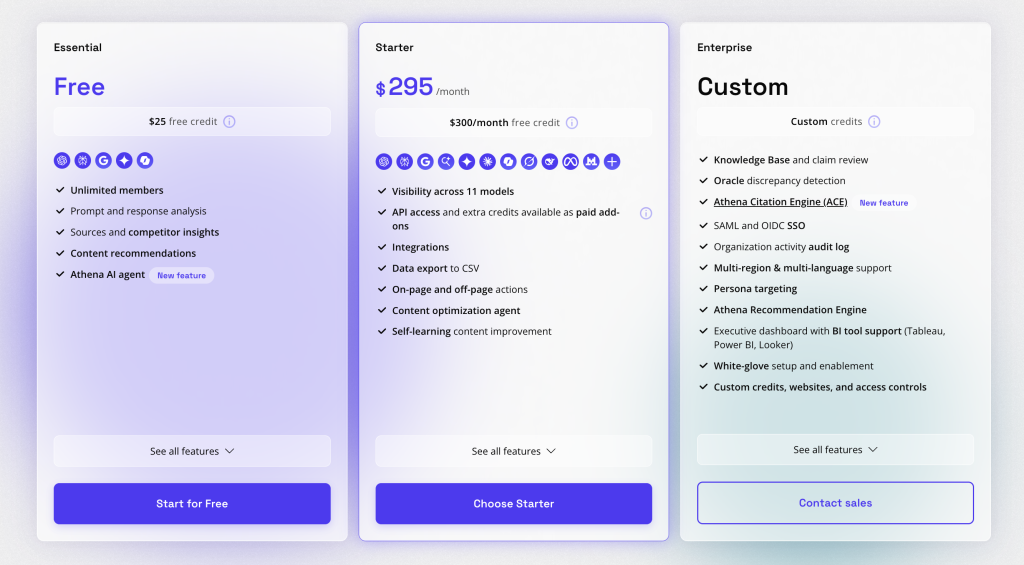
Two things soften the Starter price: a $300 per month free credit allowance that offsets a slice of usage, and 17% off on annual billing. The bigger softener is the free Essential tier, which carries 300 credits a month, a $25 free credit, unlimited members, and the core monitoring feature set across five engines. It is a genuine no-cost way to see the platform work before committing, and it replaces the free trial AthenaHQ has never offered.
What the free tier does not include is Claude, AI Mode, Grok, DeepSeek, Meta AI or Mistral. Essential covers ChatGPT, Perplexity, Google AI Overviews, Gemini and Copilot. That makes the free-to-Starter gap a coverage decision rather than a trial expiring: a team that only needs those five may sit on Essential indefinitely, while a team that needs Claude pays $295 to get it.
The line between Starter and Enterprise is less about models than about depth. Starter already covers all eleven models, unlimited topics, unlimited competitor tracking, sentiment, citation intelligence, and the Shopify, Webflow, Google Analytics and Search Console integrations. Enterprise is where the heavier machinery lives: the Athena Citation Engine, the advanced content agent with deep research, persona targeting, multi-region tracking, BI-tool dashboards, SAML SSO, audit logs, and a dedicated specialist. One detail worth pricing in before signing: on Starter, API access and top-up credits are both paid add-ons billed on top of the subscription rather than included in it.
Before committing at this price, it helps to know what an equivalent flat plan would cost for the engines that matter most. Geoptie’s pricing covers seven engines, any four per brand, on a fixed monthly fee with no credit metering, which gives a clean reference point for judging whether AthenaHQ’s premium and credit model are worth it for a given team’s usage.
How AthenaHQ’s credit-based pricing works
The credit model is the single most important thing to understand before buying, because it is what makes $295 a starting figure rather than the final one.
AthenaHQ bills by credit, where one credit equals one analyzed AI response, and the Starter plan comes with 3,600 a month. Every tracked prompt spends credits each time it runs, on each model it runs against, so the pool drains in proportion to three choices: how many prompts are tracked, how many of the eleven models each is checked on, and how often the checks repeat. A modest prompt set on two or three models weekly leaves plenty of headroom; every prompt across all eleven models on daily refreshes can move a heavy account from comfortable to constrained, at which point add-on credits are available as a paid extra.
The effect is that AthenaHQ rewards deliberate tracking and frustrates a team that turns everything on by default. The trade cuts both ways: a small, focused program pays only for what it analyzes, while a broad one gets a bill that moves month to month. That unpredictability, a usage-based cost rather than a number locked in at signup, is the most common reservation in independent reviews.
Engine coverage
Engine coverage is where AthenaHQ is genuinely strong, and it is worth stating plainly because it runs against the pattern in the rest of the category.
The Starter plan tracks eleven models: ChatGPT, Perplexity, Google AI Overviews, Google AI Mode, Gemini, Claude, Microsoft Copilot, Grok, DeepSeek, Meta AI, and Mistral, with additional models available on request. That list grew from eight over the course of 2026, and the additions are the long-tail models most competitors skip entirely.
The notable part is still Claude. Across most of the category, Claude tracking is reserved for a top, sales-led tier, with several capable trackers putting Claude behind a custom Enterprise contract. AthenaHQ includes it on its one published paid plan, which means a team that came specifically to track Claude can do so without a sales call. It is also the cleanest line between the free and paid tiers: the free Essential plan stops at ChatGPT, Perplexity, AI Overviews, Gemini and Copilot, so Claude is precisely what the $295 buys.
The qualifier ties back to credits: because each model a prompt runs against spends credits, breadth has a running cost, so the model list is an advantage on access and a factor to budget for on usage. A team that wants Claude and a wide spread can have both on Starter, as long as the prompt set and cadence stay inside the credit pool. For a no-cost way to watch a core set while weighing that trade, the free AI rank tracker covers ChatGPT, Claude, Perplexity, and Gemini with no metering and no account.
AthenaHQ’s key features
AthenaHQ is built around three jobs: monitoring where a brand stands in AI answers, acting on the gaps, and tying both back to revenue.
Monitoring and competitor intelligence
This is the core, and it works the way buyers expect. A team tracks prompts grouped into topics, and AthenaHQ records the mention and citation rate for each, on every engine in the plan, plus the competitors named in the same answers and the gap to a brand’s rivals. Track a prompt like “best AI visibility platform” and it shows where the brand surfaced on ChatGPT versus Perplexity versus Claude, which competitors appeared instead, and which sources the engines cited. Real-time sentiment sits alongside the counts, so a team sees not just whether it was named but how it was framed, and impersonation detection flags answers where a rival is passed off in a brand’s place.
Action Center
The Action Center turns monitoring into a task list. It surfaces on-page recommendations, usually topics where a brand’s mention rate trails the competition, and off-page ones, such as third-party pages and subreddits where a mention would help. The on-page suggestions are the stronger half, pointing at a specific gap with the performance data behind it; the off-page side is thinner, often a list of placements without a clear path to securing them, and testers find the outreach generator too generic to land. It identifies opportunities well and leaves much of the execution to the team.
Content optimization agent
The Starter plan includes a base content agent that drafts briefs and full articles for topics where a brand is under-cited. The briefs are reasonable starting points; the drafts need calibrating, since without brand guidelines configured the output tends toward generic AI prose and still needs fact-checking and an editing pass before publishing. It is a useful accelerator for a team that treats it as a first draft. The advanced deep-research agent and the Athena Citation Engine, which reverse-engineers why a source gets cited, are Enterprise-only.
Revenue attribution and e-commerce
This is the feature that most distinguishes AthenaHQ from a pure tracker. Through native Shopify, Webflow, Google Analytics and Search Console integrations, it connects AI citations to traffic and sales, so a Shopify brand can see whether a rise in citations for a product topic lined up with a rise in orders, and publish GEO content straight to the store. AI-search attribution is hard, so the numbers read as directional rather than exact, but for a DTC team that has to justify the spend, a credible link to revenue is more than most competitors attempt.
AI crawler tracking and blindspot detection
Rounding out the platform is a set of technical features: AI crawler tracking through the analytics integration, blindspot detection that flags where a brand is invisible to the engines, and management of robots.txt and llms.txt to control crawler access. Together they address not just where a brand ranks but whether the engines can read its content at all, with the base versions on Starter and the deepest analytics on Enterprise.
Interface and experience
AthenaHQ’s interface is one of its strongest selling points. Reviewers describe the dashboard as clean and intuitive, with the key metrics, visibility, citations, sentiment, and competitor standing, surfaced without a steep ramp, and unlimited seats let a whole team in without per-user math on both the free and paid plans. The friction sits elsewhere. Configuring the content agents to produce on-brand output takes real setup work, and the credit model adds account management most flat tools avoid: deciding which prompts and engines to run and how often, then watching the burn, which several users find harder than it should be because the platform is not always transparent about how credits and prompt volumes are calculated.
What users say about AthenaHQ
AthenaHQ is a newer entrant, and its public review base reflects that: strong ratings on a thin foundation. It holds a High Performer badge in G2’s Answer Engine Optimization category with high star ratings, but only a dozen-plus reviews at the time competitors last counted, so the sentiment is positive without being deep. The praise is consistent on two points: the platform is easy to use, and the recommendations are genuinely actionable, with the support team singled out by several users.
The criticisms are just as consistent. The credit-based pricing draws the most comment, with users wanting clearer visibility into how credits and prompt volumes are calculated so the bill is easier to forecast. The content drafts need editing before they are publishable, and as with any fast-moving startup, testers report occasional bugs and a rapid pace of feature change. The fair summary is that AthenaHQ is well-liked by the teams using it, with price and credit accounting the recurring reservations.
AthenaHQ pros and cons
Strengths
- Eleven models on a single paid plan, with Claude included rather than gated to a sales-led Enterprise tier.
- A genuinely free tier with unlimited members, five engines and the core monitoring feature set, which most rivals do not offer at all.
- Intuitive, widely praised dashboard with unlimited seats and role-based access control.
- Shopify, Webflow, Google Analytics and Search Console revenue attribution, a genuine differentiator for e-commerce and DTC teams.
- Unlimited topics and unlimited competitor tracking on the base paid plan, with sentiment and impersonation detection included.
Limitations
- At $295/mo, Starter is the highest published paid entry price in the category, and the step up from the free tier is steep.
- Claude, AI Mode, Grok, DeepSeek, Meta AI and Mistral are all absent from the free tier, so the five free engines are the common ones rather than the differentiated ones.
- Credit-based billing makes the real monthly cost a function of usage, so heavy tracking can push it well above the headline price.
- API access and top-up credits are paid add-ons on Starter rather than included.
- Content drafts need a human editing and fact-checking pass before publishing.
- The most advanced features, the Athena Citation Engine, persona targeting, multi-region tracking, and the deep-research agent, are Enterprise-only.
- Users report the credit and prompt-volume accounting is not always transparent, which complicates budgeting.
How AthenaHQ compares to Geoptie
AthenaHQ and Geoptie take opposite approaches to the same job. AthenaHQ is a premium, credit-priced platform with broad model coverage and a revenue-attribution layer, built for teams that want depth and can manage a usage-based bill. Geoptie is a flat-priced platform built for teams that want multi-engine visibility, Claude included, on a predictable monthly fee with no credit metering.
AthenaHQ’s strengths are real, and two of them are things Geoptie does not match. Its eleven-model list is wider than Geoptie’s seven, and it covers Grok, DeepSeek, Meta AI and Mistral, which Geoptie does not track at all. Its Shopify and Webflow attribution is something Geoptie does not attempt. Its interface is genuinely easier to use than most. And it has a free tier, where Geoptie has none.
Where Geoptie differs is on cost and predictability. It covers seven engines, any four selectable per brand, on every paid tier starting at $49 a month, and the bill is the same whether a team runs ten prompts or its full allowance. Both tools put Claude on their entry paid plan, so the comparison comes down to price and billing shape rather than Claude access.
| AthenaHQ | Geoptie | |
|---|---|---|
| Free tier | Essential: 5 engines, 300 credits, no Claude | None. Paid plans only, from $49/mo |
| Entry paid price | $295/mo (Starter) | $49/mo (Starter) |
| Models on entry paid tier | 11, including Claude | 7 available, any 4 tracked per brand |
| Claude tracking | Included on Starter | Included on every paid tier |
| Pricing model | Credit-based (3,600 credits/mo) | Flat per-plan, no metering |
| Seats | Unlimited, with RBAC | Unlimited on every plan |
| Best at | Model breadth, intuitive UI, revenue attribution | Predictable flat pricing at a low entry point |
The straight read is that AthenaHQ wins on model breadth, ease of use, e-commerce attribution, and having a free tier at all, while Geoptie wins on paid entry cost and a bill that does not move. A team that wants the widest model spread, a polished platform, and a way to tie AI visibility to Shopify sales, and can plan its credit usage, will get a lot from AthenaHQ. A team that mainly needs the major engines including Claude on a flat, low monthly fee, and can work within four engines per brand, is the one Geoptie fits. For the wider field, see the best AthenaHQ alternatives.
Verdict
AthenaHQ is a strong, well-designed GEO platform that earns its reputation on broad model coverage and ease of use, and the free tier now makes it easy to judge for yourself.
Good fit if: you are an agency, e-commerce brand, or mid-market marketing team that wants broad model coverage with Claude included, values an intuitive platform and Shopify revenue attribution, and can plan your tracking to fit a credit budget that starts at $295 a month.
Look elsewhere if: you want a predictable flat bill rather than usage-based credits, the five engines on the free tier are not the ones you need and $295 is hard to justify before proving the channel, or you mainly need the major engines on a low paid entry price without managing credit burn.
Start free if: the engines you care about are ChatGPT, Perplexity, AI Overviews, Gemini and Copilot. The Essential tier covers those at no cost, and there is no deadline forcing an upgrade.
FAQ
There is a free Essential tier with 300 credits a month and five engines. The paid Starter plan is $295 a month and includes 3,600 credits plus a $300 per month free credit allowance. Annual billing takes 17% off the ongoing rate. Enterprise is custom-priced through sales. API access and extra credits are paid add-ons on Starter.
AthenaHQ bills by credit, where one credit equals one analyzed AI response. The Starter plan includes 3,600 credits a month and the free Essential plan includes 300, and every prompt consumes credits each time it runs against each model, so tracking more prompts, more models, or more frequently drains the pool faster. Add-on credits can be purchased when the base allowance runs out.
Yes, on the paid Starter plan. Claude is one of the eleven models included at $295 a month, which is unusual in this category, where many competitors reserve Claude tracking for a custom-priced Enterprise tier. Claude is not available on the free Essential tier.
Eleven on Starter: ChatGPT, Perplexity, Google AI Overviews, Google AI Mode, Gemini, Claude, Microsoft Copilot, Grok, DeepSeek, Meta AI, and Mistral, with additional models available on request. The free Essential tier covers five of those: ChatGPT, Perplexity, Google AI Overviews, Gemini and Copilot. Enterprise covers the full set plus more on request.
Yes. The Essential plan is free, with 300 credits a month, a $25 free credit, unlimited members, and tracking across five engines. There is no time-limited free trial on the paid plans, but the free tier has no deadline, and Starter carries a $300 per month free credit allowance on top of its 3,600 credits.
For an agency, e-commerce brand, or marketing team that uses the full breadth of models, the revenue attribution, and the recommendations, and can manage credit usage, the price is defensible. For smaller teams or those early in an AI search program, the honest first step is the free Essential tier, and the question becomes whether Claude and the six other paid-only models are worth the jump. If they are not, a flat-priced tool often lands cheaper than Starter.
The closest flat-priced option that includes Claude on its entry plan is Geoptie, at $49 a month with seven engines available and any four tracked per brand. The wider set of trackers and platforms is covered in the best AthenaHQ alternatives roundup and the broader best AEO tools breakdown.
What to do next
Deciding on AthenaHQ comes down to two questions: whether the five free engines cover what you need, and if not, whether Claude and the wider model list are worth $295 a month against a flat-priced alternative. Start on the free tier, then put the cost side by side before upgrading. The free AI rank tracker shows your position across ChatGPT, Claude, Perplexity, and Gemini with no credit card, which is a quick way to see what Claude coverage actually surfaces before paying for it, and Geoptie’s flat-priced plans give a fixed-cost reference to weigh against AthenaHQ’s credit model.