![AI Search Optimization: How to Get Cited by ChatGPT, Perplexity & Google AI [2026]](/_next/image?url=%2Fblog%2Fai-search-optimization%2FWebpage_document_connecting_AI_i%E2%80%A6_202604291551.jpeg&w=3840&q=75)
AI search optimization is the practice of making your content discoverable, citable, and recommendable by AI-powered search engines like ChatGPT, Perplexity, Google AI Overviews, Claude, and Gemini. It’s the reason some brands get mentioned every time someone asks an AI assistant for a recommendation — and others don’t exist in AI’s world at all.
The numbers make the urgency clear. ChatGPT now has over 800 million weekly active users. Google AI Overviews appear in up to 25% of all searches. According to Search Engine Land, 37% of consumers now start their searches with AI rather than Google. And here’s the part most marketers miss: AI search traffic converts at rates 4-5x higher than traditional organic search, according to data from both Ahrefs and Semrush.
Yet most businesses have no idea whether AI recommends them or not. This guide gives you a concrete, step-by-step process to fix that — with free tools you can use at each step to check your progress.
How AI Search Engines Actually Work
Before optimizing for AI search, you need to understand what happens behind the scenes when someone asks ChatGPT “what’s the best project management tool” or searches Google and gets an AI Overview.
Every AI search engine follows a three-step process: query expansion, retrieval, and selection.
Query expansion happens first. When you type a question, the AI doesn’t just match your keywords — it interprets your intent and expands your query into multiple sub-queries. A question like “best CRM for small business” might get expanded into sub-queries about pricing, ease of use, integrations, and scalability. This is why conversational, long-tail queries are the sweet spot for AI search optimization. The AI is looking for content that answers the full intent, not just the surface keywords.
Retrieval comes next. The AI searches for relevant sources using some form of retrieval-augmented generation (RAG). Different platforms use different source indexes — ChatGPT uses Bing’s index plus real-time web browsing, Perplexity performs live web searches, and Google AI Overviews pull from Google’s own index. But the core mechanic is the same: the AI gathers a set of potentially relevant pages, then evaluates which ones to actually use.
Selection and citation is the final step — and the one where most brands lose. The AI picks only 2-7 sources to include in its response. That’s far fewer than Google’s traditional ten blue links. The selection criteria aren’t publicly documented, but multiple studies have reverse-engineered what matters most.
SE Ranking’s study on Google AI Mode found that organic traffic to a site’s homepage is the single strongest predictor of whether a site gets cited. High-traffic homepages get roughly twice as many AI citations as low-traffic ones. The number of referring domains is the second strongest factor. In simpler terms: the same signals that make you authoritative in traditional search also make you citable in AI search.
This is a critical insight. AI search optimization doesn’t replace SEO — it builds on top of it. If your traditional organic presence is weak, your AI visibility will be too.
Check how AI engines currently perceive your site → Free GEO Audit
What Gets Cited — and What Doesn’t
Not all content is created equal in the eyes of AI search engines. Research across thousands of AI citations reveals clear patterns in what gets selected and what gets ignored.
Content that earns citations
Direct answers positioned early. AI engines scan for extractable chunks of text. If the first 1-2 sentences under a heading directly answer a question, the AI can grab that and use it. Content that opens with background context or throat-clearing gets skipped in favor of pages that answer immediately.
Specific data and statistics. The Princeton research paper that established Generative Engine Optimization as a field tested nine content optimization methods. Statistics addition was the single strongest performer. “Personalization improved conversions by 47%” gets cited. “Personalization works well” does not.
Clear content structure. Pages organized with question-based headings, short paragraphs (2-4 sentences), and content chunked into 100-300 token blocks with one idea each. AI engines need to be able to extract a section and have it make sense as a standalone passage.
Author credentials and trust signals. Expert bylines with professional titles, original research, cited sources within the content, and up-to-date information. AI systems scan for these E-E-A-T signals (Experience, Expertise, Authoritativeness, Trustworthiness) when deciding which source to trust.
Pages that already rank well organically. Studies from Authoritas, Optimizely, and Rich Sanger have shown that 40-76% of citations in Google AI Overviews also come from pages in the top 10 organic search results. Strong traditional rankings are a prerequisite, not a nice-to-have.
Comparison and decision-stage content. “Best X” lists, versus comparisons, and buying guides get cited disproportionately often because they directly match the types of questions people ask AI.
Content that gets ignored
Dense, unstructured text without clear headings or logical organization. AI engines can’t easily parse walls of text.
Vague claims without evidence. If your competitors’ pages include data points and yours just makes assertions, the AI will cite them.
Outdated content. Perplexity in particular heavily favors content published or updated within the past 12 months. A page from 2023 with no update signals will lose to a 2026 page covering the same topic.
Pages blocked from AI crawlers. Some sites inadvertently block GPTBot, PerplexityBot, or ClaudeBot in their robots.txt — making their content invisible to those platforms entirely.
Keyword-stuffed content. The Princeton GEO study found that traditional keyword stuffing actually hurt performance in generative contexts. AI engines penalize content that reads like it was written for algorithms rather than humans.
How each platform differs
Not all AI engines cite the same way. Understanding the differences helps you prioritize.
Google AI Overviews have the strongest correlation with traditional Google rankings. If you’re in the top 10 organically, you’re a candidate for citation. Reddit (21%) and YouTube (18.8%) are among its most-cited third-party sources.
Perplexity does real-time web retrieval and heavily weights freshness. Reddit accounts for a remarkable 46.5% of Perplexity’s citations. It also shows only 25% source overlap between queries — meaning newer, fresher content has a genuine chance against established players.
ChatGPT favors recognized brands and authoritative entities. It rarely cites vendor blogs directly (around 1% of citations) but frequently cites major publications, review sites, and industry resources. Brand recognition matters more here than anywhere else.
Claude follows patterns similar to ChatGPT, prioritizing well-sourced, comprehensive content with clear entity relationships.
See how your content scores across these dimensions → Free Content Checker
The 7-Step AI Search Optimization Process
Step 1: Audit your current AI visibility
Before optimizing anything, establish your baseline. Go to ChatGPT, Perplexity, and Google and ask questions relevant to your industry. Ask for recommendations in your category. Ask how your brand compares to competitors. Ask about problems your product solves.
Document everything: where you appear, where competitors appear instead, what sources get cited, and what language the AI uses to describe your category. This audit reveals your starting point and highlights the biggest gaps.
Don’t limit yourself to branded queries. Test category queries (“best CRM software”), problem queries (“how to reduce customer churn”), comparison queries (“Salesforce vs HubSpot”), and use-case queries (“CRM for small sales teams”). The full landscape of how AI currently perceives your space is more revealing than any single query.
Get an automated assessment across 6 AI-readiness dimensions → Free GEO Audit
Step 2: Ensure technical accessibility for AI crawlers
AI engines can only cite content they can access. Several technical prerequisites need to be in place.
Check your robots.txt file. Make sure you’re not blocking GPTBot (ChatGPT’s crawler), PerplexityBot, ClaudeBot, or Google-Extended. This is more common than you’d expect — many sites copy robots.txt templates that block AI crawlers by default.
Consider implementing an llms.txt file. This is a newer standard, similar to robots.txt but designed specifically for AI crawlers. It lets you specify which content you want AI models to prioritize and provides context about your brand and site structure.
Optimize page load speed. AI retrieval systems operate under time constraints. If your pages take too long to load, retrieval systems may skip them entirely in favor of faster-loading alternatives.
Implement structured data markup. JSON-LD schema helps AI engines understand your content at a structural level. The most impactful schema types for AI visibility are Article schema (defines the who, what, and when of your content), FAQ schema (maps questions directly to answers), HowTo schema (captures step-by-step processes), Product and Review schema (essential for appearing in product recommendation queries), and Organization schema (helps AI engines recognize your brand as an entity).
Check 120+ technical and content factors with our GEO Readiness Checklist
Step 3: Structure content for AI extraction
AI engines don’t read your page top-to-bottom like a human visitor. They scan for extractable, self-contained chunks of information. Restructuring your content to match this behavior is one of the highest-impact changes you can make.
Use question-based headings. Frame your H2s and H3s as the actual questions people ask AI: “What is X?”, “How does Y work?”, “Why does Z matter?” This directly maps to the queries AI engines process.
Lead with the answer. Under each heading, put a complete, direct answer in the first 1-2 sentences. Then expand with context, examples, and nuance. This inverted-pyramid structure gives AI engines an easy extraction point while still providing depth for human readers.
Keep paragraphs short. Two to four sentences per paragraph. Each paragraph should contain one clear idea. AI engines chunk content at paragraph boundaries — a 10-sentence paragraph forces the AI to either take too much or too little.
Add FAQ sections. These are goldmines for AI extraction. Structure them with clear question headings and concise 40-60 word answers. FAQ schema markup on these sections doubles the benefit — it helps both AI engines and traditional search features like People Also Ask.
Include comparison tables. When covering multiple options, tools, or approaches, HTML comparison tables are among the most extractable content formats. AI engines can parse table structures and pull specific comparisons into responses.
Step 4: Build topical authority through content clusters
A single optimized page will rarely outperform a site that covers a topic comprehensively from multiple angles. AI engines assess topical authority — how deeply and consistently you demonstrate expertise across a subject area.
Build content clusters with a pillar page at the center surrounded by supporting content that interlinks:
Pillar content covers the broad topic comprehensively. For example, if your domain is project management, your pillar page might be “The Complete Guide to Project Management in 2026.”
Supporting content addresses specific sub-topics, questions, and angles: comparison pages (“Asana vs Monday.com”), how-to guides (“How to Set Up a Kanban Board”), use-case content (“Project Management for Remote Teams”), and tools content (“Best Free Project Management Tools”).
Internal linking connects everything. Each supporting page links back to the pillar and to related supporting pages. This helps AI engines understand the relationships between your content and recognize your site as an authority on the topic.
The key insight is that AI engines don’t evaluate pages in isolation. They evaluate your entire content ecosystem on a topic. Five interlinked pages covering different facets of the same subject will collectively earn more citations than five disconnected pages on unrelated topics.
Step 5: Earn third-party mentions and citations
This is where AI search optimization diverges most sharply from traditional SEO. In traditional search, authority comes primarily from backlinks. In AI search, authority comes from being mentioned, discussed, and recommended across the web — especially on sources that AI engines already trust.
The SearchEngineLand analysis of 8,000 AI citations found that brands with high visibility scores had broad mention ecosystems spanning their own content, review sites, news coverage, forums, and social media.
Industry publications and blogs. Get featured in articles, roundups, and expert interviews on authoritative sites in your space. AI engines cite these frequently.
Review platforms. Maintain active, well-optimized profiles on G2, Capterra, TrustPilot, and industry-specific review sites. These are high-trust sources AI engines pull from when users ask for recommendations.
Reddit and forum presence. Perplexity gets 46.5% of its citations from Reddit. Google AI Overviews cite Reddit in roughly 21% of responses. Genuine participation in relevant subreddits and communities — not link-dropping, but actually being helpful — builds the kind of authentic third-party presence AI engines value.
YouTube. YouTube is among the most-cited sources across AI platforms, particularly for Google AI Overviews. Video content that covers your topic area creates an additional citation surface.
Guest contributions and thought leadership. Bylined articles, podcast appearances, and conference talks create mention touchpoints that AI engines pick up as authority signals. Each genuine mention on a credible platform reinforces your brand as a recognized entity.
The goal isn’t just backlinks (though those help too). The goal is entity recognition — making AI engines understand that your brand is a real, trusted player in your category by seeing it mentioned consistently across multiple credible sources.
Step 6: Optimize for each AI platform specifically
While the fundamentals apply everywhere, each platform has nuances worth addressing.
For Google AI Overviews: Focus on traditional SEO first. The correlation between organic rankings and AI Overview citations is strong. Optimize for featured snippets — pages that already win snippets are frequently pulled into AI Overviews. Ensure your schema markup is comprehensive and your content matches informational search intent.
For ChatGPT: Brand entity recognition is paramount. ChatGPT needs to “know” your brand exists as a relevant entity in your category. This comes from consistent mentions across authoritative sources, Wikipedia presence if applicable, and a strong web footprint. Direct content optimization matters less here than overall brand authority.
For Perplexity: Freshness is your lever. Perplexity does real-time retrieval and favors recently published or updated content. Keep your key pages updated with current dates, fresh statistics, and new insights. Also prioritize presence on Reddit and discussion forums — these are Perplexity’s most-cited source category by a wide margin.
For Claude and Gemini: Focus on comprehensive, well-sourced content with clear citations and structured data. Both platforms weight content depth and source quality.
A practical approach: rather than optimizing for each platform separately, track your visibility across all of them and identify where you’re weakest. A gap on one platform usually points to a specific type of optimization you’re missing.
Track your rankings across all AI platforms → Free GEO Rank Tracker
You can also track individual platforms in more detail with our dedicated ChatGPT Rank Tracker and Perplexity Rank Tracker.
Step 7: Monitor, measure, and iterate
AI search optimization isn’t a one-time project. AI engines update their models, change their retrieval patterns, and shift citation preferences over time. What works today may not work in six months.
Track AI-specific metrics. Citation frequency (how often your brand appears in AI responses for relevant queries), brand mention rate, share of voice compared to competitors, and sentiment (whether AI describes your brand positively or neutrally).
Monitor referral traffic from AI platforms. Check your analytics for traffic from chatgpt.com, perplexity.ai, and other AI referral sources. This traffic is growing rapidly and converts at significantly higher rates than traditional search traffic.
Run regular visibility audits. Monthly at minimum. Ask the same set of queries across platforms and track how your visibility changes over time. Look for patterns: which content updates led to more citations? Which new pages got picked up fastest?
Iterate based on data. If you notice a competitor consistently getting cited where you’re not, analyze what their cited content does differently. Is it more comprehensive? More recent? Better structured? Published on a higher-authority domain? Use these insights to guide your next optimization cycle.
Discover which queries AI engines associate with your industry → Free Keyword Finder
Common Mistakes That Kill AI Visibility
Even well-intentioned optimization efforts can fail if you make these mistakes:
Blocking AI crawlers without realizing it. Check your robots.txt right now. If GPTBot, PerplexityBot, or ClaudeBot are disallowed, your content is invisible to those platforms. This is the single most common technical mistake.
Only optimizing your own site. AI engines weight third-party mentions heavily. If your entire strategy is on-site content with no effort on review profiles, industry mentions, Reddit presence, or earned media, you’re leaving the most influential citation signals on the table.
Publishing thin content and expecting citations. A 500-word blog post with no data, no examples, and no unique insight won’t get cited when competitors have 3,000-word comprehensive guides on the same topic. AI engines select the most useful, most authoritative source — depth matters.
Ignoring freshness signals. AI engines check publication dates and update timestamps. Content from 2023 with no freshness signals will lose to updated 2026 content on the same topic, even if the older content is technically better.
Treating AI search as separate from SEO. They’re deeply connected. SE Ranking’s research shows organic Google rankings are the strongest predictor of AI citations. Building traditional SEO authority simultaneously builds AI citation potential.
Only tracking Google rankings. If your analytics dashboard only shows Google Search Console data, you’re blind to how AI platforms represent your brand. You need dedicated AI visibility tracking to understand the full picture.
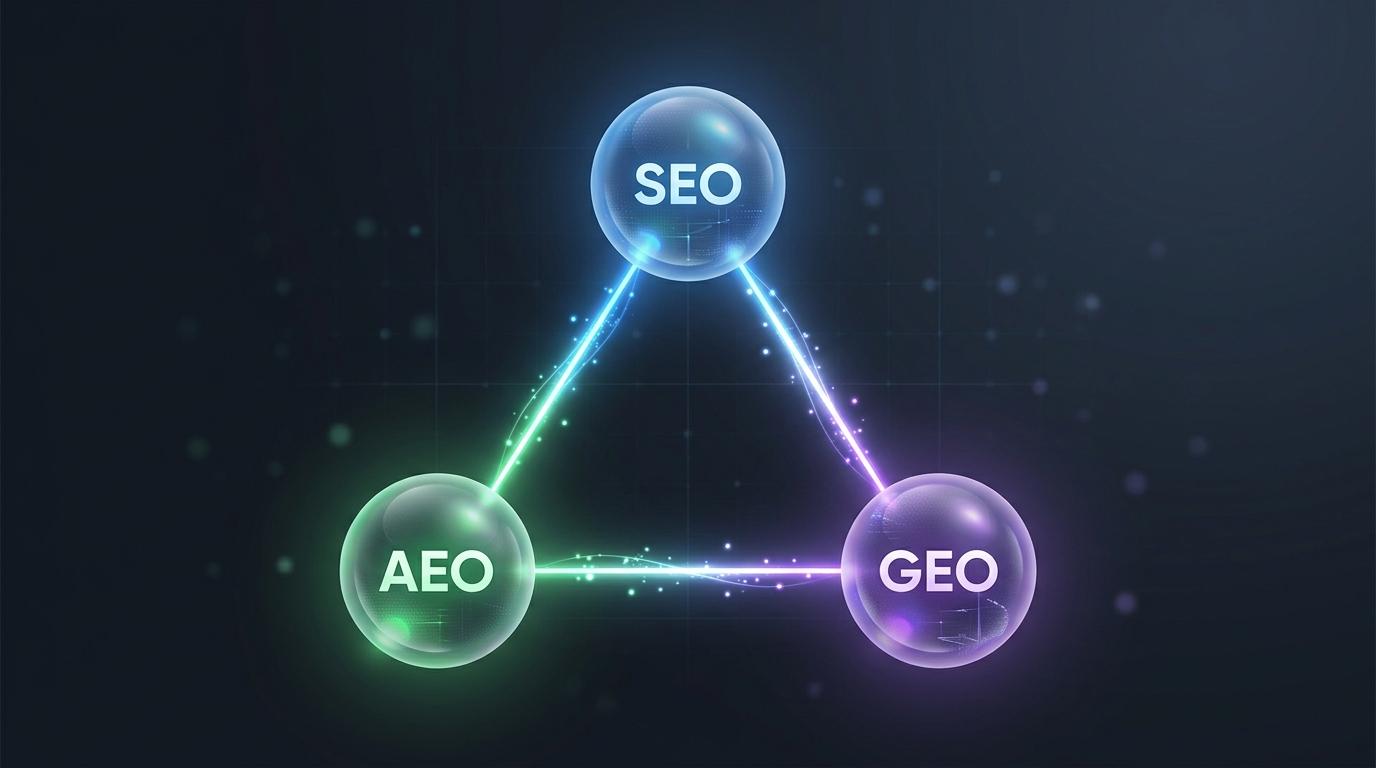
How AI Search Optimization Connects to SEO, AEO, and GEO
If you’ve been researching this topic, you’ve likely encountered three related acronyms: SEO, AEO, and GEO. Here’s how they all fit together.
AI search optimization is the broadest term — it encompasses everything involved in making your brand visible in AI-powered search experiences. Under that umbrella sit three specialized disciplines.
SEO (Search Engine Optimization) is the foundation. It focuses on ranking in traditional search results to earn clicks. Since traditional rankings strongly correlate with AI citations, SEO remains essential.
AEO (Answer Engine Optimization) focuses on being the direct answer extracted by search features — Google’s featured snippets, People Also Ask boxes, voice assistant responses, and AI Overviews. AEO is about structuring content so engines can extract and display a clean, complete answer to a specific question.
GEO (Generative Engine Optimization) focuses specifically on earning citations and recommendations inside AI-generated responses from ChatGPT, Perplexity, Claude, and similar platforms. GEO is about influencing the narrative when AI synthesizes information from multiple sources.
In practice, the tactics overlap significantly — probably 70-80%. Writing clear, authoritative, well-structured content with strong data and credible sourcing serves all three goals simultaneously. The remaining 20% is where you put specialized effort based on your priorities.
For a detailed breakdown of how these three disciplines compare and when to prioritize each one, read our complete guide: AEO vs GEO vs SEO: What’s the Difference and Which Do You Need?
For a deep dive into GEO specifically — including the academic research behind it and advanced optimization strategies — see our Generative Engine Optimization: The Definitive Guide.
Start Optimizing Today
AI search isn’t a future trend — it’s the current reality reshaping how millions of people discover brands, compare products, and make decisions. The businesses optimizing now are building compounding advantages that will be difficult for latecomers to overcome.
The process is straightforward: audit where you stand, fix the technical foundations, restructure content for AI extraction, build authority across the web, and track your progress.
You don’t need a budget to start. Run a free GEO audit to see how AI engines currently perceive your content, then work through our readiness checklist to build your action plan. Track your progress with our free rank tracker across ChatGPT, Perplexity, Claude, and Google AI.
The question isn’t whether AI will transform search. It’s whether your brand will be visible when it does.