AI visibility tools built for technical SEOs and the ones built for marketing teams aren’t quite the same product, and most buyers don’t realize which side of that line they’re on until after they’ve signed up. ZipTie sits firmly on the technical-SEO side — a credit-based tracker built by the team behind Onely, with an AI Success Score, real-browser query collection, GSC integration, and the most disciplined indexation-audit story in the category. The friction shows up when a marketing team starts using it: tracking is limited to Google AI Overviews, ChatGPT, and Perplexity (no Claude, no Gemini, no Copilot), every paid plan ships with a single user seat, and the AI Search check budget caps refresh volume at 500 to 2,000 per month depending on tier.
The seven alternatives below either open Claude and Gemini on a self-serve plan, drop the single-seat ceiling, or both. If a no-commitment starting point helps before working through the list, the free AI rank tracker covers ChatGPT, Claude, Perplexity, and Gemini with no credit card.
TL;DR — best ZipTie alternatives by use case
- Geoptie — four engines including Claude, multi-brand workspaces, no per-seat ceiling, $49/mo.
- Profound — for enterprise teams that need ten engines and SOC2 alongside AI-crawler analytics.
- Otterly AI — the budget pick, $29/mo for four engines without a credit-based limit.
The three picks cover most buyers. Full comparison and per-tool tradeoffs below.
Quick comparison table
| Tool | Best for | AI engines covered | Pricing model | Starting price |
|---|---|---|---|---|
| Geoptie | Marketing teams that want all four major answer engines on the entry tier, including Claude | ChatGPT, Claude, Perplexity, Gemini | Flat per-plan | $49/mo |
| Profound | Enterprise brands needing the deepest engine breadth with compliance and historical data | ChatGPT (Starter); ChatGPT, Perplexity, AI Overviews (Growth); ChatGPT, Claude, Perplexity, Gemini, Grok, Copilot, AI Overviews, AI Mode, Meta AI, DeepSeek (Enterprise) | Flat per-plan (enterprise custom) | $99/mo Starter |
| Scrunch | Technical SEO teams that need named AI-crawler analytics alongside citation tracking | ChatGPT, Perplexity, AI Overviews, Copilot (Core); Claude, Gemini, Meta AI, AI Mode, Grok (Enterprise) | Flat per-plan | $250/mo Core |
| Peec AI | European teams that want multilingual brand-mention tracking with granular sentiment scoring | ChatGPT, AI Mode, AI Overviews, Copilot, Perplexity, Gemini, Grok (choose 3 per tier); Claude/GPT-5 on Enterprise | Flat per-plan (3-of-7 engine cap) | $95/mo (€89) Starter |
| Otterly AI | Solo SEOs and small teams tracking AI visibility for under $30/mo | ChatGPT, AI Overviews, Perplexity, Copilot (4 on all tiers); AI Mode + Gemini as add-ons | Flat per-plan | $29/mo Lite |
| SE Ranking AI Search Toolkit | SEO teams that want AI visibility folded into a full SEO suite | ChatGPT, AI Overviews, AI Mode, Perplexity | Flat plan + flat add-on | $218/mo (Core + AI add-on) |
| Ahrefs Brand Radar | Established SEO teams that want a search-backed AI prompt database, not just custom prompts | AI Overviews, AI Mode, ChatGPT, Perplexity, Copilot, Gemini, Grok | Flat per-plan | $398/mo |
All pricing is the monthly-billed rate. Annual discounts apply on most plans. Engine coverage varies by tier on several of these tools — the engine you care about may not be unlocked at the entry price.
How we evaluated
Each tool below was tested in May 2026 against the same criteria: engine coverage on the entry tier (specifically whether Claude and Gemini are tracked at all), seat policy and team-access cost, refresh-volume model (flat prompt allowance vs credit-based checks), self-serve checkout vs sales-call gates, free trial or free tier, multi-brand support, and how quickly the dashboard surfaces useful data after signup. Geoptie is on the list and at the top; Profound is the better pick for enterprise breadth across ten engines with SOC2 and HIPAA; Scrunch ships the closest direct replacement for ZipTie’s named-crawler analytics through its Agent Experience Platform; ZipTie itself remains the strongest fit for teams whose primary workflow lives in AI Overviews monitoring with GSC-integrated query import and per-page indexation depth. If one of those criteria fits the buying scenario better than flat-priced multi-engine coverage with Claude on entry, choose accordingly.
1. Geoptie (best for marketing teams that want all four major answer engines on the entry tier, including Claude)
Pricing model: flat per-plan.
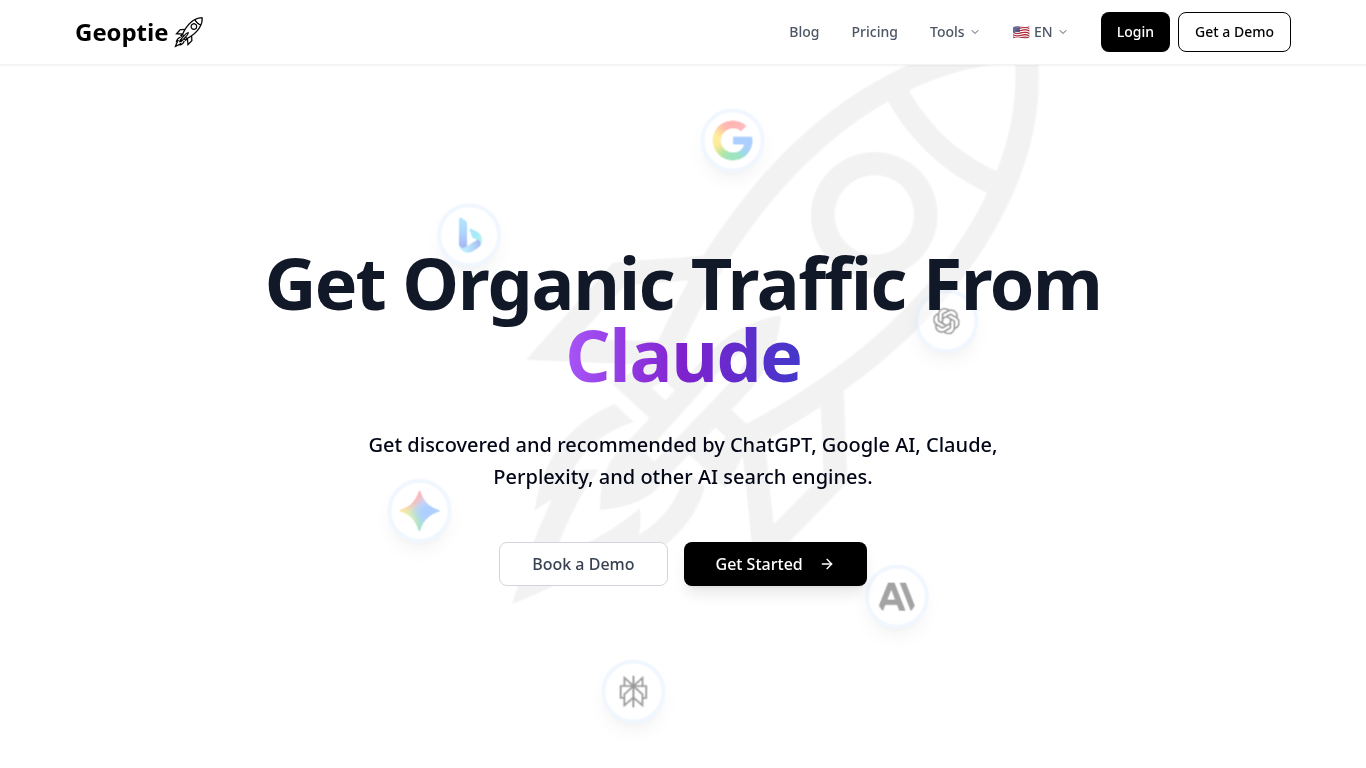
Geoptie tracks brand visibility across the four answer engines most AEO buyers track — ChatGPT, Claude, Perplexity, and Gemini — on a $49/mo Starter, with daily refreshes, citation tracking, brand-mention tracking, and competitor share-of-voice in one dashboard. The contrast with ZipTie sits in three places: engine coverage (4 vs 3, with Claude and Gemini both included), refresh model (a flat per-tier prompt allowance instead of a credit-based AI Search check budget), and team access (multi-brand workspaces from Professional up, without a single-seat ceiling on every paid plan).
Key features
- Daily tracking across ChatGPT, Claude, Perplexity, and Gemini on every paid tier
- Citation tracking (URL surfaced in an AI answer) and brand-mention tracking (brand named in the answer text) in one dashboard
- Competitor share-of-voice on the same prompt set
- Multi-brand workspaces — 10 brands on Professional, unlimited on Enterprise
- Free AI rank tracker, ChatGPT rank tracker, Claude rank tracker, and Perplexity rank tracker
Pricing
- Free — geoptie.com/geo-rank-tracker. No credit card, no time limit.
- Starter — $49/mo ($41/mo annually). 15 prompts, 2 brands.
- Professional — $99/mo ($83/mo annually). 100 prompts, 10 brands.
- Enterprise — $199/mo ($166/mo annually). 400 prompts, unlimited brands.
Pros
- Claude and Gemini both included on the $49 Starter — neither is available on any ZipTie tier
- Flat prompt allowance instead of credit-based AI Search checks
- Multi-brand workspaces fit agency and in-house multi-property workflows without per-seat math
- A genuinely free tier with no time limit
Cons
- No equivalent to ZipTie’s composite AI Success Score — reporting built around that metric has to be reshaped
- No per-page indexation audit — for crawler-accessibility diagnostics, Scrunch’s AXP layer is the closer match
- Google AI Overviews, AI Mode, and Copilot aren’t tracked
2. Profound (best for enterprise brands needing the deepest engine breadth with compliance and historical data)
Pricing model: flat per-plan; enterprise tiers are custom-priced. See best Profound alternatives for the deeper comparison.
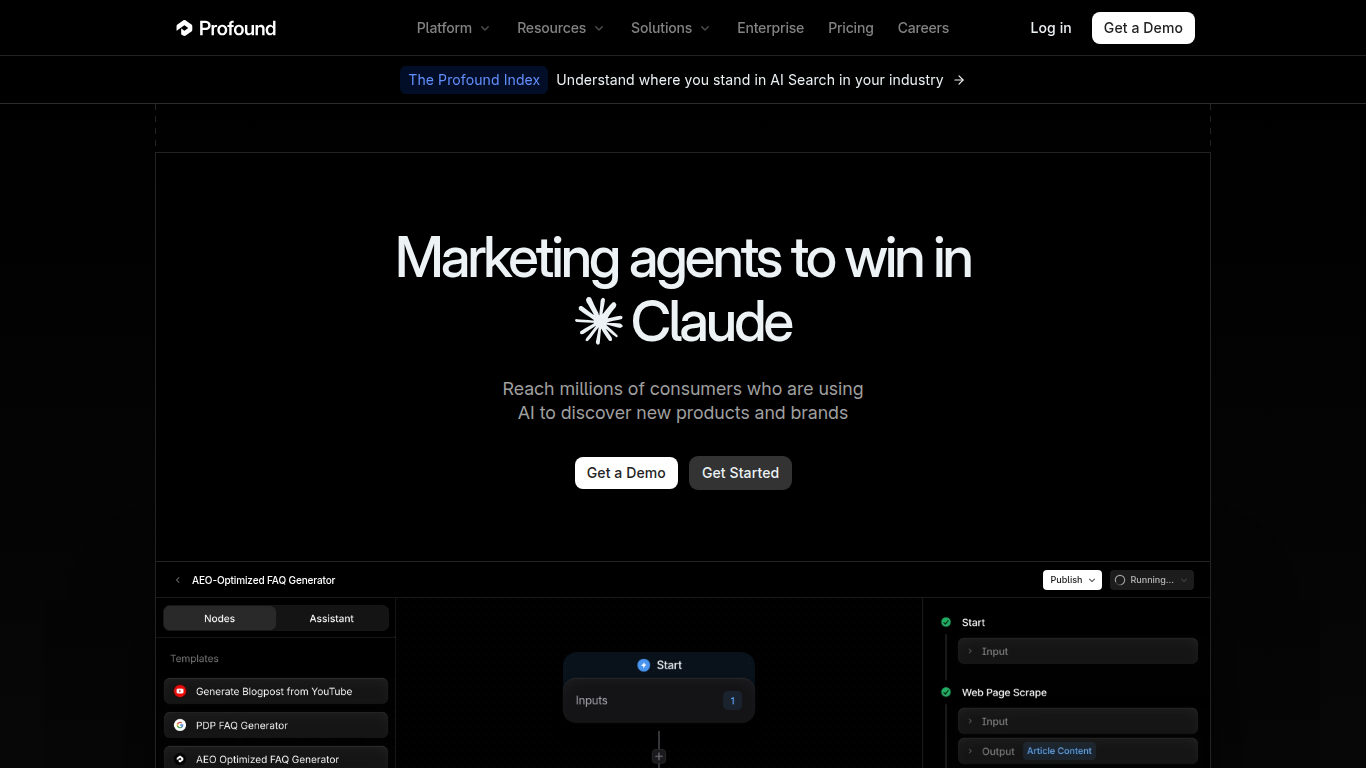
Profound is the enterprise step-up when a ZipTie user has grown out of the three-engine cap and the single-seat ceiling at the same time. Starter at $99/mo tracks ChatGPT only; Growth at $399/mo opens three engines plus six AI-optimized articles a month; Enterprise (custom) covers ten engines including Claude, Gemini, Grok, DeepSeek, and Meta AI with SSO/SAML, SOC2, and HIPAA on the table. Profound’s Agent Analytics layer also overlaps the part of ZipTie that technical SEOs care about most — AI crawler activity at the page level, with Cloudflare integration — though it’s gated to Enterprise rather than included from the entry tier.
Key features
- Up to 10 engines on Enterprise
- Agent Analytics — AI-crawler visibility (Anthropic, OpenAI, Perplexity bots) with Cloudflare integration
- Conversation Explorer with a large real-prompt dataset
- SSO/SAML, SOC2, HIPAA on Enterprise
- Six optimized articles per month included on Growth
Pricing
- Starter — $99/mo. ChatGPT only.
- Growth — $399/mo. Three engines (ChatGPT, Perplexity, AI Overviews) + 6 articles/mo.
- Enterprise — custom. Up to 10 engines, multi-company workspaces, SSO/SAML + SOC2.
Pros
- Broadest engine coverage of any flat-priced tool here
- Agent Analytics is the closest published alternative to ZipTie’s indexation focus
- Multi-company workspaces — no single-seat ceiling
Cons
- Starter is single-engine (ChatGPT) — narrower than ZipTie Basic on engine count alone
- Claude and Gemini live on Enterprise — same upgrade-to-talk gate ZipTie avoids by not offering those engines at any tier
- G2 reviews note occasional dashboard slowdowns and a steep learning curve
3. Scrunch (best for technical SEO teams that need named AI-crawler analytics alongside citation tracking)
Pricing model: flat per-plan. The deeper Scrunch breakdown lives in best Scrunch AI alternatives.
Scrunch is the closest like-for-like step up from ZipTie on the technical-SEO axis. Core at $250/mo covers four engines (ChatGPT, Perplexity, AI Overviews, Copilot — one engine more than ZipTie, with Copilot added) and ships with 125 unique prompts, 5 user seats, and a 7-day free trial. The Enterprise tier adds Claude, Gemini, Meta AI, AI Mode, and Grok along with the Agent Experience Platform — named AI-crawler analytics for ClaudeBot, GPTBot, and PerplexityBot at the page level, which is the layer ZipTie’s indexation audits sit closest to. Scrunch is roughly 3.6x ZipTie Basic and 2.5x ZipTie Standard at the entry tier, but the seat count alone (5 vs 1) closes most of the per-user cost gap for small teams.
Key features
- 4 engines on Core, 9 engines on Enterprise
- Agent Experience Platform — named AI-crawler analytics (Enterprise-only)
- 125 unique prompts on Core, 5 user seats on Core, 1 brand workspace
- Citation, mention, and sentiment tracking
- 7-day free trial on Core
Pricing
- Core — $250/mo. 125 prompts, 4 engines, 5 seats, 1 brand workspace, 5 site audits/mo.
- Agency Core — $500/mo. 250 prompts, 4 engines, unlimited seats, 3 brand workspaces.
- Enterprise — custom. 9 engines, AXP, API, SSO.
Pros
- 5 user seats on Core vs ZipTie’s 1 — the structural fix for the seat-cap problem
- Agent Experience Platform is the published feature closest to ZipTie’s indexation depth
- Free trial exists at both tiers (7 days)
Cons
- Entry price is 3.6x ZipTie Basic
- Claude and Gemini still Enterprise-only, same gate ZipTie has
- AXP is gated to Enterprise — Core buyers don’t get the named-crawler layer
4. Peec AI (best for European teams that want multilingual brand-mention tracking with granular sentiment scoring)
Pricing model: flat per-plan with per-engine add-ons. See best Peec AI alternatives for the broader comparison.
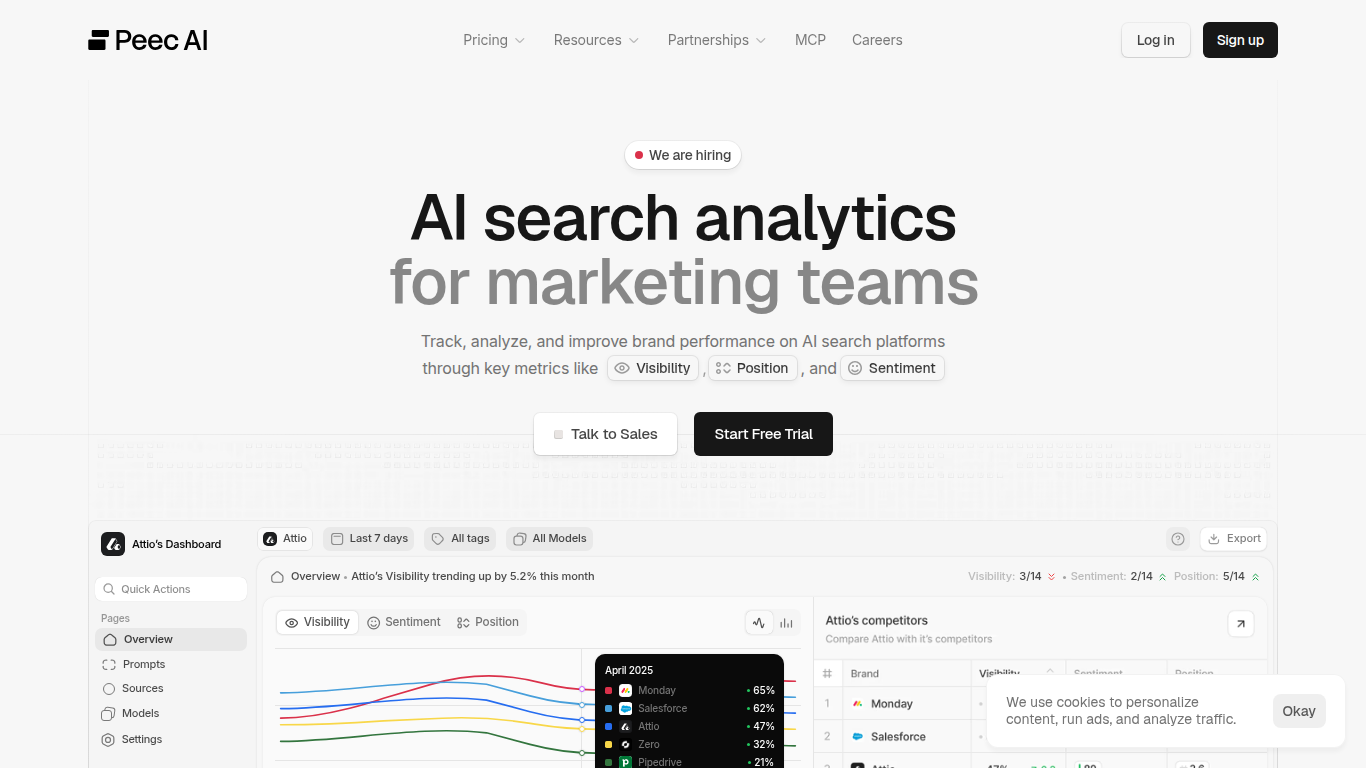
Peec is the Berlin-built brand-mention specialist with what G2 reviewers commonly cite as the most granular sentiment scoring in the category and brand-mention analytics across 14+ languages. Starter at $95/mo (€89) lands close to ZipTie Standard on price ($99/mo) but tracks 3 of 7 available engines instead of ZipTie’s locked 3, with the upgrade path to Claude and Gemini self-serve via Pro ($245/mo) or Advanced ($495/mo) — each additional engine adds €70/mo on Pro or €140/mo on Advanced. Claude Sonnet 4 itself remains Enterprise-only via API, mirroring the Claude wall ZipTie also has.
Key features
- Multilingual brand-mention analytics across 14+ languages
- Country-level citation breakdown
- Granular sentiment scoring on brand mentions
- Unlimited user seats on every paid plan — the structural fix for ZipTie’s 1-seat cap
- Looker Studio connector and API on higher tiers
Pricing
- Starter — $95/mo (€89). 50 prompts, 3 of 7 engines, 1 project.
- Pro — $245/mo (€205). 150 prompts, 3 of 7 engines, 2 projects. Additional engines €70/mo each.
- Advanced — $495/mo (€425). 350 prompts, 3 of 7 engines, 5 projects. Additional engines €140/mo each.
- Enterprise — custom. Adds Claude Sonnet 4 + GPT-5 Search via API.
- 7-day free trial; annual billing discount around 15%.
Pros
- Unlimited seats on every tier
- Sentiment depth is widely cited as best-in-category
- Multilingual coverage Otterly and ZipTie don’t match
Cons
- 3-of-7 cap holds on every self-serve tier — Gemini comes at an add-on cost
- Claude Enterprise-only via API
- EUR-denominated checkout adds friction for USD budgets
5. Otterly AI (best for solo SEOs and small teams that want to start tracking AI visibility for under $30/mo)
Pricing model: flat per-plan. See best Otterly alternatives for the broader comparison.
Otterly is the budget pick. Lite at $29/mo covers four engines — ChatGPT, Google AI Overviews, Perplexity, and Microsoft Copilot — with 15 prompts and a 14-day free trial, and the brand picked up a Gartner Cool Vendor 2025 nod for AI Marketing along the way. That’s roughly $40/mo below ZipTie Basic, with the same three engines plus Copilot, and a refresh model based on a flat prompt allowance rather than credit-based AI Search checks. Engine depth is the tradeoff: Claude isn’t tracked on any Otterly tier, and Gemini and Google AI Mode sit behind paid add-ons rather than bundled engines.
Key features
- $29 entry tier — cheapest paid AEO tracker on this list
- Four base engines on every paid plan
- Public API on Standard and Premium
- Looker Studio connector
- Workspaces for multi-client agencies
Pricing
- Lite — $29/mo ($25/mo annually). 15 prompts.
- Standard — $189/mo ($160/mo annually). 100 prompts, public API.
- Premium — $489/mo ($422/mo annually). 400 prompts, public API.
- AI Mode and Gemini add-ons $9–$149/mo depending on plan.
Pros
- Cheapest paid entry on this list, USD-denominated
- 14-day free trial vs ZipTie’s 14-day trial — equivalent, but Otterly trial includes 4 engines vs ZipTie’s 3
- One more engine than ZipTie on the entry tier (Copilot)
Cons
- No Claude on any tier — same Claude gap ZipTie has, not solved
- Gemini and AI Mode cost extra
- No AI Success Score or composite metric equivalent
6. SE Ranking AI Search Toolkit (best for SEO teams that want AI visibility folded into a full SEO suite)
Pricing model: flat plan + flat AI Search add-on.
SE Ranking is the suite-consolidation option for teams whose AI tracking ought to live next to their traditional rank tracking, backlink monitoring, and site audits. The Core SEO plan is $129/mo ($103.20/mo annually) and the AI Search add-on is $89/mo ($71.20/mo annually), landing the realistic floor at $218/mo combined — well above ZipTie Basic in price, but with the full SEO toolkit included rather than monitored separately. The AI Search add-on (branded “SE Visible”) tracks ChatGPT, AI Overviews, AI Mode, and Perplexity — four engines, no Claude. Standalone SE Visible plans are also available at $189/mo Core, $355/mo Plus, and $519/mo Max.
Key features
- SEO + AI visibility in one workspace
- “SE Visible” dashboard for brand mentions, citations, and sentiment
- 200 prompts on the entry AI Search add-on
- 14-day free trial on Core with no credit card
- Unlimited user seats on every plan — direct fix for ZipTie’s single-seat ceiling
Pricing
- Core (SEO) — $129/mo ($103.20/mo annually). 10 projects.
- AI Search add-on — $89/mo ($71.20/mo annually). 200 prompts, 4 engines.
- Combined Core + AI Search — $218/mo ($174.40/mo annually).
- SE Visible standalone — $189/mo Core / $355/mo Plus / $519/mo Max.
Pros
- Best fit when SE Ranking is already in the SEO stack
- Unlimited seats — every ZipTie buyer evaluating a team rollout benefits from this
- 14-day no-card free trial on the SEO suite
Cons
- No Claude in the AI Search add-on engine list
- Combined cost is 3.2x ZipTie Basic
- Two line items to manage instead of one all-in plan
7. Ahrefs Brand Radar (best for established SEO teams that want a search-backed AI prompt database, not just custom prompts)
Pricing model: flat per-plan.
Brand Radar takes a different shape than ZipTie. Instead of building visibility tracking around a user’s custom prompt set (ZipTie’s GSC-import workflow plus AI Prompt Generation Assistant), Brand Radar indexes 395 million-plus monthly prompts across six AI platforms — AI Overviews, AI Mode, ChatGPT, Perplexity, Copilot, and Gemini — derived from real search behavior rather than synthetic test prompts. Any brand, topic, or vertical can be queried instantly with no setup. Select platforms is $398/mo; All platforms is $699/mo and adds Grok, 2,500 custom-prompt checks per month, and YouTube/TikTok/Reddit visibility (free while in beta). Claude isn’t in the engine list at any tier — the same Claude gap ZipTie has, on a much wider platform spread.
Key features
- 395M+ monthly prompts — the largest real-search-derived dataset in the category
- Integration with the broader Ahrefs SEO suite
- Up to seven AI platforms (Grok unlocks at All platforms)
- YouTube, TikTok, Reddit visibility on All platforms (beta)
- 90-day historical reporting
Pricing
- Select platforms — $398/mo. Individual platform selection across 6 engines.
- All platforms — $699/mo. 7 engines, 2,500 custom-prompt checks/mo, plus beta social tracking.
Pros
- Real-search-backed prompt dataset is unique in the category — ZipTie’s GSC import is closer to a custom-prompt workflow
- Bundled with Ahrefs’ keyword, traffic, and backlink data
- YouTube, TikTok, Reddit visibility — sources ZipTie doesn’t track
Cons
- No Claude coverage at any tier
- $398 entry is roughly 5.8x ZipTie Basic
- No AI Success Score equivalent; positioning is dataset-first, not score-first
How to choose the right ZipTie alternative
- Claude and Gemini on the entry tier at the lowest flat price: Geoptie — $49/mo for ChatGPT + Claude + Perplexity + Gemini.
- Enterprise programs across 10+ engines with SOC2 and HIPAA: Profound.
- Named AI-crawler analytics for technical SEO teams: Scrunch (AXP on Enterprise).
- Multilingual brand-mention tracking with granular sentiment: Peec AI (mind the 3-of-7 cap).
- Cheapest paid entry under $30/mo: Otterly AI.
- SEO + GEO in one suite: SE Ranking AI Search Toolkit.
- Largest real-search-backed prompt dataset: Ahrefs Brand Radar.
- Free AI visibility tracking with no credit card and no time limit: geoptie.com/geo-rank-tracker.
- Overall best value: Geoptie.
FAQ
What are the best ZipTie alternatives in 2026?
Geoptie, Profound, Scrunch, Peec AI, Otterly AI, SE Ranking AI Search Toolkit, and Ahrefs Brand Radar. Geoptie is the best value for flat-priced multi-engine coverage with Claude and Gemini on the entry tier; Profound is the enterprise pick for ten-engine coverage with compliance; Scrunch is the closest direct match for ZipTie’s technical-SEO depth; Otterly is the cheapest paid entry.
How much does ZipTie cost?
Three paid tiers on monthly billing: Basic $69/mo (500 AI Search checks/mo), Standard $99/mo (1,000 checks), Pro $159/mo (2,000 checks). Annual billing carries a 15% discount across the board, taking effective monthly rates to $58.65, $84.15, and $135.15 respectively. Every paid tier ships with one seat and three engines (Google AI Overviews, ChatGPT, Perplexity). A 14-day free trial with 75 AI Search checks is available without billing.
Does ZipTie track Claude or Gemini?
No. ZipTie’s engine coverage is fixed at three platforms — Google AI Overviews, ChatGPT, and Perplexity — across every paid tier, with no add-on engines. For teams that need Claude visibility specifically, alternatives include Geoptie ($49/mo Starter), Profound (Enterprise), Scrunch (Enterprise), and Peec AI (Enterprise via API). For Gemini, Geoptie includes it on Starter, and Ahrefs Brand Radar and Peec AI include it on certain tiers.
Is there a ZipTie alternative with more user seats per plan?
Yes. ZipTie ships with one seat on every paid tier, which is unusually restrictive at the $99 and $159 price points. Peec AI offers unlimited seats on every plan, SE Ranking offers unlimited seats on every plan, and Scrunch Core ships with five seats. For teams of three or more, the per-user math changes the comparison materially.
Is there a cheaper ZipTie alternative?
Yes. Otterly AI Lite is $29/mo (four engines, no Claude), Geoptie Starter is $49/mo (four engines including Claude), and ZipTie Basic itself is $69/mo. Geoptie and Otterly both price below ZipTie Basic while covering an engine or two more depending on the configuration.
Does ZipTie offer a free trial?
Yes — 14 days, with 75 AI Search checks across the three covered engines. The trial includes the AI Prompt Generation Assistant and email support. Most alternatives in this list also offer free trials (Otterly 14 days, Peec 7 days, SE Ranking 14 days, Scrunch 7 days). Geoptie’s free product at geoptie.com/geo-rank-tracker has no credit card and no time limit.
What’s the difference between ZipTie and Geoptie?
ZipTie is a technical-SEO-leaning tracker built around AI Overviews, ChatGPT, and Perplexity, with a composite AI Success Score, GSC-integrated query import, and real-browser query collection — sold credit-style as AI Search checks on a single-seat plan. Geoptie is a marketing-focused AI visibility platform covering ChatGPT, Claude, Perplexity, and Gemini on flat per-tier prompt allowances, with multi-brand workspaces and a free permanent tier. Different workflows: ZipTie suits a technical SEO doing per-page indexation work; Geoptie suits a marketing team tracking brand visibility across the four engines buyers actually use.
What to do next
ZipTie buyers typically face two questions before paying: whether the three covered engines (AI Overviews, ChatGPT, Perplexity) match the engines their own buyers actually use, and whether a one-seat plan works for the team at the $69–$159 price band. If the answer to either is no, the rest of this list is the productive place to spend an hour. The free AI rank tracker covers ChatGPT, Claude, Perplexity, and Gemini at no cost — useful for baselining how much of the picture the three-engine list is missing.
For broader category context, see the best LLM tracking tools listicle, the best AEO tools roundup, and the AEO vs GEO vs SEO breakdown. For other branded comparisons, see best Scrunch AI alternatives, best Peec AI alternatives, best Profound alternatives, best AthenaHQ alternatives, and best Rankscale AI alternatives.